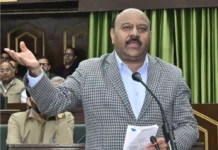
SRINAGAR: Chief Minister Omar Abdullah on Thursday reviewed the drainage system of Srinagar city and directed authorities to take time-bound measures to address waterlogging and strengthen stormwater infrastructure.
Chairing a high-level meeting, Omar called for both immediate and long-term interventions to improve the city’s drainage resilience and prevent inundation following heavy rainfall.
Commissioner Srinagar Municipal Corporation (SMC) Fazlul Haseeb briefed the meeting on the existing drainage network and presented a five-year integrated roadmap for addressing stormwater management challenges.
According to the presentation, Srinagar has around 680 kilometres of stormwater deep drainage network, while nearly 2,500 kilometres of additional drain length is required in view of future development envisaged under Master Plan 2035.
Around 15 per cent of the existing network is currently not functioning at optimum hydraulic capacity due to inadequate drain dimensions, ageing infrastructure, silt deposition and solid-waste ingress.
The meeting also discussed the impact of rapid urbanisation on the city’s natural drainage system and stressed the need to conserve and restore remaining natural drainage corridors.
Omar said the drainage system should be strengthened to ensure that Srinagar does not face inundation after just a few hours of rainfall.
He directed the SMC to adopt the proposed short-term measures as its Standard Operating Procedure and ensure their timely implementation. He also directed the civic body to immediately activate the measures whenever an alert regarding high precipitation is received.
“While these measures will help address some of the immediate problems, the major challenge is infrastructure,” Omar said, directing the SMC to proceed with long-term interventions, engage a competent agency and prepare a Detailed Project Report (DPR).
He stressed that the DPR and proposed interventions should form part of the overall drainage plan rather than being treated as a standalone emergency measure.
The Chief Minister also directed the SMC to involve all concerned departments and, after finalising the DPR and financial requirements, work out a funding mechanism, including resources available with various departments.
Emphasising public participation, Omar called for a sustained awareness campaign on proper disposal of solid waste, plastic bottles and polythene bags.
He observed that polythene bags were a major cause of choking in the drainage system and urged citizens to help keep drains free of waste.
The immediate measures proposed at the meeting include cleaning and de-silting of drains, removal of blockages, daily lifting of solid waste, prioritisation of missing links, installation of mechanical screens in large open drains and ensuring backup power for dewatering stations.
The long-term measures include construction of additional dewatering stations, segregation of sewerage and stormwater networks, upgradation of old and natural drains, prevention of encroachments, and conservation and rejuvenation of lakes.
The five-year integrated programme will be implemented in two phases, with priority given to commercial and densely populated areas, followed by low-lying areas.
Srinagar district MLAs, including Ali Mohammad Sagar, Mubarak Gul, Shamim Firdous, Tanvir Sadiq, Salman Sagar, Mushtaq Guroo and Sheikh Ahsan Ahmed, attended the meeting and shared their inputs on the city’s drainage system.
Chief Secretary Atal Dulloo, Additional Chief Secretary Jal Shakti Shaleen Kabra, ACS to the Chief Minister Dheeraj Gupta, ACS PDD Ashwini Kumar, ACS PWD Anil Kumar, ACS Finance Shailendra Kumar, Commissioner Secretary Housing and Urban Development Mandeep Kaur, Divisional Commissioner Kashmir Anshul Garg, Deputy Commissioner Srinagar and senior officers from various departments also attended the meeting.