SRINAGAR: The Jammu and Kashmir Legislative Assembly on Monday passed a resolution calling for the immediate and urgent restoration of full statehood to the Union Territory, amid a stormy session marked by heated exchanges, protests by BJP legislators and a walkout by the opposition party.
The resolution, moved by Chief Minister Omar Abdullah on September 25, was adopted after a day-long confrontation over its wording and references to earlier Assembly resolutions on autonomy and special status. As the resolution was put to vote, BJP legislators walked out of the House. The Assembly was subsequently adjourned and will meet again on Tuesday.
The resolution calls upon the Government of India for the “immediate and urgent restoration of full statehood to Jammu and Kashmir” and resolves that it be forwarded to the Centre. It also refers to resolutions passed by the House on June 26, 2000 and November 6, 2024.
It was the reference to the earlier resolutions, particularly the 2000 resolution seeking greater autonomy, that became the principal point of confrontation between the BJP and the ruling National Conference.
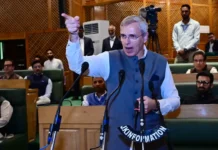
The BJP opposed the resolution, saying it calls for the autonomy of Jammu and Kashmir, which they consider unacceptable. CM Omar in his press briefing said, “BJP could abstain from voting in favour of the resolution if they find it problematic, but disturbing the house like this shows they don’t want smooth proceedings.”
The House resumed on Monday with regular business, but BJP moved a no-confidence motion against Speaker Abdul Rahim Rather. RS Pathania said, “The acceptance of CM Omar’s resolution is illegal and unconstitutional. It requires 46 votes to remove the Speaker, and certainly, we have the numbers. So, he will be removed soon.”
Rather said he had not received the motion in the manner required and cited the Assembly rules governing such a move. He said that a written notice seeking removal of the Speaker would have to be received by the Assembly Secretariat and could be included in the House’s business only on a day not earlier than 14 days after its receipt.
BJP legislators objected to the inclusion of the 2000 autonomy resolution and references to the pre-August 5, 2019 constitutional position. Leader of Opposition Sunil Sharma said the BJP supported restoration of statehood but opposed the language of the resolution, particularly references to autonomy and the earlier constitutional arrangement.
“Restoration of statehood is the agenda of the BJP. But the way language has been used in the resolution moved in the Assembly is against the Constitution of India,” Sharma said. He referred to the 2000 autonomy resolution and argued that it had been rejected by the Centre.
Ten amendments had been submitted to Omar Abdullah’s resolution, with several seeking to expand its scope beyond statehood by referring to the restoration of Articles 370 and 35A and the constitutional position that existed before August 5, 2019.
Six National Conference legislators, Javid Hassan Baig, Tanvir Sadiq, Ajaz Ahmad Jan, Hilal Akbar Lone, Altaf Ahmad Wani and Chowdhary Mohammad Akram, moved amendments seeking references to Articles 370 and 35A. One proposed amendment sought insertion of the words “along with restoration of Article 370 and the constitutional protections formerly available under Article 35A” after the reference to full statehood. Another sought to reaffirm the House’s commitment to restoration of the constitutional guarantees embodied in Articles 370 and 35A as they existed before August 5, 2019.
PDP legislator Waheed Ur Rehman Para proposed that the resolution also call for restoration of autonomy and Articles 370 and 35A in their original form. Another PDP legislator, Aga Syed Muntazir Mehdi, sought a reference to the changes made after August 5, 2019, including the cessation of Articles 370 and 35A and the reorganisation of the erstwhile state into the Union Territories of Jammu and Kashmir and Ladakh.
Congress MLA Nizam-ud-Din Bhat proposed adding a reference to the Centre’s commitments made at various forums and to the people of Jammu and Kashmir. While he proposed his amendment, the House saw an intensified exchange of slogans. BJP was sloganeering against the Congress party and the NC-Congress coalition. The slogans against Rahul Gandhi also echoed when the BJP was protesting in the well of the House.
BJP legislators tried to intimidate Nizamuddin Bhat during his speech by throwing paper bits on him, snatching his papers and using a mic to intervene. It was followed by marshalling out of four MLAs. Vikram Randhawa and Arvind Gupta from the BJP and Iftikhar Ahmad and Irfan Hafiz Lone from the Congress were marshalled out as their exchange turned heated.
An amendment moved by independent MLA Muzaffar Iqbal Khan supporting the NC government sought restoration of Jammu and Kashmir’s “full constitutional and political status” as it existed before August 5, 2019, including Article 370 and the constitutional safeguards associated with Article 35A.
The amendments became the backdrop to an increasingly disorderly session. Deputy Chief Minister Surinder Kumar Choudhary challenged the BJP’s argument that Jammu and Kashmir’s security situation should stand in the way of restoration of statehood.
“Not only Jammu and Kashmir, but half of India is living along the border. So, under the guise of the border, should we stop demanding statehood?” Choudhary said. He also questioned why the Centre had not yet restored statehood despite commitments made by Union Home Minister Amit Shah.
The exchange triggered further uproar, with BJP legislators entering the Well of the House. They raised slogans including “Bharat Mata ki Jai” and “Speaker sahib, kursi chodo, kursi chodo”, demanding that Speaker Abdul Rahim Rather vacate the chair. The slogans went ahead seeking the resignation of CM Omar and the downfall of the government.
The BJP legislators continued their protest in the Well even as the Speaker proceeded with the listed business, creating what was described as a parallel protest inside the chamber.
The confrontation came after the BJP had already disrupted proceedings when the resolution was introduced on Friday. BJP members had objected to the reference to the 2000 autonomy resolution, entered the Well and tore copies of the resolution, forcing the House to adjourn.
The 2000 resolution, passed during the Farooq Abdullah government, had sought restoration of greater autonomy to Jammu and Kashmir as it existed before August 9, 1953. It was rejected by the then BJP-led government at the Centre.
The Assembly had subsequently passed another resolution on November 6, 2024, calling for dialogue with representatives of Jammu and Kashmir for restoration of its special status and constitutional guarantees. The 2024 resolution followed the 2019 changes that ended the erstwhile state’s special constitutional position and bifurcated the state into the Union Territories of Jammu and Kashmir and Ladakh.
The BJP has maintained that it supports restoration of statehood but does not support bringing the issues of Article 370, Article 35A or autonomy into the statehood resolution. The National Conference, meanwhile, has argued that the present resolution is fundamentally a demand for statehood and that references to earlier Assembly resolutions form part of the House’s political record.
With Monday’s passage, the resolution is now to be forwarded to the Government of India. As soon as the resolution was passed, the BJP staged a walkout, and the House was adjourned for the day. In his speech for the resolution, Omar Abdullah said, “The amendments proposed to my resolution have been made under the influence of the BJP. Adding Article 370 and 35 A to my resolution will give an excuse to the BJP to oppose it.”
The resolution was then passed by a majority vote and without any amendments.
In a joint statement, JKNC Provincial Presidents Kashmir, Adv. Showkat Ahmad Mir, and Jammu, Adv. Rattan Lal Gupta, said that despite the passage of two years, the Union Government has failed to fulfil its commitment to restore statehood to Jammu and Kashmir. Describing the resolution as historic, the two leaders said that its reference to the 2000 Autonomy Resolution and the 2024 resolution on special status makes it an important milestone in the political history of Jammu and Kashmir.
The Assembly’s proceedings are scheduled to resume on Tuesday, with the confrontation over the Speaker’s motion and the wider political dispute surrounding statehood, autonomy and the constitutional changes of August 2019 likely to remain central to the session.