by Mudasir Majeed Pir
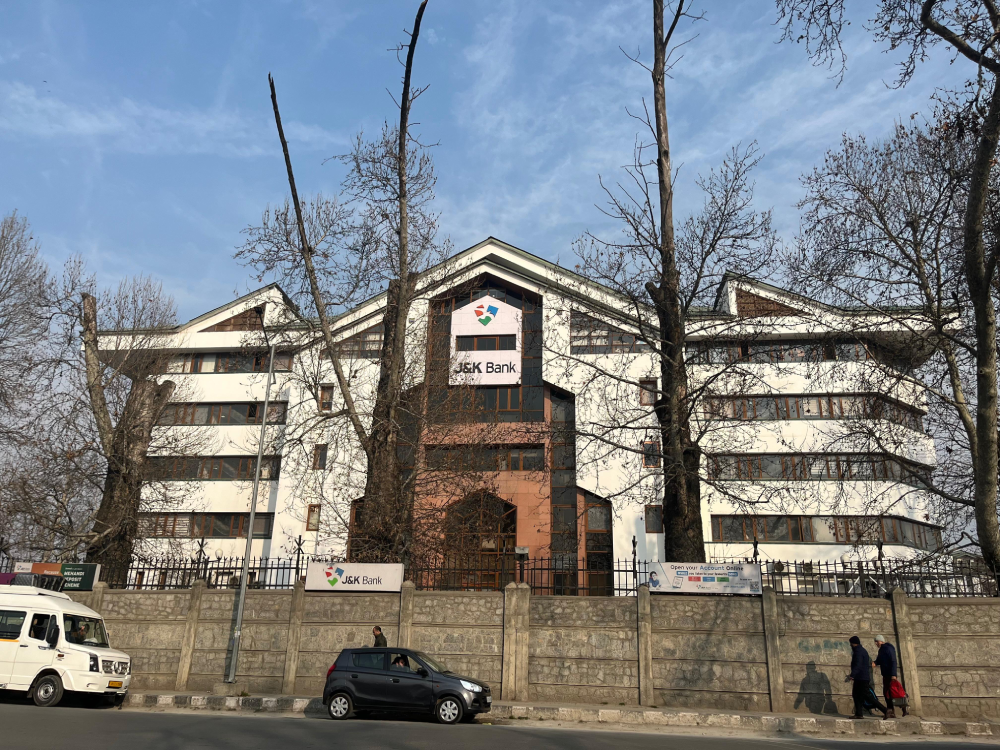
SRINAGAR: Stocks of Jammu and Kashmir Bank crashed 16 percent today, barely stopping short of hitting the lower circuit price of Rs 108.07 for the day, a day after an earnings call in which management lowered its target for low-cost deposits from earlier forecasts, refused to give a margin guidance and held back its estimate of the hit from new provisioning rules.
The bank had reported a 28.8 percent jump in quarterly profit over the previous quarter. Most of that came from its treasury desk, not its loans. Treasury income more than accounted for the year-on-year rise in pre-tax profit, while the core lending business barely grew.
The stock price closed at Rs 113.09 on the NSE today at 3.30 PM, down from Thursday’s close of Rs 135.08 and about 44% below its 52-week high of Rs 201.75. On Thursday, when the results came out during market hours, it had slipped just 0.3 percent. The stock nosedived on Friday after investors reacted to the bank’s quarter second numbers and the management conference call with analysts.
MD and CEO Amitava Chatterjee used his opening remarks on the call to set out revised guidance for FY27, which he said followed a mid-term review. His remarks were filed with the exchanges on Thursday evening. Some targets went up and others came down.
The bank now expects its CASA ratio, the share of cheap current and savings deposits, to be “42 percent+”, against 45 percent earlier. Its return-on-assets target is 1.20 percent. One analyst said the bank had earlier talked of 1.25 percent to 1.3 percent and asked why it had been downgraded. Chatterjee said it was “not downgradation” but caution, and that he meant 1.20 percent plus. The filed remarks say 1.20%. The bank earned 1.37 percent in FY26.
The earlier margin guidance of about 3.5 percent is gone. In its place is a single line saying NIM “will improve from here”. The bank raised its credit growth target to 14 percent+ from 12 percent and its deposit growth target to 12 percent+ from 10 percent, and tightened its gross NPA target to below 2 percent.
Asked how the bank planned to win back low-cost deposits, Chatterjee pointed to salary-account agreements with companies. The bank is also keeping a closer watch on transactions through the point-of-sale machines and QR codes it has given merchants. And it expected to sign a fresh salary-account MoU with the Jammu and Kashmir government, “most likely” on Friday.
He argued that the fall in the CASA ratio was a shift, not a loss. Depositors had moved their money into term deposits “with our bank only”, he said. Those deposits cost the bank more.
In his remarks, Chatterjee quoted a half-year margin of 3.22 percent. The lower figure for the quarter was not in his remarks or the press release, only in the presentation. He said a “sharp outflow of CASA deposits during Q1” had contributed to a rise in the cost of deposits.
J&K Bank’s net profit for July-September was Rs 546.36 crore, up from Rs 424.18 crore in April-June and Rs 494.11 crore a year earlier.
Net interest income, the bank’s main source of earnings, hardly moved. It is the difference between what the bank earns in interest and what it pays out. It rose 0.3 percent over the June quarter to Rs 1,502.31 crore and 4.8 percent over last year. In the same twelve months, net advances grew 25 percent to Rs 1.31 lakh crore.
Other income was a different matter. It more than doubled from a year ago to Rs 314.90 crore and was up 47 percent on the June quarter. Most of that came from treasury income, the gains the bank makes on bonds and other investments. Treasury brought in Rs 92 crore this quarter, against Rs 20 crore in April-June and a loss of Rs 63 crore a year ago.
Over the year, other income rose by Rs 161 crore, and Rs 155 crore of that was the swing in treasury income. Insurance commissions and commission and exchange income together added about Rs 13 crore. Miscellaneous income, which includes card and loan-processing charges, fell by Rs 6 crore.
Against the June quarter, the picture is much the same. Net profit rose by Rs 122 crore. Higher other income accounted for Rs 101 crore of that, Rs 72 crore of it from treasury. A lower tax bill added Rs 25 crore and lower provisions Rs 12 crore. Net interest income contributed just Rs 5 crore, while operating expenses went up by Rs 20 crore.
Leave out other income entirely and the bank’s core operating profit, net interest income minus operating expenses, comes to Rs 474.24 crore. That is 3.1 percent lower than in the June quarter and only 1.1 percent higher than a year ago. Take out treasury income alone and pre-tax profit falls about 10 percent from a year earlier, from Rs 697 crore to Rs 625 crore, according to calculations based on the bank’s filings.
For the half-year to September, net profit fell 0.9 percent to Rs 970.54 crore from Rs 978.95 crore. That figure needs no adjusting. The bank’s press release did not mention it.
Part of the treasury gain is one-time. Chatterjee told analysts the Rs 92 crore included revaluation of unlisted shares. Note 34 of the results says the bank revalued certain unlisted holdings it had been carrying at cost. It booked Rs 28.88 crore of that gain, which relates to FY25 and FY26, as other income this quarter. A separate change in how the bank accounts for priority-sector lending certificates added Rs 37.53 crore to its half-year post-tax profit. The statutory auditors flagged both.
More one-time income is on the way. Chatterjee said a stake sale completed after September 30 would add more than Rs 100 crore in the December quarter.
The weakness shows most clearly in margins. Net interest margin fell to 3.17 percent, from 3.28 percent in June and 3.56 percent a year ago, according to the presentation. That figure was not in the press release. Over the year, the yield on advances fell 65 basis points to 8.55 percent. The cost of deposits barely moved and stood at 4.85 percent as the share of low-cost deposits slipped to 41.97 percent from 45.89 percent.
When analysts asked for a margin outlook, Chatterjee would not give a number, saying his past forecasts had not been received well. He said he was “100 percent sure” margins would “go up substantially”. He pointed to repo-linked loans that reprice the same day, the run-off of high-cost deposits and faster growth in retail loans, which he said yield about 10 percent. Corporate loans outside Jammu and Kashmir yield about 7.2 percent he said.
The bank’s return on assets was 0.97 percent in the first half. An analyst at ICICI Securities asked how it would reach 1.20 percent for the year. Chatterjee said the bank would post 1.40 percent in the second half, helped by recoveries from written-off loans, a new one-time settlement scheme for old bad debts, insurance and forex income, and treasury. When the analyst suggested the write-off recoveries might not last, he replied: “It is a statement that you made, I didn’t make it.” Such recoveries brought in Rs 25 crore this quarter. Earlier in the call, Chatterjee had acknowledged that their timing is hard to predict.
Analysts also asked how ready the bank was for expected-credit-loss provisioning. At the end of September, loans overdue by 31 to 90 days made up about 5 percent of standard advances. Those overdue by 61 to 90 days, at Rs 3,477 crore, were larger than the bank’s entire stock of gross bad loans. Management said its transition hit would be below the industry average and that it had a buffer of about Rs 300 crore, but it would give a figure only in December. It also confirmed plans to raise Rs 1,000 crore in equity and Rs 500 crore in debt.
There were bright spots. Gross bad loans fell to 2.23 percent of advances, the lowest in a decade, the bank said. Fresh slippages dropped to Rs 104 crore from Rs 237 crore a year earlier, and capital adequacy stood at 16.57 percent. Management expects the recent repo rate hike, a shift towards retail lending, lower term-deposit rates and fresh CASA inflows to lift yields from the third quarter and bring down funding costs.