SRINAGAR: A piece of the sacred textile history of Islam, dating back several centuries to the Mamluk period(1250-1517), has been lying largely unnoticed in the textile collection of Srinagar’s Sri Pratap Singh (SPS) Museum.
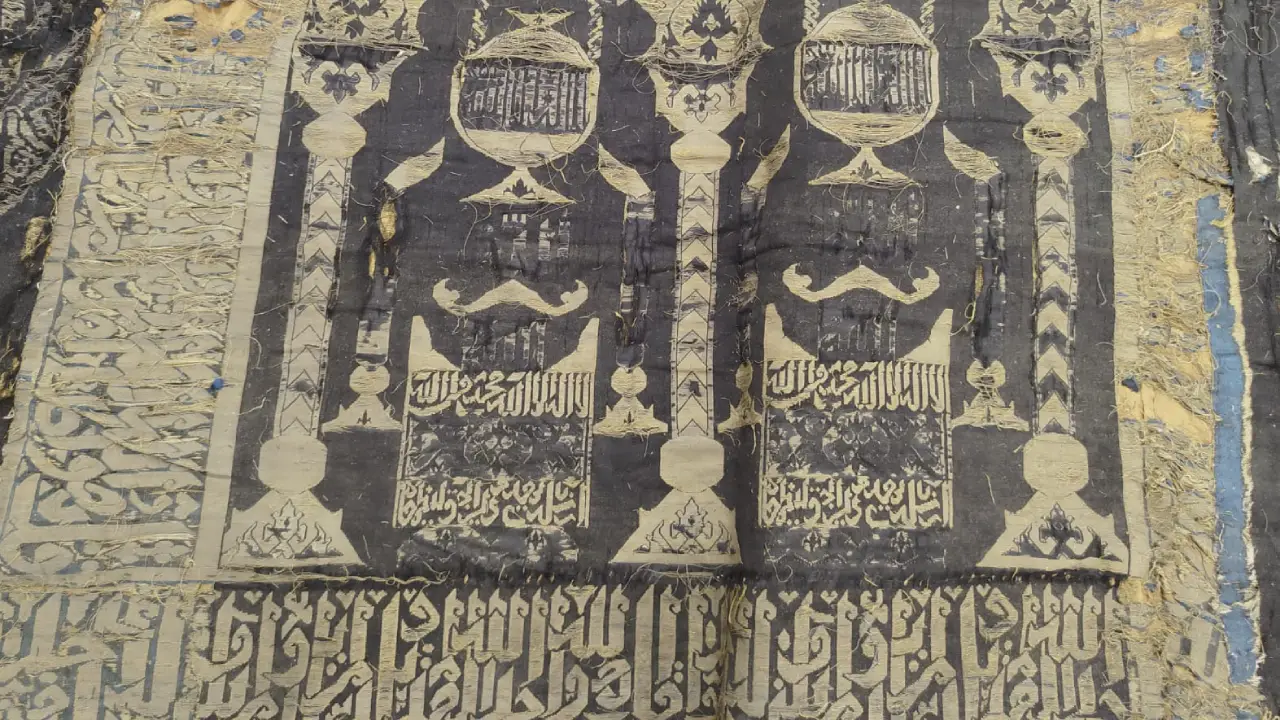
Historian Sameer Hamdani has drawn attention to an extraordinary assemblage of black silk fragments carrying Quranic inscriptions, the Shahadah and elaborate gold-woven ornamentation, identifying them as sacred textiles associated with the Kaaba and other holy sites in Mecca and Medina.
The fragments, stitched together on a yellow cloth backing, comprise nine textile pieces of varying sizes, along with several border sections. Their distinctive patterns, calligraphy and weaving techniques have prompted comparisons with surviving examples of the Kiswah, the sacred covering of the Kaaba.
Hamdani’s examination brings into focus an unusual historical object in Kashmir’s museum collection, potentially connecting the Valley with the centuries-old tradition of producing sacred coverings for Islam’s holiest sanctuaries.
The historian has undertaken a comparative examination of the fragments, studying their inscriptions, ornamental designs and textile construction, and has consulted specialists in Islamic art and textile history.
One of the most compelling comparisons is with a 16th-century red Kiswah fragment that once adorned the interior walls of the Kaaba. Both textiles carry the Shahadah arranged in chevron, or zigzag, patterns, with palmette motifs positioned at the crests of the chevrons.
The lettering in the two pieces also shows marked similarities. The two testimonies of faith are arranged in an inverted V-shaped formation, with the letters of the first part positioned diagonally against the ascending outline and those of the second arranged perpendicular to it.

The Srinagar fragment has more elongated palmettes than the red Kiswah example. It also carries two additional linear bands of inscriptions above and below the three chevron bands, containing verses from Surah al-Ikhlas.
An important technical feature of the Srinagar textiles is that their decorative motifs and inscriptions appear to have been woven into the fabric rather than embroidered. Hamdani considers this significant in establishing their historical context and suggesting a pre-Ottoman origin.
Another fragment, square in shape, has a central circular panel carrying what appears to be a mirrored inscription, possibly the Islamic invocation Bismillah-ir-Rahman-ir-Rahim, although Hamdani says the reading is not certain.
The four corners carry the name Allah in prominent calligraphy, enclosed within an elaborate golden border. A calligraphic scroll at the bottom contains a distinctive formulation of the Shahadah, adding the declaration that Ibrahim is the Friend of Allah.
The inscription reads: “There is no god but Allah; Muhammad is the Messenger of Allah; Ibrahim is the Friend of Allah.”
A third fragment features a mihrab-style architectural design, with a series of arches containing lamp and candlestick motifs. The lamps carry portions of the Shahadah, while textile-like panels hanging from them contain the testimony of faith followed by a Quranic verse referring to Allah sending His Messenger with guidance and the true religion to make it prevail.
The verse is found in Surah al-Fath, Surah al-Tawbah and Surah al-Saff. The fragment also carries partially decipherable inscriptions containing the name Allah and a border with verses from Surah al-Ikhlas.
Hamdani suggests that this particular textile could have been commissioned for the Prophet’s Mosque in Medina, possibly as a curtain for the Mihrab-i-Nabi.
The distinction is important because the Mamluk and subsequent Ottoman traditions involved the production and dispatch of different sacred textiles for the Kaaba and the Prophet’s Mosque. These included coverings for the Kaaba’s exterior and interior, its door curtain, and textiles for the Prophet’s tomb, mihrab and other sacred spaces in Medina.
Hamdani says he has consulted Nahla Nissar, curator of the Khalili Collection of Islamic Art, as well as Nasser Rabbat, Qaisra Khan, Mehran Qureshi, Maria Sardi and Mehreen Chida-Razvi on the historical and artistic significance of the fragments.
While there is broad agreement among the specialists that the textiles belong to the Mamluk period and were intended for sacred ritual use, their precise identification remains a subject of scholarly discussion. The fragments could have formed part of a Kiswah for the Kaaba, been associated with the Mahmal, or been commissioned for the Prophet’s Mosque in Medina.
The Mahmal was an ornate ceremonial structure carried with the Hajj caravan and historically associated with the transportation of the Kiswah and other sacred textiles from Egypt to Mecca.
The Mamluk period, which lasted from 1250 to 1517, was particularly important in the history of the Kiswah. The Mamluk sultans made the provision of the Kaaba’s covering a major expression of religious patronage and political legitimacy. Sultan Baybars sent a Kiswah to Mecca in 1263, and the Mamluk rulers subsequently maintained a specialised system of production and dispatch.
“The piece was discovered in the mausoleum of Sultan Zain al Abidin’s mother, where it was used to cover her grave. Known as qabarposh in Kashmiri, no one was aware of its origin,” Sameer told Kashmir Life. “Its worthwhile to remember that Sultan Zain al Abidin is said to have received gifts from Mamluk Sultans and Sharif of Medina. Both were in the habit of sending fragments of Kiswah from the Kabba as gifts to frinedly Muslim rulers whom they held in high esteem.”
A study published in the Mamluk Studies Review records that Sultan al-Nasir Hasan sent an inner Kiswah to the Kaaba in 1359. Made of black silk with gold decoration, it is an important historical example of the textiles used inside the sanctuary. The study also highlights how the inner covering differed from the exterior Kiswah and was renewed less frequently.
Egypt, particularly Cairo, became the principal centre for producing the Kaaba’s coverings for centuries. The textiles were dispatched with the annual Hajj caravan in elaborate ceremonies, making the Kiswah a symbol of both religious devotion and the political authority of the rulers who sponsored it.
The tradition subsequently continued under the Ottomans, who sent sacred coverings to Mecca and Medina through the Surre processions from Istanbul.
Hamdani has referred interested readers to The Hajj: Collected Essays, edited by Venetia Porter and Liana Saif; Nahla Nassar’s study, The Kiswah of the Kaabah from Early Islam to the 16th Century; and Selin Ipek’s research on Ottoman Ravza-i Mutahhara covers sent to Medina through the Surre processions.
The SPS Museum, established in 1898 and housed in the former summer palace of the Maharajas, has a substantial collection of archaeological artefacts, manuscripts, textiles and decorative arts. Its textile collection includes Kashmir’s celebrated shawls and other historic fabrics.
The presence of these unusual fragments in the museum adds another dimension to the historical importance of its collections. Their possible association with the sacred textile traditions of Mecca and Medina raises questions about how they reached Kashmir, who brought them, and under what circumstances they eventually became part of the museum’s holdings.
For now, their precise journey to Srinagar remains to be established. But the fragments offer an extraordinary glimpse into a period when the making of sacred textiles connected the great centres of Islamic power, craftsmanship and religious patronage across the Muslim world.