by Maleeha Sofi
PAMPORE: In Kashmir’s famed saffron country, a local farmer is experimenting with an unconventional combination that could open up new possibilities for agriculture in the region: growing saffron alongside high-density apple trees.
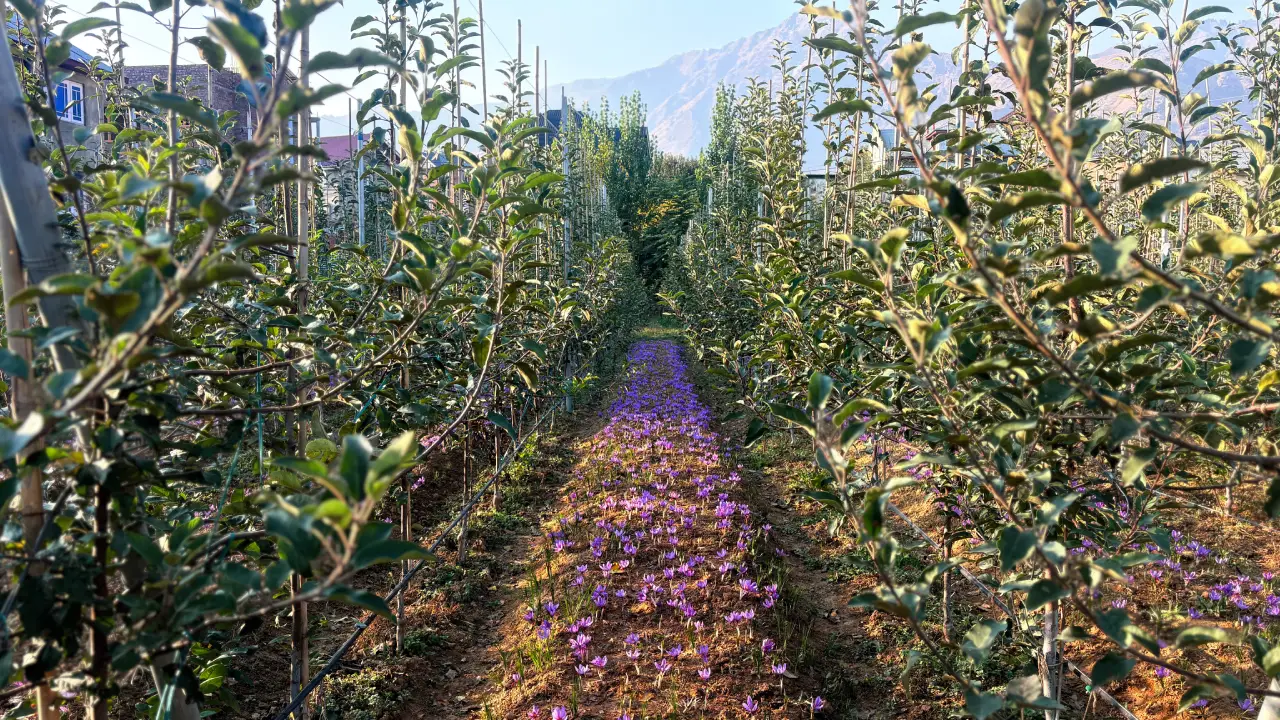
Mohammad Sultan Rath, a farmer from Ishambal village near Pampore, planted saffron corms between rows of high-density apple trees in August 2025. A year later, the saffron has flowered, offering an encouraging first glimpse of what intercropping could achieve on the region’s traditional karewa agricultural land.
The idea emerged from a simple observation. After planting high-density apple trees in 2025, Rath noticed that the spaces between the rows, ranging from six to ten feet, were largely unused. Rather than leave the land idle while the young trees grew, he decided to put it to another productive use.
He prepared the soil and planted saffron corms in the spaces between the apple trees, turning an otherwise vacant area into an experimental saffron plot.
The first flowering has encouraged him to explore the potential of the method, which could allow farmers to diversify their produce and generate additional income from the same piece of land. While the experiment is still at an early stage, it offers a locally developed approach to making better use of agricultural space in Pampore’s saffron-growing belt.
One of the most striking features of the trial, according to Rath, is the timing of the flowering. He says the saffron in his orchard bloomed five to 15 days earlier than in surrounding areas.
He attributes the early flowering to timely irrigation, repeated soil preparation and the moisture-retaining effect of the young apple trees. The orchard already had an automated drip irrigation system, which he adapted to provide the saffron with water at critical stages of its growth.
Rath said he irrigated the crop two to three times during August and September 2026. He also tilled the soil at different stages to improve conditions for the corms to establish their root systems. The apple trees, meanwhile, provided shade that helped retain soil moisture and reduced evaporation from direct sunlight.
The approach is particularly relevant as farmers contend with changing weather patterns and increasingly unreliable rainfall. Rath believes the decline in timely rains over the past two decades has affected traditional saffron cultivation, making carefully managed irrigation an important tool for adapting to changing conditions.
Saffron does not require heavy watering, but the timing of moisture availability can be crucial. By combining controlled irrigation with soil management, Rath is testing whether growers can create more favourable conditions for the crop without abandoning established cultivation practices.
He is also encouraged by what he describes as the size and thickness of the saffron flower’s stigmas, the valuable red strands harvested to produce the spice. Rath believes these characteristics could translate into better yields and quality. However, the trial’s actual productivity and saffron quality will need to be assessed through systematic harvesting, weighing and testing over successive seasons.
The experiment also raises an important question for farmers: whether saffron and high-density apple cultivation can coexist productively over the longer term. As the apple trees mature, their changing canopy, root systems and demand for water and nutrients could affect the saffron crop. Monitoring these factors will be essential before the method can be recommended on a wider scale.
Rath said the saffron was not treated directly with chemical additives or pesticides. When pesticides is sprayed on the apple trees, the saffron is nowhere around and the corm is too deep under the soil to take even a fraction of the pesticides. The compatibility of the two crops, including any potential effects of orchard treatments on the saffron and soil, will nevertheless need to be assessed as the experiment develops.
For now, the response from fellow farmers has been encouraging. Rath said a neighbouring farmer had already contacted him to enquire about the cost of adopting the method on two to five kanals of land.
That interest suggests the experiment has the potential to generate wider discussion about how farmers in Pampore can diversify cultivation, particularly during the years when newly planted apple orchards have not yet reached full production.
The trial does not yet establish whether intercropping saffron with high-density apples will deliver higher overall returns or consistently improve saffron quality. Those answers will depend on yields, production costs, crop competition and performance over several seasons.
But the first flowering has given Rath reason to continue. In a region where saffron is both an agricultural mainstay and a cultural symbol, his experiment offers a practical example of farmers looking for new ways to preserve a traditional crop while making their land work harder.
For Pampore, the promise lies not simply in growing two crops together, but in exploring whether innovation can help sustain the livelihoods built around one of Kashmir’s most prized agricultural products.