SRINAGAR: National Conference president and former Jammu and Kashmir Chief Minister Dr Farooq Abdullah has reiterated that he opposed the release of militants during both the 1989 kidnapping of Rubaiya Sayeed and the 1999 hijacking of Indian Airlines flight IC-814, warning that such decisions would have grave consequences for the country’s national security.

In an interview with former MP and journalist Shahid Siddiqui on his YouTube programme I Witness with Shahid, Abdullah recalled that he was in the United States when the political transition from the Rajiv Gandhi government to the government headed by V P Singh took place. He said he had travelled to Houston after being advised by the Government of India to undergo medical tests following a reported diagnosis of a heart attack.
Abdullah said he was told that he had suffered a heart attack and was advised to go to Houston, where several prominent Indians, including former President Zail Singh, had undergone medical procedures.
“I was sitting on my hospital bed in Houston when the phone call came informing me that Rajiv Gandhi’s government had fallen and VP Singh had become Prime Minister,” he recalled.
He said doctors in Houston subsequently told him that the earlier diagnosis was incorrect and that he was in good health.
After V P Singh became Prime Minister, Abdullah returned to Kashmir. Following the kidnapping of Rubaiya Sayeed, daughter of then Union Home Minister Mufti Mohammad Sayeed, his cabinet decided to release five militants in exchange for her freedom, he said.
“I asked them, ‘Why will we release them? Are we going to bow our heads before them?’ I refused to agree,” Abdullah recalled.

He said he spoke to the then Intelligence Bureau chief A S Dulat and Chief Secretary Moosa Raza, telling them that the proposed release was wrong.
Abdullah also recalled that one of the five militants, identified by him as Sheikh, was injured and that a proposal had been discussed to facilitate his treatment outside India.
According to Abdullah, the options included taking Sheikh to the Uri border so that he could cross the Line of Control into Pakistan for medical treatment, or sending him to Iran, from where he could travel to Pakistan.
He said Dulat rejected these proposals and instead offered to arrange treatment for the injured militant at the All India Institute of Medical Sciences in Delhi, with the possibility of flying him to the United States if required.
“Dulat told me, ‘This will not happen. We will take him to AIIMS in Delhi to treat him there, and if needed, we will fly him to America for treatment’,” Abdullah recalled.
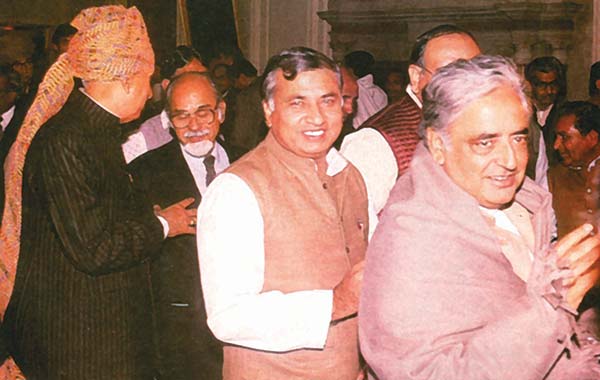
Photo Courtesy: INDIA TODAY
Abdullah said he nevertheless remained opposed to any arrangement that would result in the release of the militants.
He alleged that Home Minister Mufti Mohammad Sayeed sent Justice Koul, whom Abdullah described as close to the minister, to persuade him to accept the deal.
“They told me, ‘Look, you also have a daughter’. I replied, ‘I acknowledge that, but is the nation more important or a daughter? If they took my own daughters or my son, I still would not make a deal, because the nation comes first’,” he said.
Abdullah said he had submitted a 13-page protest to the President and the Governor, warning that releasing the militants would be the “final nail in the coffin of Indian security”.
He also claimed that V P Singh, Mufti Mohammad Sayeed, I K Gujral and Arif Mohammad Khan insisted on the release, and that Gujral threatened to dismiss his government if he refused to sign the orders.
The five militants were eventually released on December 13, 1989, in exchange for Rubaiya Sayeed’s freedom. Abdullah has argued that the decision emboldened militancy in Kashmir.
A decade later, Abdullah said, he found himself opposing another decision to release militants when Indian Airlines flight IC-814 was hijacked and taken to Kandahar in December 1999.

Recalling the arrival of A S Dulat in Srinagar with a delegation of around 20 people from the Prime Minister’s Office, Abdullah said he was informed that the Atal Bihari Vajpayee government had decided to release three militants to secure the freedom of the passengers and crew.
Dulat told him that he had come on behalf of Prime Minister Atal Bihari Vajpayee and that the release of the three prisoners was necessary to secure the hostages, Abdullah said.
“I told him, ‘First you had five released and ruined everything. Now you want to release these three as well? Remember, among them is Maulana Masood Azhar. They will set up their bases, and we will have to fight those bases for the rest of our lives’,” Abdullah recalled.
He said he subsequently spoke to Foreign Minister Jaswant Singh, Home Minister L K Advani and Vajpayee, reiterating his opposition.
Jaswant Singh, he recalled, told him that the government had to release the prisoners because people were waiting outside their doors for the hostages to be brought home.
Abdullah said he responded by asking whether the country could not make a sacrifice to protect its long-term security.
He claimed that Advani was personally uncomfortable with the decision, although the government eventually yielded to public pressure.
Abdullah also recalled approaching then Governor Girish Chandra Saxena, a former R&AW chief, to discuss the security implications of the proposed release.
“I told him, ‘If we do this, how will we save the nation? How will it survive?’ He said, ‘Brother, this is how it is, it is over right now’,” Abdullah said.
Abdullah said he made it clear that the responsibility for the consequences would rest with those taking the decision, not with him.
The release of Masood Azhar subsequently enabled him to establish Jaish-e-Mohammed, which went on to carry out major terrorist attacks in India.
Abdullah maintained that his opposition to both decisions reflected a consistent position: that the release of militants under pressure could have consequences far beyond the immediate crisis.