SRINAGAR: Ladakh’s experimental saffron cultivation has produced its first flowers within 30 days of planting, well ahead of the usual two-month flowering timeline, with nearly 22 grams of pure saffron harvested in the first four days, Lieutenant Governor Vinai Kumar Saxena said on Sunday.
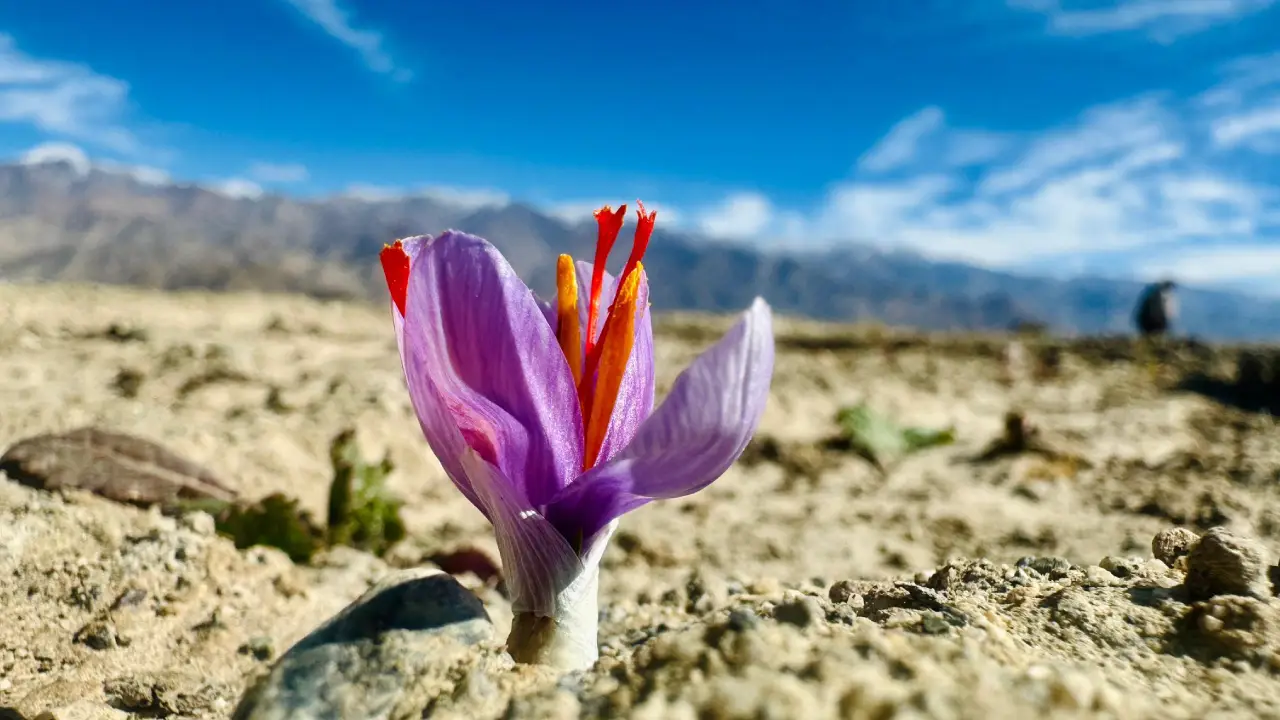
Saxena, who inspected the experimental saffron field on recently restored degraded land in Leh, described the early results as a significant breakthrough for high-altitude agriculture in the Union Territory, opening up the possibility of expanding cultivation of the high-value spice beyond its traditional growing areas in Kashmir.
Sharing the development on X, the Lieutenant Governor said that, on average, 20 to 25 flowers bloomed daily, while 72 flowers were recorded on Sunday morning alone.
The experiment, spread over 4,000 square metres in Leh, involves the plantation of 90,000 saffron corms weighing approximately 800 kilograms. It is being undertaken as part of Project Him Sarovar, a government initiative aimed at reclaiming degraded and lost agricultural land in Ladakh and putting it to productive use.
The project, launched on October 2, seeks to explore the commercial potential of saffron cultivation in the cold desert’s distinctive agro-climatic conditions. Its early flowering has raised expectations of creating new livelihood opportunities through high-value agricultural production.
Saffron, botanically known as Crocus sativus, is among the world’s most expensive agricultural products. Its cultivation in India has traditionally been concentrated in Kashmir, particularly Pampore in Pulwama district, which is renowned for producing some of the finest saffron.
The Ladakh experiment, however, is not the first attempt to establish the crop in the region. In 2024, scientists at the CSIR-Indian Institute of Integrative Medicine (IIIM), Jammu, successfully demonstrated saffron cultivation in open fields in Leh, establishing the possibility of growing the crop under Ladakh’s high-altitude conditions.
The institute subsequently signed a memorandum of understanding with the Ladakh Autonomous Hill Development Council, Leh, to establish demonstration farms for medicinal, aromatic and flowering plants. It has also been developing cultivation, processing and post-harvest management protocols to extend the technology to farmers.
Saxena said the early success of the present initiative demonstrated the resilience of Ladakh’s environment and its untapped agricultural potential. He credited the Agriculture Department and its field staff for their contribution to the pilot project.
He said the experiment could lay the foundation for commercial-scale saffron production, creating new opportunities for farmers, young entrepreneurs and self-help groups while strengthening Ladakh’s local economy.
Saffron cultivation requires specific climatic and soil conditions. The crop generally flowers during autumn, with temperature, moisture, snowfall and the quality and size of corms playing a critical role in determining yields. Corms weighing more than 10 grams are generally considered suitable for flowering.
In Pampore, an acre of saffron cultivation can yield up to two kilograms under favourable conditions, although actual production varies considerably with climatic conditions and crop management.
Scientists associated with saffron research have welcomed efforts to expand cultivation to newer regions, arguing that successful adaptation could help increase India’s overall production and provide farmers with additional income opportunities.
The early harvest in Leh is expected to provide an important basis for assessing the crop’s adaptability, productivity and commercial viability under Ladakh’s high-altitude conditions. However, the sustainability of yields over successive flowering seasons will be crucial in determining whether the experiment can be scaled up into a viable agricultural enterprise.