by Babra Wani
SRINAGAR: As artificial intelligence increasingly shapes how people communicate, learn, and access information, Kashmiri remains poorly represented in much of the technology people use every day. A new initiative, Kashmiri.ai, is trying to close that gap, starting with a free English-to-Kashmiri translation service.
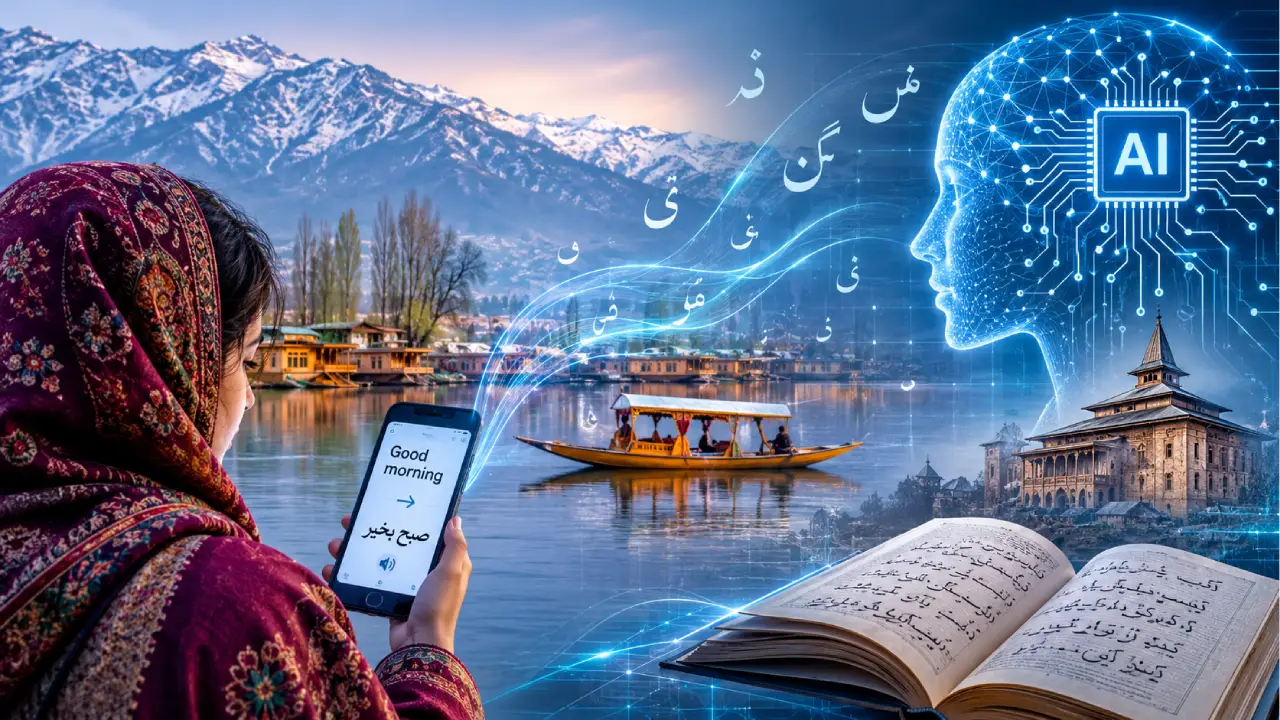
Called Kath Bath (conversation), the online tool, available at kashmiri.ai, allows users to enter English text and receive its Kashmiri translation in the Perso-Arabic script. It supports up to 500 characters in a single submission and offers diacritical marks and voice playback, allowing users not only to read the translated text but also to hear it.
The project has been developed by Jibran Shah, a machine-learning engineer, with Omer Muzaffar, a product manager, collaborating on its development. The initiative is being built under an open project called Kathbakwaas.
The immediate applications range from helping tourists communicate in Kashmir and enabling people learning the language to giving Kashmiri families living outside the Valley an accessible way to engage with their mother tongue. It could also offer a practical resource for members of the diaspora seeking to maintain their connection with the language across generations.
What makes the initiative particularly interesting, however, is the technology behind it.
The developers have built their translation system around Koshur-Sarvam-4B, a Kashmiri-specific model derived from Sarvam-Translate 4B. According to its technical documentation published on Hugging Face on October 15, 2026, the model was fine-tuned using 108,322 human-translated English-Kashmiri sentence pairs drawn from multiple datasets.
The translation process involves two distinct stages. The first model converts English into Kashmiri, initially producing text without diacritical marks. A separate character-level model then restores the diacritics to the translated text.
This second component is particularly relevant to Kashmiri written in the Perso-Arabic script, where vowel markings help convey pronunciation and distinguish between sounds. Rather than relying on the translation model alone to produce these marks, the developers have trained a separate system specifically for the task.
The diacritic-restoration model, called Koshur-JibDiacritizer-152M, was trained on 244,303 rows of Kashmiri text, including transcripts from AI4Bharat’s IndicVoices dataset. Its function is to restore the appropriate marks without changing the letters, words or punctuation produced by the translation model.
The technical work has also been evaluated against established language-translation benchmarks. The developers report a mean KATHE score of 14.91 across four public test datasets, compared with 12.90 for the original Sarvam-Translate model. Their evaluation places the combined system ahead of the other publicly available systems they compared. However, they acknowledge that a fresh blind evaluation is still required to establish how well it performs on entirely unfamiliar material.
The wider significance of the initiative lies in the fact that Kashmiri, despite being spoken by millions of people, has received relatively limited attention in the development of modern language technologies. The absence of reliable digital tools can make it difficult for a language to establish a meaningful presence in online communication, educational resources and emerging AI applications.
Translation is therefore being treated as an entry point rather than the final product.
The longer-term ambition of the developers is to build a Kashmiri artificial intelligence system with which people can converse naturally, much as they interact with ChatGPT. Such a system would require considerably more than translating individual sentences. It would need to understand context, respond to questions, generate original Kashmiri text and eventually support more complex interactions.
For now, Kath Bath remains a relatively modest tool, with a 500-character limit and English-to-Kashmiri translation as its principal function. Its developers say the system is a work in progress and will continue to improve.
Users can access the service free of charge at https://kashmiri.ai. The developers are inviting feedback, corrections and suggestions at [email protected], recognising that the involvement of native speakers will be important in improving the quality and naturalness of its translations.