SRINAGAR: Early identification of psychological distress among children, timely intervention in developmental disorders, trauma-informed treatment and inclusive care for persons with disabilities emerged as key priorities at a two-day advanced psychiatry conference that concluded in Srinagar on Saturday, with experts stressing the need to move mental healthcare beyond hospitals and into schools, families and communities.
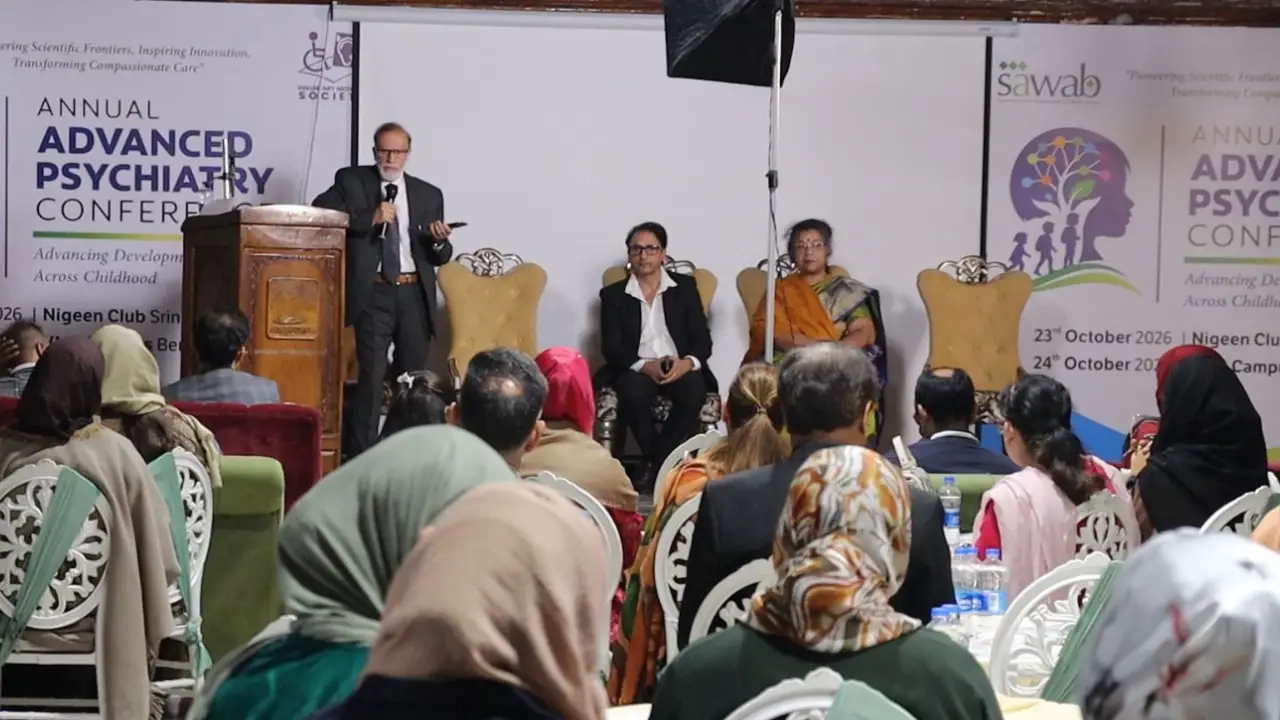
The SAWAB Annual Advanced Psychiatry Conference 2026 brought together psychiatrists, psychologists, neurologists, educationists, medical professionals, social workers and community representatives to deliberate on childhood development, psychological trauma, suicide and suicidal behaviour, complex psychiatric conditions and disability rights.
Organised by SAWAB (Supporting Always Wholeheartedly All Brokenhearted) under the leadership of its founder and director, Prof (Dr) Mushtaq Ahmad Margoob, the conference was held on October 23 and 24 at Nigeen Club and the Voluntary Medicare Society (VMS), Bemina, with a special evening programme at Golden Tulip, Srinagar.
The discussions emphasised that mental health interventions should begin before psychological difficulties become severe, with teachers, parents and healthcare professionals working together to identify warning signs and provide appropriate support. Experts also underlined the importance of understanding the long-term effects of childhood adversity and ensuring that persons with disabilities receive care that protects their dignity and enables their participation in society.
The first day, held at Nigeen Club under the theme Advancing Developmental Science Across Childhood, focused on brain development, neuroplasticity, neurodevelopmental disorders, specific learning disabilities, childhood trauma, toxic stress and resilience.
The opening plenary, titled Building Better Brains and Healing Childhood, was chaired by Prof (Dr) Yasir Rather and Prof (Dr) Rayees Ahmad Wani. Scientific presentations were delivered by Dr Shabir Ahmad Dar, Dr Insha Rouf, Dr Syed Karar and Dr Yuman Kawoosa.
Addressing the gathering, Prof Margoob stressed the need to connect advances in developmental neuroscience with the everyday experiences of children and their families, particularly in communities exposed to prolonged adversity.
He emphasised early identification, timely intervention, supportive relationships and compassionate community engagement as essential elements of contemporary mental healthcare.
Prof (Dr) Arshid Hussain, Head of the Department of Psychiatry at the Institute of Mental Health and Neurosciences, Kashmir (IMHANS-K), Government Medical College Srinagar, also addressed the gathering.
The keynote address, The Inner Compass: Mindfulness and Resilience in Young Minds, was delivered by Prof (Dr) Rajashree Ray, Chair of the South Asian Division of the Royal College of Psychiatrists, United Kingdom.
Her presentation focused on emotional awareness, resilience-building and the role of psychologically supportive environments in protecting children’s mental well-being.
Prof (Dr) Abdul Majid, Head of the Department of Psychiatry at SKIMS Medical College, Srinagar, served as programme convener.
A multidisciplinary panel titled Healing Childhood through Compassionate Care examined trauma-informed approaches, family- and school-based interventions, coordinated professional support and ways to strengthen resilience among children and caregivers.
The panel included Prof (Dr) Zaid Ahmad Wani, Head of the Child Guidance and Well-Being Centre; Dr Irfan Yousuf, Senior Consultant in Neurology; Dr (Adv) Syed Mujtaba, Supervisor of the Litigation Fellowship, Jammu and Kashmir; Dr Mudassir Hassan Pandith, Lecturer in Child Psychology at Government Medical College Baramulla; Dr Deeba Nazir, Consultant Psychiatrist with Tele-MANAS; and Prof S Zahoor Ahmad Geelani, educationist and Nodal Officer for Student Mental Health Care at the Central University of Kashmir.
A major focus of the conference was the need to recognise psychological distress in children before it develops into more serious difficulties.
At a master class titled Spotting the Invisible: Early Identification in Schools, Prof Rajashree Ray discussed how emotional and psychological problems may manifest through changes that are not always immediately recognised as mental health concerns.
These can include unexplained behavioural changes, declining academic performance, recurrent physical complaints without an obvious explanation, withdrawal from social interactions and emerging risk behaviours.
The session highlighted the role of teachers, families and educational institutions in noticing such changes and facilitating timely professional assessment.
The emphasis on schools reflected a broader concern that mental health problems in children may remain unrecognised when behavioural or academic difficulties are treated in isolation rather than understood in the context of emotional well-being and developmental needs.
Another specialised master class, conducted by Prof Amit Arya and Prof Pawan Kumar Gupta, addressed the developmental and clinical considerations involved in cases of child sexual abuse.
The session covered sensitive assessment, appropriate documentation and preparation for legal proceedings, stressing the importance of protecting children’s dignity while ensuring that clinical responses are scientifically informed and legally appropriate.
The conference also examined how prolonged or repeated psychological adversity, particularly during sensitive stages of childhood development, can affect emotional regulation, self-perception, interpersonal relationships and personality functioning.
In a master class titled The Wound That Becomes Us: Trauma, Complex Post-Traumatic Stress Disorder and the Enduring Architecture of Personality, Prof Margoob discussed developments in the scientific understanding of trauma, attachment, neurobiology and developmental psychopathology.
The presentation examined Complex Post-Traumatic Stress Disorder (CPTSD), a condition associated with prolonged or repeated traumatic experiences that may affect not only a person’s sense of safety but also emotional regulation, self-worth and relationships.
The discussion challenged approaches that overlook the lasting developmental consequences of psychological trauma and stressed the importance of understanding the wider circumstances in which psychiatric difficulties emerge.
At the same time, the presentation highlighted the possibilities of recovery through resilience, neuroplasticity, meaningful human relationships and appropriate therapeutic support.
The discussions placed particular emphasis on the need to understand psychological distress in its developmental and social context rather than viewing symptoms in isolation.
The special evening programme at Golden Tulip on October 23 brought together professionals, community leaders, educationists, journalists and other stakeholders for further scientific discussions and the formal launch of SAWAB’s website.
The digital platform is intended to strengthen the organisation’s outreach, knowledge-sharing and public engagement, while improving access to information about its community mental health initiatives.
The launch marked an additional step in SAWAB’s efforts to connect scientific knowledge with the needs of individuals and families seeking mental health support.
The second day, held at the Voluntary Medicare Society in Bemina, focused on translating scientific evidence into clinical practice, including the assessment and management of neurodevelopmental disorders, disability certification and benefits, disability etiquette and inclusive healthcare.
The inaugural session was attended by Prof (Dr) Kaisar Ahmad, President of the Former Faculty Forum of J&K Medical Institutions, as chief guest, and Prof (Dr) Mohammad Maqbool Dar, Head of the Department of Psychiatry at Kashmir Medical College, as guest of honour.
Prof Margoob, Dr Farooq Ahmad Kaloo, Secretary of the Voluntary Medicare Society, and Prof GM Malik, former Professor and Head of the Department of Medicine at Government Medical College Srinagar and editor of the medical journal JK Practitioner, also attended.
An important academic component was a series of interactive clinical case discussions under the theme From Evidence to Action.
Chaired by Prof (Dr) Mansoor Ahmad Dar, Dr Tajamul Hussain and Prof (Dr) Junaid Nabi, the sessions brought psychiatrists and clinical psychologists together to discuss complex clinical presentations and demonstrate the importance of collaborative assessment and multidisciplinary treatment.
The cases covered suicide and suicidal behaviour, presented by Dr Nizamuddin and Ms Nazia Baba; borderline personality disorder, presented by Dr Syed Mehvish and Dr Aijaz Ahmad Khan; and post-traumatic stress disorder, presented by Dr Shazia Kouser and Ms Aeiman Rafiq.
The discussions addressed the need to integrate clinical expertise, psychological assessment, risk evaluation and individualised therapeutic interventions in managing complex psychiatric conditions.
The conference also called for a shift away from viewing disability primarily as an individual impairment, arguing for a more inclusive approach centred on dignity, accessibility, reasonable accommodation and meaningful participation.
A multidisciplinary panel titled Beyond the Deficit Model: Reimagining Disability in Clinical and Community Settings examined how healthcare institutions and communities could move towards more rights-based and person-centred approaches.
The panel included Prof (Dr) SM Salim Khan, President of the J&K State Medical Council; Prof Abdul Majid Ganai, former Professor and Head of the Department of Community Medicine at SKIMS Soura; Prof Masooda Yaseen; Prof (Dr) Ashfaq Ahmad Butt, Head of the Department of Community Medicine at SKIMS Medical College; Dr Shah Nilofer, Senior Resident in Psychiatry at JVC; and Dr Arshid Bashir of HRID, VMS.
The deliberations highlighted the need for accessible services, appropriate support and institutional sensitivity so that persons with disabilities can participate more fully in healthcare and community life.
The panel’s central concern was that diagnosis and impairment should not become the sole basis for determining how people with disabilities are treated or what opportunities they receive.
The conference’s discussions assumed particular significance in Jammu and Kashmir, where prolonged psychosocial adversity, changing family structures, pressures within educational environments and gaps in access to specialised services make preventive and community-based mental healthcare especially important.
Participants emphasised that advances in neuroscience and psychiatric research would have limited practical impact unless translated into early detection, timely treatment, coordinated professional support and accessible services.
They also stressed the need for stronger collaboration among healthcare professionals, educational institutions, families, civil society organisations and policymakers.
Such coordination, the conference highlighted, can help children receive support before difficulties become more severe, enable people experiencing psychological distress to access treatment and improve the inclusion of persons with disabilities.
The broader discussions reinforced the need to recognise mental health as an issue extending beyond hospitals and specialist clinics into the social environments in which people grow, learn, work and maintain relationships.
The conference concluded with a valedictory session attended by Prof (Dr) Fazlul Qadir Parray, Principal of SKIMS Medical College and Hospital, as valedictory guest of honour.
The concluding deliberations highlighted the importance of sustained scientific exchange, interdisciplinary partnerships and translating emerging evidence into improvements in clinical practice and community well-being.
Founded by Prof Margoob, SAWAB emerged in the early 1990s in response to escalating psychosocial distress in Jammu and Kashmir. The organisation has since focused on community outreach, psychosocial support, mental health education, research, early intervention and accessible care for vulnerable populations.
The two-day conference reiterated its emphasis on linking psychiatric science with the lived experiences of individuals, families and communities.
Its central message was that effective mental healthcare must extend beyond treating disorders after they emerge to recognising vulnerability early, preventing avoidable suffering, strengthening resilience and building compassionate and inclusive systems of care.