SRINAGAR: The J&K Forest Rights Coalition (JKFRC) has sought a transparent and time-bound review of rejected claims under the Forest Rights Act (FRA), 2006, besides stronger institutional mechanisms to protect the rights and traditional livelihoods of forest-dwelling, tribal and pastoral communities.
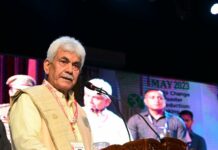
The demand was raised during an interaction-cum-consultation organised by the JKFRC in association with the Gujjar-Bakerwal Youth Welfare Conference with Forest, Ecology and Environment and Tribal Affairs Minister Javed Ahmed Rana at the Banquet Hall here.
The consultation brought together tribal and social activists, representatives of indigenous communities, pastoralists and grassroots workers involved in implementation of the FRA, protection of traditional livelihoods, community conservation, social justice and climate resilience.
The Coalition presented the Minister a memorandum outlining a roadmap for making implementation of the FRA transparent, participatory, accountable and compliant with the law.
Among its key recommendations was the constitution of a UT-level Advisory Committee on Forest Rights comprising experts, researchers, practitioners, community representatives and civil society organisations, including the JKFRC. It also sought strengthening of Sub-Divisional Level Committees and District Level Committees through regular reviews, greater accountability and meaningful engagement with forest-dwelling communities.
The Coalition called for regular inter-departmental coordination meetings involving the Forest, Revenue, Rural Development and Tribal Affairs departments and grassroots organisations to resolve procedural difficulties and implementation bottlenecks.
A major concern raised was the large number of rejected forest rights claims. The JKFRC called for a systematic and claimant-friendly review mechanism under the FRA and its Rules, with every claimant being informed of the reasons for rejection and eligible claims reconsidered through due process.
It also sought regular district-level FRA meetings, greater cooperation with Gram Sabhas, awareness programmes, capacity building and periodic monitoring, stressing that the Gram Sabha must be recognised as the primary authority in the claims process.
The Coalition further proposed quarterly UT-level reviews to assess progress and ensure that implementation reaches communities on the ground rather than remaining confined to official files and offices.
A dedicated Gujjar-Bakerwal State Advisory Board was also proposed, with representation from traditional pastoralists, experts, researchers, civil society and government departments. The proposed body would address issues concerning forest rights, traditional grazing, seasonal migration routes, Community Forest Resource rights, customary livelihoods, climate resilience and pastoral knowledge.
Rana assured participants that the legitimate rights of traditional forest dwellers would be protected.
“The rights of traditional forest dwellers would be protected at every cost,” the Minister said.
He said forest dwellers had a legitimate stake in forests and that their rights had to be protected, while emphasising that forests were a shared lifeline whose protection and preservation was equally important.
“We have to ensure that the rights of forest-dwelling communities and the larger objective of forest conservation move together,” Rana said.
The Minister said forest rights and conservation should not be treated as competing objectives, calling instead for a balanced, participatory and legally compliant approach that recognised communities as partners in conservation.
Taking note of concerns over rejected claims, he directed that such cases be reviewed strictly in accordance with the FRA and its Rules so that no eligible forest dweller was deprived of a legitimate right because of procedural shortcomings or inadequate consideration.
Rana also directed the Director, Tribal Affairs, to initiate the process for constitution of the requisite committees and organise a UT-level workshop on the FRA, followed by similar programmes at divisional, district and grassroots levels.
He stressed the need for training and sensitisation of field-level Forest officials so that the FRA was understood and implemented in its true spirit rather than through an enforcement-centric approach.
Dr Shaikh Ghulam Rasool, chairman and founding member of the JKFRC, said forest-dwelling and pastoral communities should be recognised as rights-holders, knowledge-holders and partners in ecological stewardship rather than merely as beneficiaries of government schemes.
“Forest dwellers are not the enemies of forests. They are among the oldest custodians of these landscapes,” Rasool said, arguing that nature could not be protected by dispossessing communities that had historically lived with it.
He said pastoral communities possessed generations of ecological knowledge and traditional adaptation and could be important partners in building climate-resilient mountain ecosystems.
Rasool called for a shift from exclusion to coexistence and said the FRA must “move from files to forests, from offices to Gram Sabhas and from assurances to legally recognised rights”.
He welcomed the assurances given by Rana while stressing that the next stage should focus on time-bound implementation, transparent monitoring and accountability on the ground.
Rasool also appreciated Chief Minister Omar Abdullah and his government’s initiatives concerning social justice, transparency, participatory governance and forest rights. He particularly acknowledged the government’s engagement with social movements and civil society, saying continued dialogue was important in a democratic society but should translate into institutional transparency and measurable protection of people’s rights.
Zahid Parwaz Chowdhury, convener of JKFRC and president of the Gujjar-Bakerwal Youth Welfare Conference, said the success of the FRA would ultimately be measured by whether the last forest dweller in a remote village received justice.
He sought stronger Forest Rights Committees, Gram Sabhas, SDLCs and DLCs, transparent review of rejected claims and urgent attention to Community Forest Resource rights.
Chowdhury said community participation should become a regular component of governance rather than an occasional consultation.
Ch Mustafa Rahi, former DDC Kalaroos and founder of JKFRC, highlighted difficulties faced by forest-fringe and remote communities, calling for improved access to education, healthcare, roads, connectivity and essential services.
He said development in ecologically fragile mountain landscapes must remain environmentally responsible and compatible with local ecosystems.
Participants, including Peer Sheikh Ghulam Mohiuddin, Altaf Poswal, Irshad Ahmad Fidae, Bashir Tedwa, Advocate Naveed Bukhtiyar, Mukhtar Dar, Shareef Paktoon, Master Ali Mohammad, Mushtaq Budgami, Danish Kasana and Sajad Kasana, raised concerns about forest rights claims, rejected cases, functioning of Forest Rights Committees, access to basic services, pastoral livelihoods and community participation.
The participants also challenged the perception that pastoral communities were inherently a threat to forests or wildlife, stressing their historical relationship with forests, alpine meadows, water sources and wildlife.
The Coalition said traditional systems of seasonal migration, grazing and ecological adaptation could offer valuable lessons amid climate change and increasing pressure on mountain ecosystems.
The consultation ended with a shared emphasis on a model of conservation in which the protection of nature and people’s rights reinforce each other.
The JKFRC and Gujjar-Bakerwal Youth Welfare Conference said they would continue constructive engagement with the government while advocating indigenous rights, pastoral livelihoods, community forest rights, ecological protection and climate resilience.