SRINAGAR: Kalhana’s 12th-century chronicle Rajatarangini, which documents the political and cultural history of Kashmir, has been included in UNESCO’s Memory of the World Asia-Pacific Regional Register, bringing international recognition to one of the subcontinent’s pioneering works of historical writing.
The chronicle is among three Indian documentary heritage works recognised during the 2026 inscription cycle at the 11th meeting of the Memory of the World Committee for Asia and the Pacific (MOWCAP), held in Jakarta, Indonesia. The other two are the Mahabharata and Arthashastra, attributed to Maharishi Vedavyasa and Kautilya respectively.
UNESCO recognised 21 documentary heritage nominations from countries across the Asia-Pacific region in this cycle. India’s three inclusions were approved following an evaluation process and deliberations by the committee.
Composed by Kalhana in the 12th century, Rajatarangini is regarded as a pioneering historical chronicle, offering an account of Kashmir’s rulers, political developments and cultural life. Its inclusion places the historical record of Kashmir among the documentary heritage recognised for its contribution to the collective memory of the Asia-Pacific region.
The original manuscript of Rajatarangini is preserved at the Oriental Research Library in Srinagar. The Mahabharata manuscript is held by the Bhandarkar Oriental Research Institute (BORI) in Pune, while the Arthashastra is preserved at the Oriental Research Institute in Mysuru.
The three works represent different strands of India’s intellectual traditions. While Rajatarangini records historical and political developments in Kashmir, the Mahabharata encompasses philosophical, ethical and literary traditions, and the Arthashastra deals with statecraft, governance, political economy, diplomacy and administration.
The Indira Gandhi National Centre for the Arts (IGNCA), functioning under the Union Ministry of Culture, served as India’s nodal institution for the UNESCO Memory of the World Programme and coordinated the nominations.
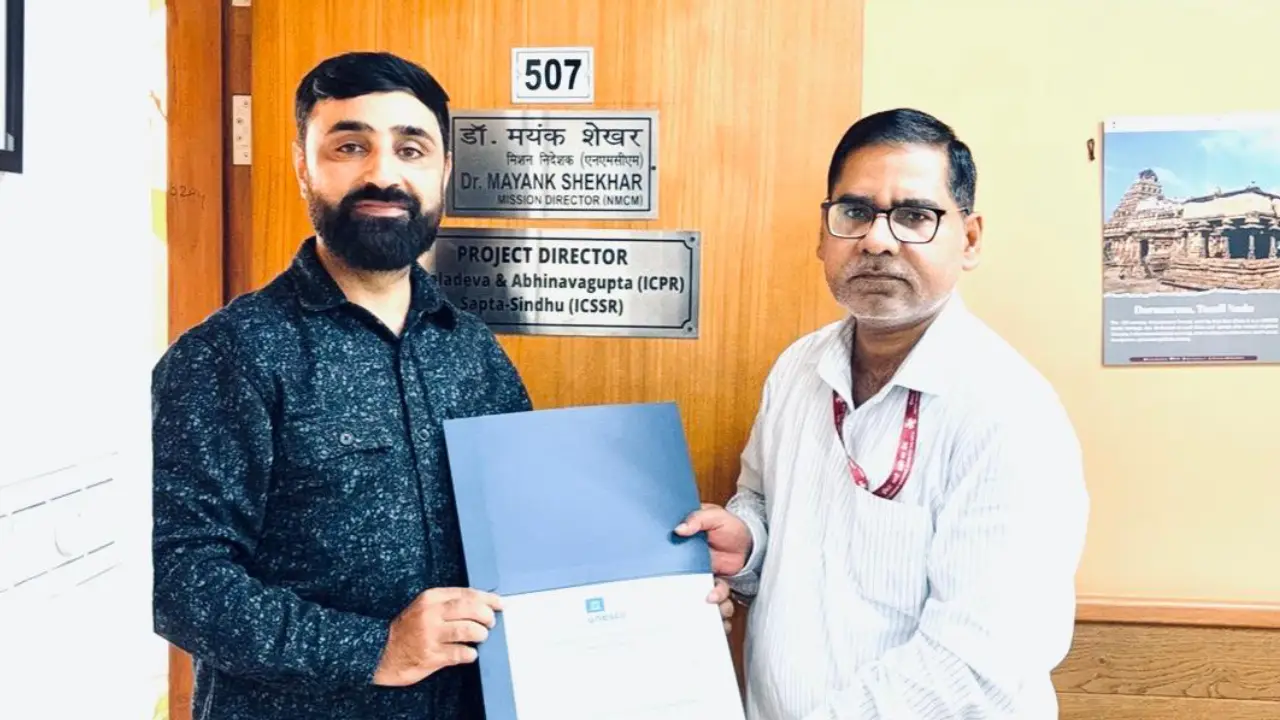
Dr Mayank Shekhar, In-charge of the UNESCO Cell at IGNCA, represented India at the Jakarta meeting and presented and defended all three nominations before the committee. The proposals were approved after consideration of recommendations by the Register Subcommittee, deliberations and voting by representatives of member states.
IGNCA Member Secretary Dr Sachchidanand Joshi described the recognition as a significant achievement and acknowledged the institution’s efforts towards the preservation, documentation and international recognition of India’s documentary heritage.
The Memory of the World Programme seeks to preserve documentary heritage and promote access to records and manuscripts of significance to humanity. The latest recognition marks another international acknowledgement of the historical, literary and intellectual traditions preserved in India’s manuscript collections.