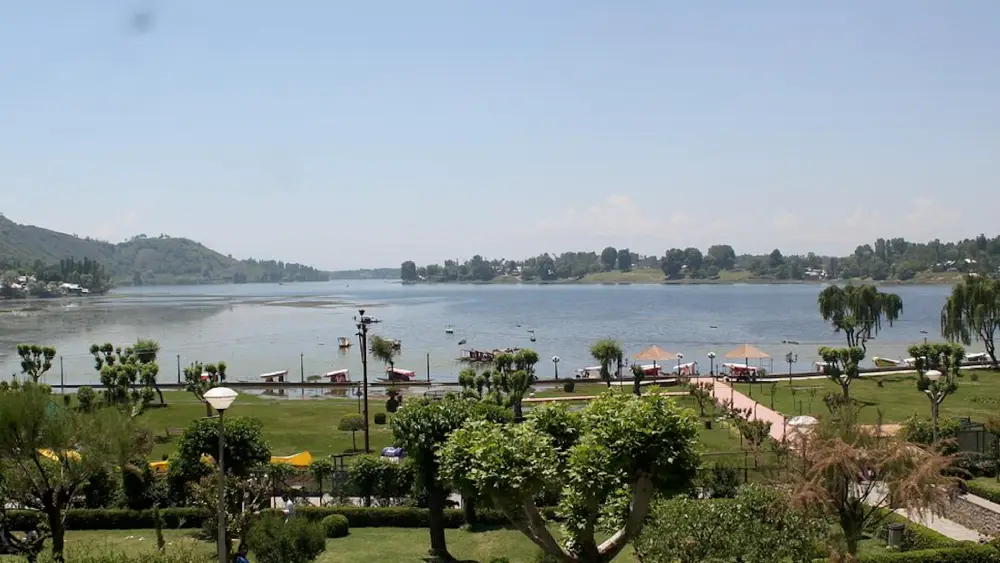
SRINAGAR: Water samples collected from Manasbal Lake and its feeder system by the Central Pollution Control Board (CPCB) have revealed widespread contamination, with none of the seven tested locations meeting the prescribed Class B standard for outdoor bathing.
The findings have raised serious concerns over the quality of water supplied for drinking purposes to thousands of residents in parts of Ganderbal and Bandipora districts.
The CPCB conducted the sampling on April 4, 2026, following directions from the National Green Tribunal (NGT) in a case filed by environmental activist Dr Raja Muzaffar Bhat, who had alleged that untreated sewage from 14 villages was entering the Manasbal wetland through the Lar Canal.
The CPCB team collected seven water samples, four from Manasbal Lake, two from natural springs around the lake and one from the Lar Canal. The samples were collected from the southern portion of the lake near Kondabal, its central portion, the lake outlet, the point from where water is extracted for municipal supply, two springs and the Lar Canal.
The report submitted to the NGT states that all seven samples failed to comply with Class B water quality criteria, which relates to water suitable for organised outdoor bathing.
Of the seven locations, five, which includes all four locations within Manasbal Lake and the Lar Canal, were classified as Class D, meaning the water was suitable only for propagation of wildlife and fisheries under the CPCB’s Designated Best Use criteria.
Only one location, the spring at the temple outlet, qualified as Class C, which denotes a drinking-water source requiring conventional treatment and disinfection. The other spring did not qualify under any of Classes A, B, C or D.
The findings are particularly significant because one of the four lake samples was collected from the point where water is extracted for municipal supply.
The CPCB report also recorded visible evidence of pollution around the lake. During its inspection of the lake periphery from the Safapora-Gratabal side towards Kondabal, the team observed mixed municipal solid waste, including plastic carry bags, bottles and other litter, along the immediate lakefront. In several places, waste was found accumulated along the lake margin and partially submerged in the water.
Open dumping of solid waste and discharge of grey water from houses along the lakeside slope were also observed in the Safapora-Gratabal stretch, while scattered solid waste was found on the Kondabal side.
The CPCB further observed that part of the Lar Canal was being diverted into Manasbal Lake.
According to the report, seven villages including Kondabal, Chesma Manasbal, Jarokbal, Gratbal, Kharbagh and Bhagwan Mohalla, are located along the lake’s periphery, with grey water generated by household activities being discharged directly into the lake. The report says officials and residents informed the CPCB team that household sewage was generally being managed through soak pits.
The J&K Pollution Control Committee (JKPCC), however, had observed sewage flowing through small surface drains during an inspection conducted on February 17, 2026, according to the CPCB report.
The microbial analysis has added to the concern. The CPCB findings recorded high levels of faecal coliform and total coliform bacteria in the lake samples, indicating contamination associated with human or animal sewage.
While most heavy metals were below detectable limits, the CPCB report makes clear that the pollution concern is primarily linked to biological contamination, wastewater discharge and solid waste rather than heavy-metal contamination.
The NGT had ordered the CPCB and JKPCC on January 30, 2026, to ascertain the water quality of the wetland, identify sources of pollutant discharge and submit a status and action-taken report.
The petition before the Tribunal alleges that untreated sewage from 14 villages is entering Manasbal Wetland through the Lar Canal, causing severe ecological degradation. Bhat has also submitted that the lake is a drinking-water source for thousands of people in Safapora, Sumbal, Sonawari and adjoining areas of Ganderbal and Bandipora districts.
Bhat is represented before the Tribunal by advocates Rahul Chowdhary and Shreepuna Dasgupta.
Speaking about the CPCB findings, Bhat said local residents, the Civil Society Safapora and the Social Concern Group had been raising concerns over pollution in Manasbal for a long time.
“Authorities never took them seriously,” Bhat said, alleging that despite government claims that a sewage treatment plant would be established to protect the lake, the proposed facility had not materialised.
He described the situation as “criminal negligence” and said the issue would be placed before the NGT, particularly in view of the drinking-water supply drawn from the lake.
Bhat said he hoped the Tribunal would pronounce its final judgment at the next hearing in October and impose substantial environmental compensation on the government.
The CPCB report also records measures claimed to have been undertaken by the Wullar-Manasbal Development Authority (WMDA), including sewage and solid-waste management, lake dredging, de-weeding, prevention of encroachment and awareness campaigns.
The NGT is now expected to consider the CPCB findings along with the responses and action-taken reports of the concerned authorities before passing its final order in the matter.
The case is registered as Original Application No. 74 of 2026, Raja Muzaffar Bhat versus Union Territory of Jammu and Kashmir and Others.