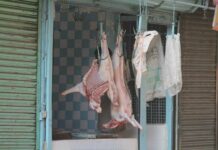
SRINAGAR: The Court of the Adjudicating Officer, Srinagar, has imposed a penalty of Rs 1.8 lakh on M/S Arif Enterprises, a meat trading firm, for selling misbranded chicken products in violation of the Food Safety and Standards Act (FSSA), 2006.
The case was initiated after a Food Safety Officer (Zone-V, Srinagar) carried out a surprise inspection at the firm’s premises at Bulbul Bagh Bund, near Tengpora Bridge, on August 11, 2025. Inspectors discovered 42 packets of packaged chicken stored in cold storage, with labels that omitted key information, including the use-by date, type of chicken (frozen or chilled), date of packing, and supplier details.
Officials said this was a direct breach of Section 26(1)(2)(ii) of the FSSA and the Food Safety and Standards (Labelling and Display) Regulations, 2020, which require that all pre-packaged food clearly state the name of the product, net quantity, manufacturer or importer details, and the FSSAI licence number.
Legal Provisions
The court imposed the penalty under Section 52 of the Act, which provides, “Any person who whether by himself or by any other person on his behalf manufactures for sale or stores or sells or distributes or imports any article of food for human consumption which is misbranded, shall be liable to a penalty which may be extended to Three Lakh Rupees.”
Court Proceedings
The case was first listed on August 23, 2025, when the defence sought time to respond. The court granted the request and adjourned proceedings to August 28. On resumption, however, the defence failed to provide any documentary evidence to counter the charges or to prove the source of the misbranded chicken.
The Department of Legal Metrology had already seized the consignment, which remains in custody. The court observed that the accused had been given “ample opportunity” to produce invoices or supplier details but had not done so.
Court’s Findings
In its order, the Adjudicating Officer made sharp observations about the risk posed to the public, stating, “Given the gravity of the offence supplying and selling rotten meat which poses a direct and severe threat to public health, a stringent penalty is warranted to act as a deterrent. They cannot take people for a ride. Supplying rotten meat for human consumption is not only unethical but it poses a grave threat to the health and lives of those who consume it.”
After reviewing the case, the court concluded that M/S Arif Enterprises had committed an offence under Section 52. While the maximum penalty under the provision is Rs 3 lakh, the court imposed a fine of Rs 1.8 lakh, amounting to 60 per cent of the maximum, citing the provisions of Sections 49 and 52.
Enforcement Measures
The accused firm has been directed to deposit the penalty into the designated Jammu and Kashmir Bank account of the Adjudicating Officer, Food Safety and Standards, Srinagar. The Food Safety Officer has also been ordered to keep the firm under close surveillance and to conduct surprise inspections to ensure future compliance.
Wider Food Safety Concerns
The judgment comes amid growing concerns over food safety in Kashmir. In recent years, authorities have uncovered several cases involving expired packaged goods, improperly stored dairy products, and adulterated cooking oil. Officials say non-compliance with labelling and storage norms not only undermines consumer rights but also endangers public health.
A senior officer from the Food Safety Department commented that proper labelling is “the first line of defence” for consumers. Without it, buyers are unable to judge quality, shelf life, or source, leaving them exposed to serious risks.
With Kashmir having one of the highest per capita meat consumption rates in the country, officials stress that proper packaging and cold storage practices are vital. Informal markets and non-compliance by traders, however, continue to make regulation a challenge.
Right to Appeal
While imposing the penalty, the court clarified that the accused has the right to appeal before the appellate tribunal if aggrieved.
This ruling is being seen as a clear signal that violations of food safety norms will not be tolerated and that penalties will be enforced to protect public health.