by Muhammad Nadeem
SRINAGAR: On a warm Wednesday summer evening in London, Sudanese-Scottish author Leila Aboulela stood at the heart of English PEN’s annual gathering at the October Gallery, her heart swelling with quiet disbelief. The announcement came: she had won the 2025 PEN Pinter Prize, a prestigious accolade celebrating her unflinching exploration of migration, faith, and the lives of Muslim women. Actors Khalid Abdalla and Amira Ghazalla read excerpts from her work, their voices weaving her stories into the air, as the room buzzed with admiration for a writer whose pen has carved a unique space in contemporary literature.
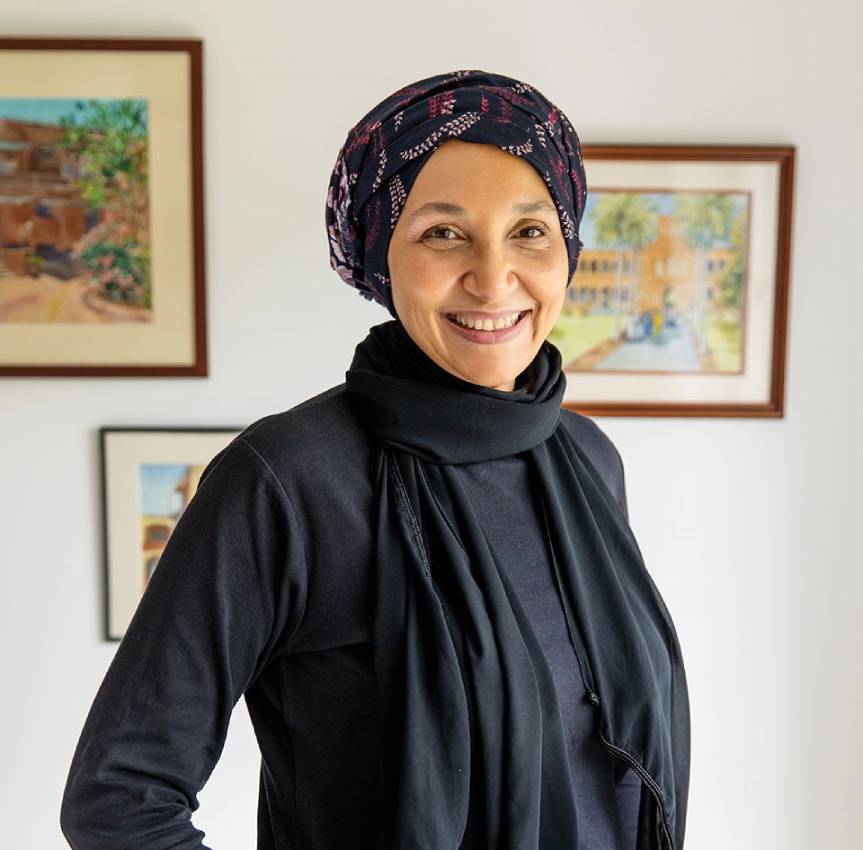
Leila-Aboulela-Honoured-with-PEN-Pinter-Prize
A Voice for the Unheard
Born in Cairo in 1964 to an Egyptian mother and Sudanese father, Aboulela grew up in Khartoum, Sudan, before moving to Aberdeen, Scotland, in 1990. Her writing, rooted in her experiences as a Muslim immigrant, probes the intersections of identity, spirituality, and displacement. The PEN Pinter Prize, established in 2009 to honour Nobel Laureate Harold Pinter, recognises writers who cast an “unflinching, unswerving” gaze on the world, reflecting a fierce commitment to truth. Aboulela’s work, spanning six novels and two short story collections, embodies this spirit, centring Muslim women navigating cultural and spiritual landscapes with grace and resilience.
The judging panel, comprising English PEN chair Ruth Borthwick, poet Mona Arshi, and novelist Nadifa Mohamed, praised Aboulela for her nuanced perspectives on faith, migration, and displacement. They described her writing as a balm and shelter, particularly resonant amid global crises in places like Sudan and Gaza. Borthwick noted that Aboulela’s stories, from delicate short fiction to expansive novels, give voice to those rarely heard, reshaping how communities are understood. Arshi highlighted the subtlety and courage in Aboulela’s portrayal of women often ignored in mainstream narratives, while Mohamed emphasised her commitment to making Muslim women’s lives and decisions central to her work.
A Literary Journey Rooted in Faith
Aboulela’s literary career began in 1992 while she worked as a lecturer and research assistant in Aberdeen, having earned degrees in Economics and Statistics from the University of Khartoum and an MSc and MPhil from the London School of Economics. Her debut novel, The Translator (1999), a semi-autobiographical tale, thrust her into the literary spotlight. It follows Sammar, a Sudanese widow in Aberdeen, whose intellectual connection with a Scottish Islamic scholar blossoms into love, only to be tested by their differing worldviews. Nobel Laureate J M Coetzee called it “a story of love and faith all the more moving for the restraint with which it is written.”
Her 2005 novel Minaret traces Najwa, a once-privileged Sudanese woman who, after a political coup, becomes a maid in London. Turning to Islam for solace, Najwa finds redemption and community in a mosque, her journey a poignant reflection on spiritual fulfilment. Aboulela has described the novel as a testament to a woman’s need for faith as much as love or career. Lyrics Alley (2010), set in 1950s Sudan, portrays a wealthy trading family grappling with tradition and modernity after the heir, Nur, is paralysed. The novel, which won the Scottish Book Awards, captures a nation on the cusp of independence.
River Spirit (2023) transports readers to 19th-century Sudan during the Mahdist uprising. Through the eyes of Akuany, an orphaned girl, and Yaseen, a Quranic scholar, the novel explores faith, colonialism, and resilience, bringing a turbulent historical period to life. Aboulela’s short story collection Elsewhere, Home also earned the Saltire Fiction Book of the Year Award, cementing her reputation as a master of both long and short forms.
A Moment of Recognition
The announcement of the PEN Pinter Prize left Aboulela overwhelmed. “This comes as a complete and utter surprise,” she said, her voice steady but heavy with emotion. She expressed gratitude to English PEN and the judges, noting the significance of the award for a Muslim Sudanese immigrant writing from a religious perspective. For her, the prize expands the meaning of freedom of expression, amplifying stories that might otherwise remain unheard. She also spoke of her honour in receiving an award tied to Harold Pinter, a writer whose legacy continues to inspire.
On 10 October 2025, Aboulela will formally accept the award at the British Library, where she will announce her choice for the Writer of Courage award, given to an author defending freedom of expression at great personal risk. Last year, Arundhati Roy, the 2024 recipient, selected imprisoned British-Egyptian activist Alaa Abd el-Fattah for this honour.
A Legacy of Impact
Aboulela’s accolades extend beyond the PEN Pinter Prize. She was the first winner of the Caine Prize for African Writing and has been longlisted three times for the Orange Prize (now the Women’s Prize for Fiction). Her works, translated into fifteen languages, include radio plays like The Insider and The Mystic Life for BBC Radio. As an Honorary Professor at the University of Aberdeen’s WORD Centre and a Fellow of the Royal Society of Literature, her influence spans academia and literary circles.
The judges’ words linger: Aboulela’s writing is not just a mirror to the world but a beacon for those navigating its complexities. Her stories, whether set in Khartoum’s bustling streets or Aberdeen’s quiet corners, bridge the global and local, the political and spiritual. As Mohamed put it, her work offers dignity to Muslim women’s struggles and joys, serving as an inspiration in a world marked by suffering. For readers new to her work, novels like The Translator, Minaret, Lyrics Alley, and River Spirit offer a profound entry into her world, where faith and identity intertwine with quiet power.