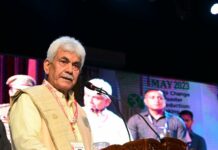
SRINAGAR: Lieutenant Governor Manoj Sinha on Tuesday called for making millets a people’s movement in Jammu and Kashmir, saying the traditional grains can help address malnutrition, lifestyle-related diseases and improve the economic prospects of marginal farmers.
Sinha was speaking at the concluding session of a two-day national seminar on ‘Millets for One Health’ at Lok Bhavan, Srinagar. The programme was organised in collaboration with Kheti Virasat Mission and brought together farmers, scientists, chefs, doctors, students and policymakers from across the country.
“Millets are climate-smart, nutrition-rich and farmer-friendly. I believe Jammu Kashmir can lead the way in making millets a people’s movement, strengthening farmers, empowering women and youth entrepreneurs, and ensuring healthier lives for all,” Sinha said.
He said millets such as jowar, bajra, ragi, kodo, kangni and kutki had sustained communities for centuries and argued that their revival could help address growing concerns over soil degradation, water stress and biodiversity loss.
“Several research studies show that millets require minimal water, thrive on rain-fed lands, need little or no chemical inputs and are highly nutritious, rich in fibre, iron, calcium and protein, with a low glycaemic index that helps combat lifestyle diseases such as diabetes,” he said.
Sinha said Jammu and Kashmir needed to develop an ecosystem covering seed diversity, crop diversification, farmer training, processing, value addition and millet-based food products.
He urged stakeholders to move beyond seminars and take millet initiatives to farms and markets.
“Now, we must move beyond seminars to the field and the market. Initiatives such as processing, value addition, chef training, ‘from grain to plate’ programmes, and women’s home-based millet-cuisine campaigns must be transformed into a people’s movement,” he said.
The Lieutenant Governor also highlighted the role of millets in building climate-resilient agriculture, particularly amid changing weather patterns and increasing pressure on water resources.
He called for sustained efforts by government departments, agricultural experts, chefs, farmers and the media to promote millets as part of everyday diets and encourage wider cultivation and consumption of the crops.
Sinha said farmers’ prosperity and environmental conservation could go together, describing millets as an opportunity to promote a more sustainable and inclusive agricultural system in Jammu and Kashmir.
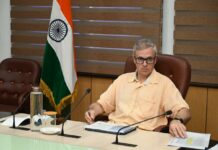
Chief Justice of the High Court of Jammu and Kashmir and Ladakh Justice Pushpendra Singh Bhati, Chief Minister Omar Abdullah, Padma Shri awardee and food scientist Khadar Veli, Chief Secretary Atal Dulloo, DGP Nalin Prabhat and Kheti Virasat Mission Executive Director Umendra Dutt were among those present at the event.
Judges of the High Court, ministers, legislators, Padma Shri awardees, heads of educational institutions, social activists, civil society members, senior officials and other participants also attended the programme.
A millet-based dinner was organised after the event, showcasing dishes prepared from traditional grains.