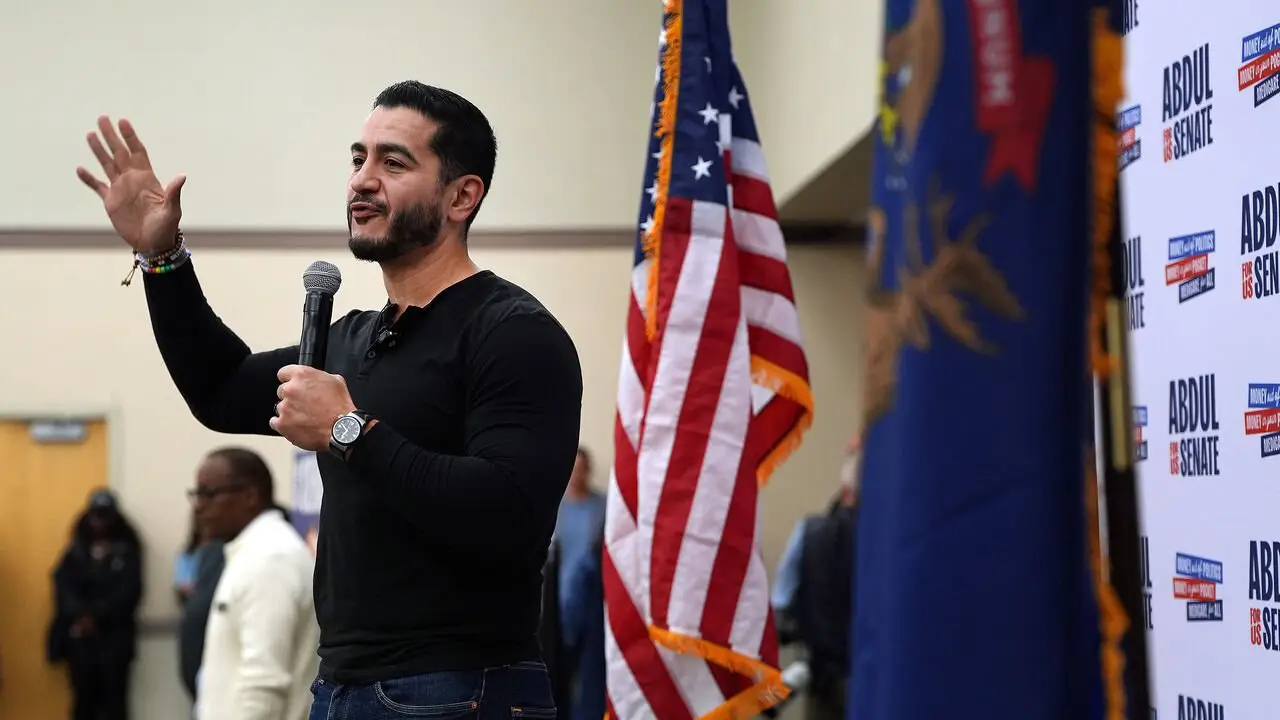
SRINAGAR: The 2026 US midterm elections have produced a historic breakthrough for Muslim political representation, with at least seven Muslim lawmakers winning seats in Congress, including Abdul El-Sayed, who has become the first Muslim elected to the United States Senate.
The election has also fundamentally altered the political balance in Washington, with the Democratic Party wresting control of both the Senate and the House of Representatives from President Donald Trump’s Republican Party in what is being described as a sweeping electoral rebuke to his presidency.
The results represent a significant moment for Muslim Americans, whose political participation and representation have increasingly become part of the national debate, particularly amid heightened Islamophobic rhetoric, immigration controversies and divisions over Washington’s military and diplomatic support for Israel.
The victories have come despite campaigns in which religion, Muslim identity and positions on the war in Gaza became contentious political issues. Several Muslim candidates made Palestinian rights, humanitarian assistance, civil liberties and restrictions on American military assistance to Israel central elements of their campaigns.
First Muslim Senator
The biggest milestone for Muslim representation came from Michigan, where 42-year-old Democrat Abdul El-Sayed defeated Republican Mike Rogers in the closely contested Senate election.
El-Sayed, an Egyptian-American physician and former public health administrator, becomes the first Muslim ever elected to the US Senate.
His victory is particularly significant because the campaign was marked by repeated attacks on his religious identity and political positions. President Donald Trump and other Republican figures questioned his political loyalties and sought to associate him with Islamic extremism, allegations for which no supporting evidence was presented.
Trump also made disparaging references to El-Sayed’s name and Muslim identity. The candidate, however, refused to allow the controversy to dominate his campaign, repeatedly arguing that voters were more concerned about the cost of living, healthcare, employment and the direction of the American economy.
El-Sayed campaigned on an ambitious progressive platform that included universal healthcare through Medicare for All, reducing housing costs, limiting corporate influence in politics and improving economic opportunities for working families.
His foreign policy position also distinguished him from several mainstream Democratic politicians. He criticised unconditional American military assistance to Israel, described its military operations in Gaza as genocide and demanded that American taxpayers’ money not be used to support violations of Palestinian rights.
His victory came after an unusually bitter Democratic primary in August, when he defeated Congresswoman Haley Stevens. Stevens subsequently endorsed Republican Mike Rogers shortly before the general election, citing disagreements with El-Sayed’s positions and political associations.
The endorsement did not prevent him from winning the seat vacated by retiring Democratic Senator Gary Peters.
El-Sayed’s victory was also celebrated by progressive political figures, including Senator Bernie Sanders, who had supported his campaign.
In his victory speech, El-Sayed referred to the religious expressions he had regularly used during the campaign, saying that the time had come to replace inshallah (God willing) with alhamdulillah (praise be to God).
He also directly addressed Trump and Vice-President JD Vance, turning the attacks on his name into a moment of political defiance.
A Karnataka Connection
El-Sayed’s victory has attracted particular interest in India because his wife, Dr Sarah Jukaku, belongs to a family with roots in Bhatkal, a coastal town in Karnataka’s Uttara Kannada district.
Sarah’s grandfather, JH Shamsuddin Jukaku, was a prominent lawyer, educationist and politician who served as deputy minister for finance in the erstwhile Mysore State government under Chief Minister BD Jatti in the 1950s.
Shamsuddin was also associated with the educational and social development of Bhatkal and belonged to the Nawayath Muslim community.
Sarah’s father, Dr Jukaku S Tayeb, is a nephrologist who moved to the United States after completing his medical education in India.
Sarah met El-Sayed while studying at the University of Michigan. The couple married in 2006 and have two daughters.
A practising psychiatrist, Sarah was actively involved in her husband’s election campaign.
El-Sayed has occasionally spoken humorously about his association with his wife’s South Indian family, saying that after nearly two decades of marriage he might have become more Indian than Arab.
His election has therefore brought international attention to a family whose roots lie in a small coastal town in Karnataka.
Seven Muslim Lawmakers
The Muslim victories extend beyond the Senate. At least seven Muslim lawmakers have secured seats in the two chambers of Congress, combining three significant new victories with four successful re-election campaigns.
Among the newly elected lawmakers is Adam Hamawy, a 56-year-old Democrat who defeated Republican Gregg Mele in New Jersey’s 12th Congressional District, becoming the first Muslim elected to represent New Jersey in Congress.
A plastic surgeon, retired US Army combat physician and Iraq War veteran, Hamawy volunteered at the European Hospital in Gaza in 2024. His campaign focused on universal healthcare, cancellation of medical and student debt, immigration reform and ending American military assistance to Israel.
Another significant victory came in New York, where Darializa Avila Chevalier, a civil rights investigator, doctoral student and convert to Islam, secured a House seat after defeating long-serving Democratic Congressman Adriano Espaillat in the party primary in June.
She secured more than 85 per cent of the vote in the general election. Her campaign emphasised community organising, civil rights and Palestinian rights.
Four Lawmakers Relected
Palestinian-American Democrat Rashida Tlaib won a fifth term representing Michigan’s 12th Congressional District. She remains the only Palestinian-American member of Congress and has consistently advocated Palestinian self-determination, civilian protection and restrictions on arms transfers that could facilitate violations of international law.
Ilhan Omar, the Somali-American Democrat representing Minnesota’s 5th Congressional District, also secured a fifth term. Omar, who arrived in the United States at the age of 12, became the first Somali-American federal lawmaker when she entered Congress in 2019. She has been a prominent advocate of humanitarian assistance and oversight of American military support abroad.
Andre Carson retained his Indianapolis-based 7th Congressional District seat in Indiana. Having served in Congress since 2008, he is the longest-serving Muslim member of the House of Representatives.
Lateefah Simon, meanwhile, retained her East Bay congressional seat in California’s 12th District. Her political advocacy has included civil rights and opposition to offensive American arms deliveries.
Muslim candidate Aisha Wahab was also maintaining an early lead in another California congressional contest as vote counting continued. Her race was not included in the confirmed tally of seven.
The combined victories are significant because Muslim representation is no longer confined to a handful of congressional districts. With El-Sayed entering the Senate and Hamawy and Chevalier joining the House, Muslim Americans will have a broader presence in the national legislature.
It is also important to recognise that Muslim identity does not automatically translate into a common political position. The lawmakers come from different backgrounds and represent different constituencies, although several have made civil rights, healthcare, humanitarian issues and Palestinian rights prominent parts of their political work.
Democrats Sweep Chambers
The Muslim political gains took place against the backdrop of an extraordinary Democratic electoral performance.
The Democrats won control of both chambers of Congress, ending the Republican hold over the legislature and handing Trump one of the most consequential electoral setbacks of his second presidency.
The victories were particularly striking because several traditionally Republican states swung towards Democratic candidates.
In Texas, Democrat James Talarico won the Senate race, ending a decades-long Democratic losing streak in the state. Democrat Gina Hinojosa also won the governorship, becoming Texas’s first Latina governor.
Kansas elected Democrat Adam Hamilton to the Senate, giving the state its first Democratic senator since 1932. In Maine, Democrat Troy Jackson defeated Republican Senator Susan Collins, ending her three-decade tenure in the Senate. Democrats also registered major victories in Ohio, Iowa, South Carolina and other traditionally Republican territories.
In Georgia, Democrat Keisha Lance Bottoms won the governorship, becoming the first Black woman elected governor of a US state and ending more than two decades of Republican control of the office.
Democrats also made substantial gains in the House, flipping more than two dozen Republican-held seats and securing the majority.
The results were particularly damaging for Trump because several candidates personally backed by him failed to win their contests.
Historic Victories
The 2026 elections also produced several other milestones in American political history.
Keisha Lance Bottoms became the first Black woman elected governor of a US state through her victory in Georgia.
Democrat Chris Pappas won the Senate race in New Hampshire, becoming the first openly gay man elected to the upper chamber. He had previously served in the House of Representatives.
In New Mexico, Democrat Deb Haaland became the first Native American woman elected governor. She had earlier served as US Secretary of the Interior under President Joe Biden.
Minnesota Democrat Peggy Flanagan also became the first Native American woman elected to the US Senate.
In Florida, Republican Byron Donalds won the governorship, becoming the state’s first Black governor.
The victories reflect a broader diversification of political representation, with women and candidates from minority communities making substantial advances in national and state-level politics.
Why Trump Lost?
The Republican defeat cannot be explained simply by the emergence of minority candidates or Muslim political representation. The larger story is a widespread voter backlash against the Trump administration.
The economy was among the biggest concerns for American voters. High prices, fuel costs, inflation and the financial pressures facing ordinary households became central campaign issues. Democrats successfully turned economic dissatisfaction into a campaign against the administration’s policies.
The US-Israel war with Iran also emerged as a major political liability for Trump. The conflict affected fuel prices and intensified concerns about the economic consequences of American military involvement abroad. Republicans struggled to convince voters that the administration’s foreign policy decisions were consistent with its promises to prioritise domestic economic concerns.
The elections also became a referendum on Trump’s second presidency. His personal involvement in Republican campaigns, endorsement of candidates and confrontational political rhetoric did not translate into electoral success.
Democrats benefited from strong turnout among their traditional supporters and independent voters, while Republicans experienced losses among several demographic groups that had contributed to Trump’s 2024 victory.
The results suggest that the Republican defeat was not merely a series of isolated local setbacks but a broader political shift, extending into territories that had comfortably supported Trump in the presidential election two years earlier.
Who Gains Power?
The most immediate beneficiary is the Democratic Party. Its control of both chambers gives it considerable influence over the remainder of Trump’s presidency.
The Republicans, meanwhile, have lost their legislative advantage and will find it considerably harder to advance the administration’s priorities through Congress.
For Trump, his ability to push legislation through Congress will be severely restricted. Democrats can block or delay legislative proposals, scrutinise his administration and demand accountability through congressional investigations.
For the Democrats, the victory gives them control of the legislative agenda and the opportunity to investigate administration policies, challenge executive decisions and influence national debates on immigration, healthcare, taxation and foreign policy.
For Muslim Americans, the election has delivered an important breakthrough in political representation. A Muslim in the Senate, alongside several Muslim representatives in the House, provides the community with a stronger institutional presence in Washington.
The implications for Palestine could also be significant. The election may strengthen congressional scrutiny of American military assistance to Israel. Several newly elected and returning Democrats have called for restrictions on arms transfers and greater accountability over civilian casualties. However, the election does not automatically mean a change in US policy towards Israel.
For American foreign policy, a Democratic-controlled Congress could put pressure on the administration over the wars involving Iran and other international conflicts, although the president retains substantial authority over foreign policy.
There are, however, constitutional limitations to the Democrats’ new power. Trump remains President, retains veto authority and can continue to exercise executive powers. Congress can pass legislation, but overriding a presidential veto requires a two-thirds majority in both chambers.
The Democrats’ victory therefore establishes a period of divided government rather than transferring control of the executive branch.
A New Political Landscape
The 2026 midterms have consequently produced two overlapping political stories.
One is the defeat of Republicans and the emergence of a Democratic-controlled Congress that can constrain Trump’s legislative agenda for the remainder of his presidency.
The other is the expansion of political representation for communities that have historically remained underrepresented in America’s national institutions.
For Muslim Americans, the election of the country’s first Muslim senator is particularly consequential. El-Sayed’s victory, alongside the success of Hamawy, Chevalier, Tlaib, Omar, Carson and Simon, marks a new stage in their participation in American electoral politics.
But the larger test begins when the newly elected lawmakers take office in January.
Their ability to translate electoral victories into legislation, oversight and changes in public policy will determine whether this historic representation also produces tangible political gains.
For Trump, meanwhile, the message from the electorate is unmistakable: the remaining two years of his presidency will be politically far more difficult than the first two.