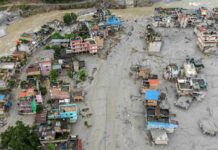
SRINAGAR: At least 40 people were killed and dozens injured after a magnitude 7.7 earthquake struck off Indonesia’s Flores island early Saturday, collapsing buildings, triggering landslides and sending residents fleeing to safer areas.
The shallow earthquake struck at around 5:58 am local time, with the epicentre located about 68 kilometres north-northwest of Ende in East Nusa Tenggara province, according to the US Geological Survey.
The quake was followed by around 235 aftershocks by Saturday afternoon, with the strongest measuring up to magnitude 6.2, Indonesia’s meteorological agency said.
Authorities initially issued a tsunami warning for parts of East Nusa Tenggara, West Nusa Tenggara, South Sulawesi and Southeast Sulawesi and urged people to move away from beaches and riverbanks.
The warning was later lifted after monitoring showed no significant sea-level changes posing a wider threat to coastal communities.
However, tsunami waves were recorded along parts of the Flores coast, with waves reaching up to 1.61 metres in Manggarai and East Manggarai regencies. Waves measuring around 0.94 metres were also recorded in Maurole in Ende Regency.
Videos showed a coastal village in East Manggarai covered in mud and debris after the tsunami waves receded. Fishing boats were left stranded ashore, while homes and infrastructure were damaged.
Waves exceeding 0.5 metres were also detected in Bulukumba in South Sulawesi and Sape in Bima Regency.
East Nusa Tenggara Police Chief Rudi Darmoko said the earthquake caused severe damage and collapsed buildings in several areas. Power outages and communication disruptions have hampered efforts to assess the full extent of the damage.
Landslides triggered by the earthquake also blocked parts of the Trans-Flores highway, a roughly 700-kilometre road stretching across Flores island from Labuan Bajo to Larantuka.
National Search and Rescue Agency chief Fathur Rahman said rescuers had recovered at least 40 bodies, mostly from Sikka, Manggarai and East Manggarai regencies. Around 50 injured people were taken to hospitals.
More than 2,000 residents in Nagekeo regency fled their homes and moved to temporary shelters, officials said.
The death toll could rise as landslides have buried or cut off several remote villages across six regencies on Flores island. Some villages were reportedly completely buried, while damaged roads and a lack of heavy equipment have slowed rescue operations.
Three helicopters and a rescue vessel were deployed to support rescue and relief operations, including possible evacuations from areas difficult to reach by road.
The earthquake was felt across much of Flores, with residents rushing out of homes and buildings as the ground shook.
Yohanna Embu, a resident of Sikka regency, said several buildings were damaged and people ran towards higher ground.
She said the waiting room at the port terminal in Maumere had collapsed.
At St Peter Major Seminary in Sikka, students attending morning Mass fled in panic after the roof of an assembly hall collapsed.
Seminary rector Rev Guidelbertus Tanga said one priest suffered a broken leg after jumping from the second floor of a building during the earthquake.
The quake also caused panic in Labuan Bajo, a gateway to Indonesia’s Komodo National Park. Damage was also reported in Bima in neighbouring West Nusa Tenggara province and parts of southern Sulawesi.
Indonesia, an archipelago of more than 17,000 islands, is highly vulnerable to earthquakes and volcanic activity because it lies along the Pacific “Ring of Fire”, an area marked by active fault lines and volcanoes.
Flores has witnessed devastating earthquakes and tsunamis in the past. A powerful earthquake and tsunami struck the island in 1992, killing around 2,500 people. In 2018, a magnitude 7.5 earthquake triggered a major tsunami and other disasters in Indonesia, killing more than 4,400 people.
In December 2004, a magnitude 9.1 earthquake off Sumatra triggered a massive Indian Ocean tsunami that killed around 230,000 people across a dozen countries.