SRINAGAR: The Jammu and Kashmir Government has said the historic Chinar tree at Chattergam in Budgam district is around 650 years old and is considered the oldest Chinar tree in Asia.
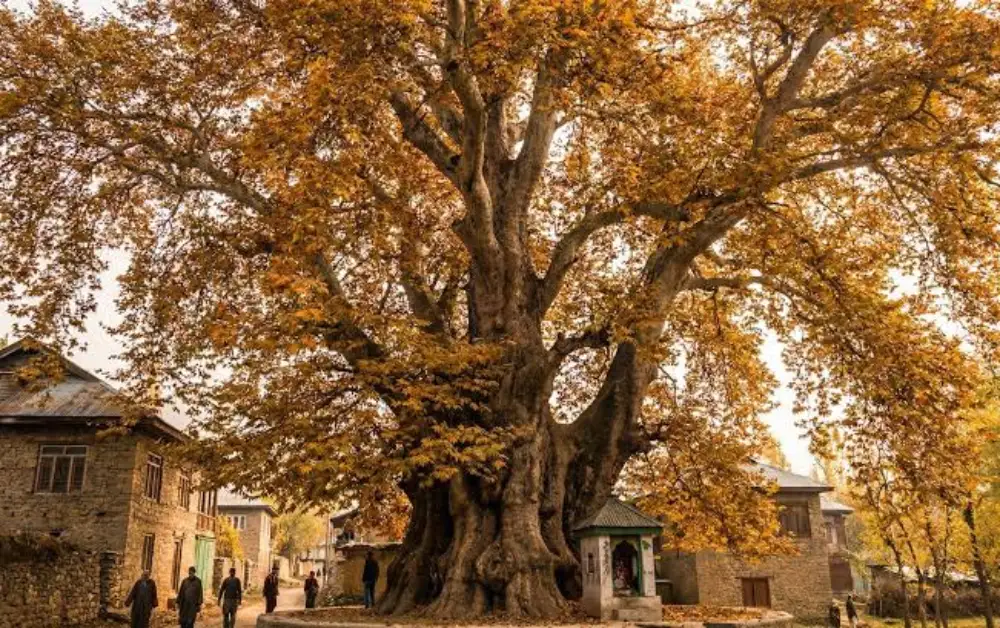
The government provided the information in response to a question raised by Budgam MLA Aga Syed Muntazir Mehdi on the condition and preservation of the centuries-old tree.
The Minister in charge of the Forest, Ecology and Environment Department said some old and dried branches had fallen naturally, while the remaining portion of the tree continued to remain green.
Several measures have been taken to protect the tree, including installation of an iron fence around its critical root zone to prevent soil compaction and root suffocation and restrict vehicular movement near the roots, the government said.
The government attributed the decline in Chinar numbers across Kashmir to natural ageing of old trees, diseases and pest attacks, as well as felling linked to developmental activities. Shrinking land availability and population growth were also cited as factors affecting the survival of the species.
Under existing rules, no person can cut even a branch of a Chinar without prior permission from the local administration. Activities including driving nails into trees, fixing signboards, carving on bark and damaging the bark or roots are also prohibited.
The Department of Floriculture, Gardens and Parks undertakes annual Chinar plantations to replenish damaged or pruned trees. Government offices, private institutions and the public are also encouraged to plant Chinars, with saplings provided free of cost.
The government said the Floriculture Department had planted 709 Chinar saplings over the past three years in gardens and parks maintained by it. A further 7,134 saplings were distributed free of cost to members of the public, educational institutions, security installations and other stakeholders across Kashmir division.
Where permission is granted to prune a Chinar branch, the department recommends treating the cut portion with lime or Chaubatia pruning paste to protect the tree from infection and further deterioration, the government said.
The Jammu and Kashmir Forest Research Institute (JKFRI) has also conducted a survey-based census of Chinar trees across Kashmir. Around 30,000 trees have been surveyed so far, excluding those located within security campuses and installations.
Permission for pruning or cutting Chinars is issued by the offices of the District Development Commissioners or the Revenue Department in accordance with the applicable procedure, the government said.
In Budgam, 70 orders were issued by the competent authority during the past three years for lopping dried or hazardous Chinar branches. During the same period, 161 applications seeking permission to prune such branches were received, of which 130 cases were disposed of after technical opinions were obtained and provided.
The government said the measures were aimed at protecting existing Chinar trees while expanding plantation to support the long-term conservation of the species in Kashmir.