SRINAGAR: The Union Government has said that a direct train service between Jammu and Srinagar will be operationally feasible only after ongoing station development works at Jammu Tawi and related security clearances are completed. The clarification came in the Rajya Sabha in response to a question on whether a dedicated Jammu–Srinagar train was being planned to meet rising passenger demand on the corridor.
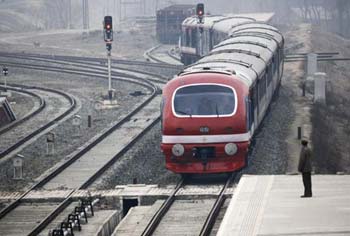
Railways Minister Ashwini Vaishnaw informed the House that the Udhampur–Srinagar–Baramulla Rail Link (USBRL), the country’s most challenging post-Independence railway project, has already been fully commissioned, formally linking the Kashmir Valley to the national rail network. With this, the entire 272-kilometre line across Udhampur, Reasi, Ramban, Srinagar, Anantnag, Pulwama, Budgam and Baramulla is now in operation.
Despite the commissioning of the line, the Minister did not announce an immediate direct service between Jammu and Srinagar. He stated that extending Vande Bharat services up to Jammu Tawi would become possible only after the ongoing infrastructural enhancement at the station is completed and the required security Standard Operating Procedures are finalised. Until then, passengers travelling between Jammu and the Valley will continue to depend on services routed through Katra or the Valley’s MEMU/DEMU network.
The reply placed on record the scale and difficulty of the USBRL project, emphasising that the line cuts through some of the most geologically unstable stretches of the young Himalayas. The project includes the world’s highest railway bridge over the Chenab in Reasi, standing 359 metres above the riverbed with a 467-metre steel arch span. The Anji Khad bridge, India’s first cable-stayed railway bridge, also forms part of this corridor, with its deck rising 331 metres above the riverbed.
The Minister noted that the project has required more than 215 kilometres of approach roads, including a tunnel and 320 small bridges, dramatically improving mobility for communities across the Pir Panjal. This infrastructure, he said, has contributed to socio-economic changes, generated local employment, and supported the movement of goods.
Following the commissioning, Indian Railways has started four Vande Bharat services between Katra and Srinagar. In addition, six pairs of DEMU/MEMU services operate on the Qazigund–Srinagar stretch, and five pairs run between Srinagar and Baramulla. These services have boosted tourism and enabled easier movement of commodities such as cement into the Valley while helping apple farmers ship produce to markets across India.
However, the absence of a dedicated Jammu–Srinagar service remains a gap in the new rail era of Jammu and Kashmir, especially given the high passenger volume between the two regional capitals. The Government’s statement indicates that the first leg of such a service may emerge through the extension of Vande Bharat trains to Jammu Tawi once the station’s redevelopment and security preparations are complete.
For now, the Government has not given a firm timeline, making the completion of the Jammu station upgrade the decisive factor in the launch of the long-anticipated direct Jammu–Srinagar train.