by Humaira Nabi
SRINAGAR: Each month, more than 13 lakh banking transactions are carried out not just inside bank branches or service counters, but in rice fields, apple orchards, village squares, and on the doorsteps of elderly pensioners across Jammu and Kashmir. The quiet architects of this revolution are the Business Correspondents of Jammu and Kashmir Bank, locally known as Khidmat Centres, who have turned traditional banking on its head with a hyper-local, deeply humanised approach.
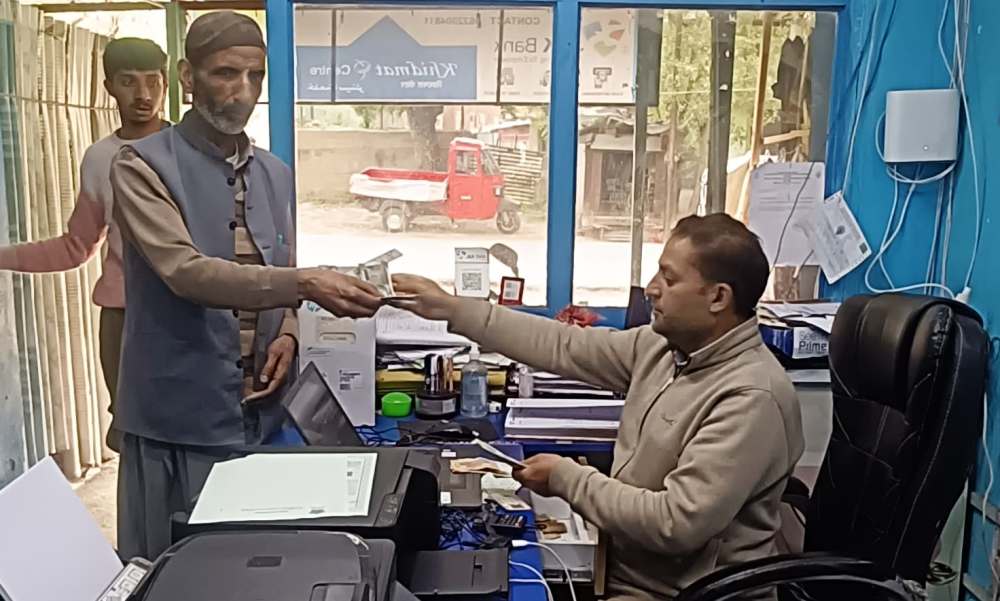
At nearly 2,000 strong, the Khidmat Centre network today stands as the largest branded, IT-enabled financial services system in Jammu and Kashmir. Collectively handling over Rs 1,000 crore in monthly transactions and facilitating the opening of around 5,000 new accounts each month, this network is redefining both access and agency for the unbanked and under-banked populations of the region.
But what truly sets it apart is its reach beyond fixed locations. Khidmat operators don’t just wait behind desks. In a landscape where the next village may lie beyond a hill or across a snow-covered trail, they move. Whether it’s a call from a frail elderly man in a distant hamlet or a group of farm workers needing a payment update right in the middle of a rice field, the Business Correspondents arrive, with their handheld devices, biometric kits, and quiet professionalism.
“It’s not uncommon to see them conducting transactions under a walnut tree or inside an orchard,” says a farmer from Sopore. “You call them, and they come, even if you’re in the middle of your work.”
Manned by local well-read youth, trained and authorised under the Reserve Bank of India’s Business Correspondent framework, each Khidmat Centre delivers nearly 40 types of services, ranging from basic cash deposits and withdrawals to Aadhaar-enabled payments, pension disbursals, and digital transfers. Using the Aadhaar Enabled Payment System (AEPS) developed by NPCI, these operators now offer services with just a fingerprint and an Aadhaar number.
For Jammu and Kashmir Bank, this model has been a breakthrough. By shifting routine banking activity to these decentralised, community-rooted centres, the bank has not only decongested its branches but also extended its reach to areas previously considered financially inaccessible.
“Our goal was never just convenience, it was inclusion,” says a senior official at JK Bank. “And inclusion has to meet people where they are, literally.”
The numbers speak volumes. Thirteen lakh transactions monthly. Five thousand new account holders every month. Over Rs 1,000 crore coursing through a rural financial bloodstream. Yet, the true power of this model lies in what cannot be easily counted: the grandmother who no longer has to walk miles to withdraw her pension, the young apple grower who sends money to his university-going sibling, the widowed woman who now receives her government benefits directly in her village.
These BCs are paid 0.5 per cent for every transaction, including credit as well as deposit. They have a set commission for interbank and intra-bank transfers as well. In April, one official said the JK Bank paid Rs 2.50 crore as commission to 1280 Business Correspondents.

Equipped with laptops and handheld machines, the Khidmat operators are now being upgraded to a smart, all-in-one tablet device that merges micro-ATM functionality, biometric verification, a thermal printer, speaker-based transaction alerts, and a custom Android application, effectively giving them the power of a mini-branch in their backpacks.
This fusion of technology and trust has turned many Khidmat Centres into informal community hubs. They offer not just banking services but also advice, support, and even reassurance to those unfamiliar with the formalities of banking. “They read the slips for me, explain things slowly, and never make me feel small,” says a non-literate woman in Kulgam who now regularly uses the centre in her village.
In a region as complex and geographically challenging as Jammu and Kashmir, banking has never been just about brick-and-mortar. It is about presence, empathy, and mobility. And in that regard, the Khidmat Centre network is a resounding success.
As they crisscross paddy fields, step across icy roads, or pause under orchard canopies to process a withdrawal, these Business Correspondents are not just extending banking; they are building a bridge between technology and trust, between policy and people.
For thousands across the region, they are not just banking agents. They are neighbours, helpers, and in many cases, lifelines. What began as a service experiment is now a flagship success. And for thousands of families across Jammu and Kashmir, Khidmat Centres are more than just banking counters; they are gateways to financial dignity and security. In a region where accessibility has always been a challenge, Khidmat Centres are quietly scripting a success story of dignity, inclusion, and local empowerment, one transaction at a time.