SRINAGAR: Referencing community-led reform in Sheikhgund village of Anantnag, Kashmir, Prime Minister Narendra Modi on Sunday highlighted how collective resolve can tackle deep-rooted social challenges, as he addressed the nation in the 130th episode of Mann Ki Baat, his first radio programme of 2026. Citing the village’s successful campaign against drugs and tobacco, the Prime Minister said the strength of family and society, when united, can overcome even the most complex problems.
The Prime Minister recalled how residents of Sheikhgund, led by a local citizen, mobilised across generations to curb substance abuse, leading to shops voluntarily discontinuing the sale of tobacco products and significantly raising awareness about addiction. The initiative, he said, exemplified the spirit of social responsibility that defines India’s grassroots strength.
Opening the address on the eve of India’s 77th Republic Day, the Prime Minister paid homage to the framers of the Constitution and underlined the significance of January 25 as National Voters’ Day. Describing the voter as the “soul of democracy”, he urged families and communities to celebrate first-time voters with the same enthusiasm as birthdays, to deepen democratic awareness among the youth.
He lauded election officials and grassroots workers for safeguarding India’s democratic processes and appealed to young citizens to register as voters immediately upon turning 18, calling it both a constitutional duty and a civic milestone.
Reflecting on a decade of Start-up India, launched in January 2016, the Prime Minister said India has today emerged as the world’s third-largest start-up ecosystem. He credited young innovators for venturing beyond comfort zones and driving breakthroughs across sectors ranging from artificial intelligence, space and semiconductors to green hydrogen, biotechnology and nuclear energy.
He saluted India’s start-up founders and aspirants, noting that innovations once considered unimaginable are now shaping global conversations.
With the world closely watching India’s economic rise, the Prime Minister made a strong pitch for quality as a national mission. Declaring the era of compromise over, he urged industries, manufacturers and start-ups to adopt “quality, quality and only quality” as their guiding principle.
Invoking the vision of ‘Zero Defect, Zero Effect’, he said uncompromising excellence across products, from textiles and electronics to packaging, was essential to accelerating India’s journey towards a Viksit Bharat.
The address showcased multiple examples of community-led environmental revival. In Azamgarh, Uttar Pradesh, citizens restored the polluted Tamsa River through cleaning drives and plantation efforts, reclaiming a vital cultural and spiritual lifeline. Similarly, in drought-prone Anantapur, Andhra Pradesh, local participation under the Ananta Neeru Sanrakshanam Project led to the revival of over ten reservoirs and the plantation of more than 7,000 trees, rejuvenating the local ecosystem.
The Prime Minister observed a new cultural trend among India’s youth—“bhajan clubbing”—where devotional music is presented in contemporary concert-style formats without diluting its spiritual core. He described it as a harmonious blend of tradition and modern expression, particularly popular among Gen Z.
He also highlighted the global spread of Indian culture, praising the Indian diaspora in Malaysia for preserving linguistic and cultural heritage. Noting the presence of over 500 Tamil schools there, he cited the Malaysia India Heritage Society’s ‘Lal Paad Saree’ heritage walk, which recently set a national record and celebrated Bengal’s cultural legacy.
From Chandanki village in Gujarat, where a community kitchen has fed an entire village for 15 years, to global recognition of family systems, the Prime Minister underscored India’s tradition of collective living. He also referenced the UAE’s decision to mark 2026 as the ‘Year of the Family’, calling it a commendable initiative.
Highlighting youth-led cleanliness drives, the Prime Minister praised initiatives in Arunachal Pradesh, where young volunteers removed over 11 lakh kilograms of garbage, as well as similar efforts in Assam, Bengaluru and Chennai focused on waste management and recycling.
He drew attention to individual environmental champions, including Benoy Das of Cooch Behar, who has planted thousands of trees single-handedly, and Jagdish Prasad Ahirwar of Madhya Pradesh, whose documentation of medicinal plants has now been published as an official reference.
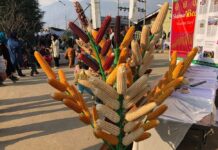
Reiterating the importance of Shree Anna (millets), the Prime Minister said the momentum generated during the International Year of Millets in 2023 continues to grow. He cited women farmers in Tamil Nadu’s Kallakurichi district and millet innovators in Rajasthan’s Ramsar as examples of how value addition is boosting farmer incomes and nutrition.
He welcomed the growing practice of offering millet-based prasad in temples, calling millets a “superfood” vital for both health and sustainability.
Concluding the address, the Prime Minister announced that India will host the India AI Impact Summit in February, bringing together global technology experts and showcasing India’s advancements in artificial intelligence.
Extending Republic Day greetings to the nation, he said future episodes of Mann Ki Baat would continue to celebrate the achievements and collective spirit of the people of India.