SRINAGAR: A coffee-table book celebrating Kashmir’s saints, sages and historic poets through evocative photography and English translations of their verses was launched by Asmat Ashai, founder of Funkar International, at a Srinagar hotel over the weekend. The event also featured a musical component, complementing the book’s celebration of Kashmir’s rich spiritual and cultural traditions.
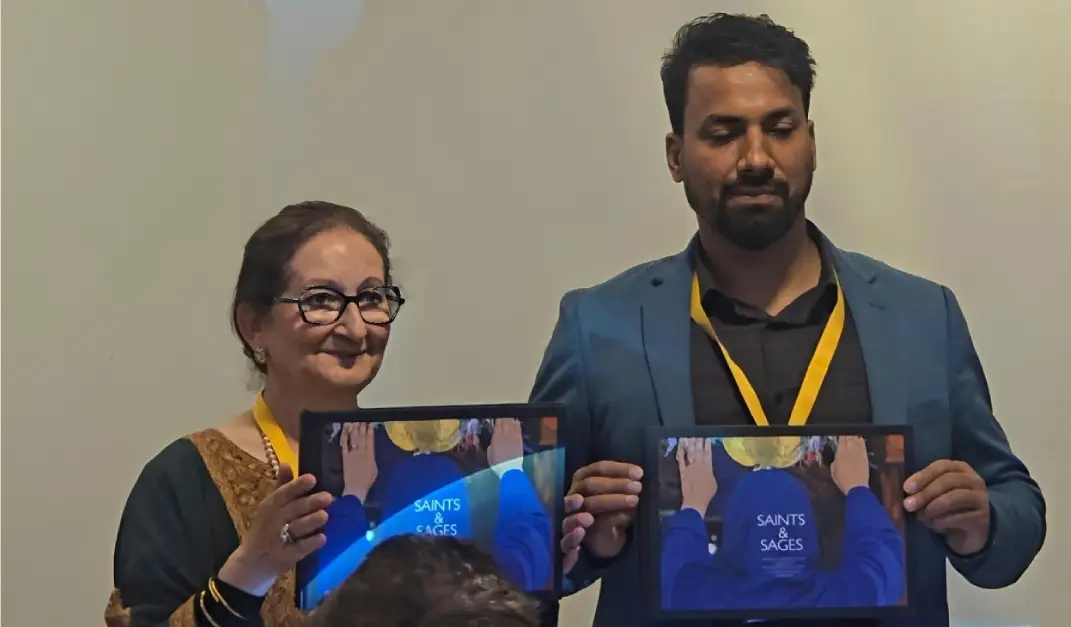
Titled Saints and Sages, the book combines photographs of shrines and symbols of devotion with poetic expressions drawn from the works of some of the Valley’s most revered spiritual figures and literary voices. Conceived by Ashai, it seeks to introduce a new generation of readers to Kashmir’s spiritual inheritance through a visual and poetic experience.
Rouf Khanday, a photographer from Bamno village in Pulwama district, captured the images, while Onaiza Drabu edited the book and Sana Shah designed it. The poetry has been rendered into English by Asiya Zahoor, Muneeb Haroon, Zahoor Zahid and Salik Basharat, making the verses accessible to readers beyond the Kashmiri-speaking world.
The book features figures from different periods of Kashmir’s history, including Lal Ded (1320-1373), Sheikh Noor-ud-Din Wali (1377-1438), Mahmood Gami (1765-1855), Nyam Saeb (1775-1865), Soch Kral (1775-1855), Wahab Khar (1812-1912), Shamas Faqir (1843-1901), Samad Mir (1893-1959) and Mahjoor (1887-1952). Photographs are from a number of shrines spread across Kashmir.
Through photographs of shrines, sacred spaces and objects associated with devotion, the publication documents the enduring relationship between Kashmir’s people and their spiritual traditions. The accompanying verses offer glimpses into the ideas of love, humility, faith and human experience that have shaped the Valley’s cultural imagination across generations.
Ashai said the project was driven partly by the need to make Kashmir’s spiritual and literary heritage more accessible to younger audiences, who may not always have the time or opportunity to engage with extensive literary works.
“The idea was to offer evocative photography, meditation and thought through a coffee-table book,” Ashai said, explaining that the combination of images and selected poetic passages could encourage readers to explore the original works more deeply.
She described the photographs as central to the project, bringing the poetry and the spiritual settings associated with it to life. The intention, she said, was not to provide an exhaustive interpretation of Kashmir’s spiritual traditions but to create an entry point for those interested in discovering them.
In her introductory note, Ashai writes that Kashmir’s spiritual inheritance transcends any single tradition or period, flowing across centuries through a shared language of devotion, humility and love.
The book, she explains, is neither an intellectual commentary nor a definitive account of spiritual lineages. Instead, it is an invitation to pause, look and feel. The photographs capture devotion as it exists today, while the verses preserve the continuing resonance of the words spoken by saints and sages long ago.
Ashai likens the publication to Ope Tsope, the Kashmiri expression associated with a child’s first taste of solid food, a moment intended to awaken the senses rather than satisfy hunger. In the same spirit, she presents the book as a beginning, intended to inspire readers to listen more closely, read more deeply and explore the wisdom contained in Kashmir’s literary and spiritual traditions.
Funkar International, which Ashai founded around 25 years ago, has also worked to document and disseminate Kashmir’s musical heritage. Ashai said the organisation has produced 12 digital audio CDs of Kashmiri music, featuring the work of prominent singers including Raj Begum and Naseem Begum. The recordings have since been uploaded to Spotify and other digital music platforms.
The organisation has also worked with Kashmiri artists on artwork accompanying its cultural projects. Saints and Sages extends this effort into the visual documentation of the Valley’s shrines, poetry and spiritual traditions.
For Khanday, the photographs provide a record of places and practices that continue to hold significance for Kashmiris. By bringing together the images and the translated poetry, the publication seeks to preserve elements of this inheritance while presenting them in a format suited to contemporary readers.
The book’s emphasis on shrines, sacred spaces and the poetry associated with them also reflects an effort to document the continuing place of spiritual traditions in everyday Kashmiri life.
Rather than claiming to offer the final word on Kashmir’s saints and sages, the publication leaves readers with an invitation to discover their works, visit the places associated with them and engage with the ideas that have travelled across generations.
For Ashai, that invitation is the book’s central purpose: to offer a first glimpse of a spiritual inheritance that continues to shape Kashmir’s people and culture.