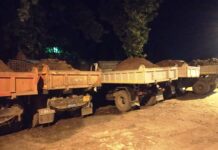
SRINAGAR: Kashmir’s apple economy, the backbone of its agrarian landscape and the largest fruit-producing sector in the region, has been severely disrupted this season due to repeated closures of the Srinagar–Jammu National Highway (NH-44). Prolonged rainfall, landslides, and floods in late August and early September left thousands of fruit-laden trucks stranded and delayed the transport of nearly half of the Valley’s apple produce to markets across India.
According to official data, the current year’s apple production in Jammu and Kashmir is estimated at 22.15 lakh metric tonnes (MT). Of this, around 14 lakh MT is traditionally exported outside the Union Territory, while the rest is either consumed locally, stored in controlled atmosphere (CA) facilities, or lost to perishability. However, this year, repeated blockages on NH-44, the Valley’s lifeline for trade, have disrupted the flow of produce during its crucial export window.
Between August 26 and September 3, 2025, heavy rainfall triggered landslides and flooding that washed away major stretches of the highway. The worst-hit zones were in Ramban and Udhampur districts, where nearly 630 millimetres of rainfall was recorded — one of the heaviest downpours in recent years. The Udhampur–Banihal stretch suffered extensive damage, particularly near the Thard–Bali Nallah–Samroli section, where a major slope failure caused large-scale road collapse.
Authorities said the National Highways and Infrastructure Development Corporation Limited (NHIDCL) undertook repairs on a war footing, reopening the highway on August 29 after a closure of two and a half days. However, further landslides on September 2 and 3 caused a massive 300-metre hill mass slide at Thard, forcing another complete shutdown. Full vehicular movement was restored only on September 9, eight days later, after round-the-clock clearance operations under continuous rainfall.
By that time, nearly 13,800 trucks carrying apples had been stranded along the highway. Official records show that 1,500 trucks managed to pass through the route on September 17, while another 7,833 trucks were diverted through the Mughal Road between September 1 and 16. Despite these efforts, the logistical bottleneck slowed down the overall dispatch of apple consignments — a sharp contrast to previous seasons when over 17,800 trucks were sent out in September 2024 and 13,595 trucks in the same month in 2023.
At the time of the road blockade, an estimated 22,000 MT of apples, roughly 1 per cent of total production, remained stranded on NH-44. Officials added that most of the remaining produce will continue to move out in phases through the rest of the season as the highway stabilises.
The Department of Horticulture (Planning and Marketing) established a control room at Qazigund to monitor truck movement and coordinate with police and road authorities. Farmers and traders were advised to defer harvesting until the highway was fully restored or to use the railway route from Budgam and Anantnag. During the disruption, 1,25,326 apple boxes worth Rs 10.03 crore were dispatched by train to Jammu and Delhi markets. By October 23, 2025, nearly 14,000 MT (or nine lakh boxes) of fruit had been shipped by rail.
Despite these alternate arrangements, farmers across south and north Kashmir have reported extensive losses due to incessant rains and flash floods. Official assessments show that floods in September damaged 431 hectares of horticultural land, with crop losses exceeding 33 per cent in several districts. The government has calculated compensation worth Rs 152.37 lakh, of which Rs 12.29 lakh has already been disbursed.
In a longer-term measure, the Jammu and Kashmir Government is preparing to roll out the Re-structured Weather-Based Crop Insurance Scheme (RWBCIS), covering apple, saffron, mango, and litchi crops. The tendering process to select an insurance company from among those empanelled by the Centre is currently underway.
The apple industry remains hopeful but cautious. As Kashmir’s iconic Red Delicious and Royal Delicious varieties, which together account for over 77 per cent of total production, move toward peak harvest, traders fear any further disruption on NH-44 could deepen the economic strain. While the Mughal Road and railways have provided temporary relief, growers say the Valley’s dependence on a single highway remains its most critical vulnerability, one that has once again exposed how fragile Kashmir’s horticultural lifeline truly is.