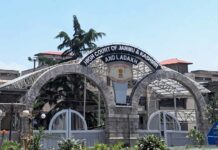
SRINAGAR: The High Court of Jammu and Kashmir and Ladakh has upheld the retirement of an Associate Professor of Nursing from the Islamic University of Science and Technology (IUST) at the age of 60, ruling that the enhanced retirement age of 62 years applicable to University teachers did not extend to faculty serving in the University’s constituent colleges.
A Division Bench comprising Acting Chief Justice Sanjeev Kumar and Justice Mohd. Yousuf Wani, in a judgment pronounced on August 11, 2026, dismissed a petition filed by Asmat Parveen, holding that the IUST Executive Council had specifically excluded teachers of constituent colleges from the enhanced superannuation age. The Court said the University had therefore “rightly retired” Parveen on attaining 60 years.
Parveen, represented by advocates Shafqat Nazir and Sabreena Bashir, had challenged the April 9, 2026 judgment of the Central Administrative Tribunal, Srinagar Bench, which had dismissed her claim, as well as the University’s retirement order dated March 31, 2026. IUST and its Vice-Chancellor were represented by Government Advocate Jahangir Dar.
Parveen had initially approached the High Court in 2023 after serving at Sher-i-Kashmir Institute of Medical Sciences (SKIMS), Soura. She applied for the post of Associate Professor in IUST’s Nursing College pursuant to an advertisement issued in December 2015 and was selected and appointed in May 2016. She was relieved by SKIMS in June 2016 to join IUST. Her past service at SKIMS was subsequently counted by the University for service and retiral benefits.
Her principal argument was that she should have been allowed to continue beyond 60 because the applicable regulations and IUST’s own statutes provided for higher retirement ages for teaching faculty. She also relied on the case of an IUST Assistant Professor, Abdul Majeed Andrabi, who, according to her, had been permitted to continue until 62.
Parveen further relied on Statute 5.18 of IUST, which she said prescribed superannuation at 65 for teachers in permanent whole-time service, subject to the Chancellor’s assent. She argued that Nursing faculty formed part of the University’s institutional structure and could not be subjected to a different retirement age.
The University opposed the claim, maintaining that Parveen belonged to a distinct cadre of Nursing faculty serving at the Alamdar Memorial College of Nursing and Medical Technology, Charar-i-Sharief, a constituent college governed by a separate regulatory framework. It argued that the regulatory norms applicable to nursing institutions, including those of the Indian Nursing Council, prescribed 60 years as the age of superannuation.
The High Court’s examination of the University’s statutory framework proved decisive.
The Bench noted that Clause 5.4 of Chapter IV of the IUST Statutes clearly provided that an officer or teacher of the University would retire on attaining 60 years. Clause 5.18 similarly prescribed 60 years as the age of superannuation for teachers in permanent whole-time service.
The Court found that although the IUST Statutes were subsequently amended to provide for superannuation at 65, the amendment was subject to the assent of the Chancellor, which was never granted. The Vice-Chancellor later enhanced the retirement age from 60 to 62 years using emergency powers, subject to ratification by the University’s Executive Council.
The matter was considered by the Executive Council at its 10th meeting on July 4, 2020. While ratifying the Vice-Chancellor’s decision to raise the retirement age of University teachers from 60 to 62, the Executive Council expressly excluded teachers serving in constituent colleges.
The resolution stated that the enhanced age “shall not be applicable to the Constituent Colleges of the University”.
The Bench noted that a subsequent University order dated November 11, 2020, implementing the Executive Council’s decision, did not reproduce the exclusion concerning constituent colleges. However, the Court held that the order had to be read in conjunction with the Executive Council’s July 4 decision.
“the age of superannuation of the teaching faculty of the University is 62 years. However, the teaching faculty of the constituent Colleges, like the petitioner, would not be entitled to the benefit of the enhanced age and shall retire on attaining the age of superannuation of 60 years,” the Court held.
The Bench also noted that neither the Executive Council decision nor the subsequent University order had been specifically challenged by Parveen before the Tribunal or the High Court.
“In the absence of any specific challenge laid to the University Executive Council decision and the consequent University Order dated 11.11.2020, the petitioner was bound by the University Statutes as they existed at the time of her attaining the age of 60 years,” the Court said.
The Court declined to adjudicate on whether the University’s classification of teachers of constituent colleges separately from teachers working on the main campus was legally permissible. It said that issue was not the subject matter of the petition.
“Suffice it to say that the University followed the Statutes and retired the petitioner on attaining the age of 60 years,” the Bench observed, adding that the University’s decision could not be faulted on the grounds raised before the Tribunal or the High Court.
The Bench also considered the petitioner’s reliance on the University Grants Commission Regulations of 2018 and Indian Nursing Council regulations. It noted that the Tribunal had already examined those provisions and concluded that, in the absence of their adoption by IUST, they could not confer the claimed benefit on the petitioner.
The judgment records that IUST teachers were originally required to retire at 60. The Executive Council had earlier approved an increase to 65, but that decision remained subject to the Chancellor’s assent, which was never granted. Subsequently, the Vice-Chancellor raised the age to 62, but the Executive Council, while ratifying the decision, specifically excluded teachers of constituent colleges.
“In view of the aforesaid clear position obtaining from the University Statutes, we are left with no option, but to go by the stand of the respondent-University that the petitioner was rightly retired on attaining the age of superannuation of 60 years,” the Bench concluded.
Finding no merit in the petition, the High Court dismissed it. The judgment was reserved on August 6 and pronounced on August 11, 2026, at Srinagar.