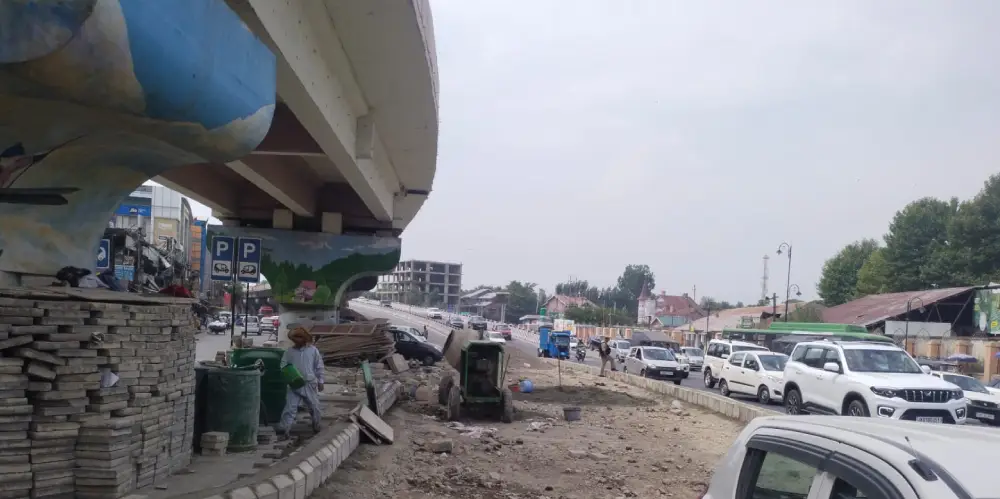
SRINAGAR: A stretch of Jehangir Chowk developed under the Srinagar Smart City project is now being dismantled and reworked, with walkway tiles being removed and stacked alongside the road, raising fresh questions about the planning and execution of infrastructure at one of Srinagar’s busiest junctions.
Workers have prised up sections of the pedestrian walkway and removed the tiles, while further work appears to be under way before the area can be restored for public use. No official explanation has been given so far for the latest intervention.
The reworking comes amid two immediate developments that could have prompted changes at the site: the recent flooding and persistent traffic congestion at the junction. However, without an official explanation, it is not clear whether either of these factors is directly responsible for the ongoing work.
The visible dismantling has nevertheless drawn attention because Jehangir Chowk was among the areas upgraded under the Srinagar Smart City project, a major urban redevelopment programme that was explicitly designed to improve mobility and civic infrastructure.
The congestion now routinely witnessed at the junction, coupled with the apparent alteration of the road layout, has renewed scrutiny of whether the infrastructure delivered under the project was adequately designed to cope with the traffic volumes and urban pressures at the site.
The Srinagar Smart City project was cleared in April 2017 under the third round of the Union government’s Smart City Mission. According to the District Srinagar administration, the project comprised two major components: Area Based Development, with an estimated outlay of Rs 2,869.24 crore, and Pan City Solutions, costing Rs 765.03 crore. Together, the two components amounted to Rs 3,634.27 crore.
The original Smart City proposal envisaged Area Based Development across 1,180 acres of Srinagar’s core city. The programme was intended to address a wide range of urban needs, including mobility, smart utilities, sewage and sanitation, solid waste management, heritage and cultural tourism, downtown renewal and economic revival.
The Pan City component was designed to complement these physical interventions through technology-driven solutions covering urban mobility, e-governance, disaster management, environmental protection and general services and utilities. Urban mobility alone accounted for Rs 284.94 crore under the Pan City component.
The stated objective was to combine physical redevelopment with technology-enabled civic services to create a more efficient and liveable city. The administration’s vision included walkable neighbourhoods, improved transport choices, protected open spaces and smart solutions integrated into everyday infrastructure and public services.
It is against this stated objective that the situation at Jehangir Chowk assumes significance.
Urban mobility was not a peripheral element of the Smart City programme. It was a central component of both Area Based Development and Pan City Solutions. Yet the junction continues to experience severe congestion, while infrastructure completed under the project is now being visibly dismantled and reconfigured.
The latest intervention therefore raises a more fundamental question than why the tiles are being removed: whether the infrastructure originally constructed at Jehangir Chowk was sufficiently assessed for the area’s traffic, drainage, pedestrian movement and other operational requirements before it was executed.
If the present work is a response to flooding, traffic management requirements or shortcomings identified after completion, it would also raise questions about the extent to which such factors were incorporated into the original design.
The issue is particularly relevant given the scale of the investment. The Smart City programme was not conceived merely as a beautification exercise but as a comprehensive intervention intended to improve the functioning of Srinagar’s urban infrastructure.
The Srinagar Smart City project was implemented through Srinagar Smart City Limited, a special-purpose vehicle established in September 2017.
With sections of a completed intervention now being taken apart and the junction’s traffic problems persisting, Jehangir Chowk has become a visible test of whether the Smart City programme’s ambitious plans translated into infrastructure capable of meeting the city’s actual requirements.
An official explanation for the present dismantling and the proposed redesign of the stretch would help establish whether the work represents routine maintenance, a response to recent conditions, or a correction of deficiencies in infrastructure already constructed.