by Faiqa Masoodi
SRINAGAR: Amid growing concerns over the delay in releasing its rightful water share from the Shahpur Kandi Dam on the Ravi River, the Jammu and Kashmir Government has formally written to the Punjab Government, seeking a clear timeframe for water release. The request comes as the dam’s reservoir continues to fall short of its required pondage level, effectively stalling the flow of water to irrigation-dependent regions in Kathua and Samba districts.
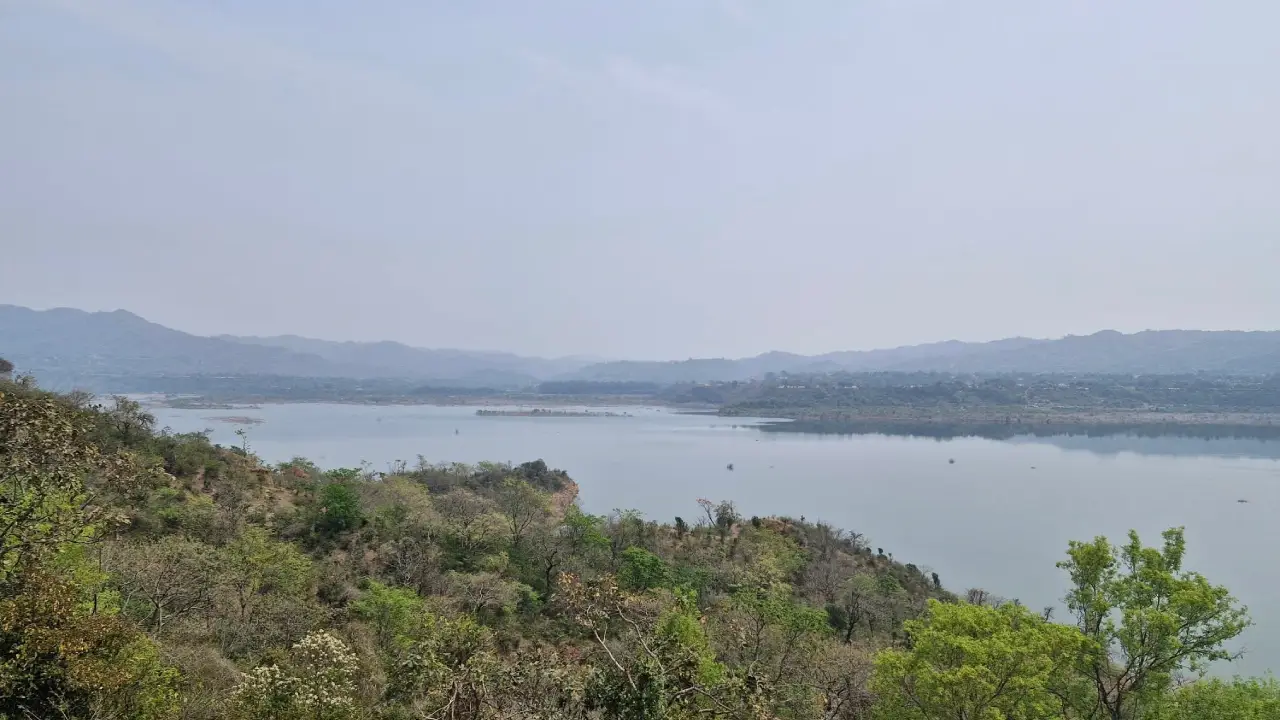
Official sources confirmed that the Union Territory’s Irrigation and Flood Control Department has reached out to the Chief Engineer, Canals, Punjab Government, asking for the latest status of water storage at Shahpur Kandi and a tentative release schedule. As per the 2018 agreement between the two states, Jammu and Kashmir is entitled to receive 1,150 cusecs of water, aimed at irrigating 32,173 hectares of land through a gravity-fed canal system.
“Without full pondage, water cannot be legally or technically released,” said a senior official familiar with the communication. “That is why we have also requested a timeline—to ensure we can prepare in advance for effective distribution.”
However, progress on dam readiness remains slow. A key committee constituted by the Punjab Government to certify compliance with National Dam Safety Authority (NDSA) parameters has yet to submit its final report. This compliance is a prerequisite for raising the reservoir to its maximum level, currently recorded at around 390 metres, well below the required 401 metres.
Meanwhile, the responsibility of preparing for the eventual water release rests with J&K’s irrigation department, which is scrambling to upgrade the canal network. Officials admit that the existing system is currently incapable of handling the expected volume of water.
“The infrastructure is outdated. Distributaries are weak, and even the main canal needs urgent reinforcement,” a departmental source said. “A plan is now in motion to strengthen the weak spots on a war footing until a full-scale project is sanctioned.”
Efforts to secure financial assistance under the Accelerated Irrigation Benefits Programme (AIBP) have also hit bureaucratic roadblocks. Though a proposal was submitted to the Ministry of Water Resources, it was rejected by the Central Water Commission due to existing guidelines that prohibit funding the same project within ten years of previous assistance. The earlier AIBP-funded project, sanctioned in 2010 and completed only in 2022, focused primarily on mechanical upgrades, leaving the structural network vulnerable.
Now, the Jammu and Kashmir Government is looking for alternative funding sources to support a second phase of canal rehabilitation, which is considered crucial to maximise benefits once water from Shahpur Kandi finally starts flowing.
The Shahpur Kandi Dam project, declared a national project by the Union Ministry of Water Resources in 2008, was envisioned to serve both Punjab and Jammu and Kashmir. While civil works on the dam have been completed by Punjab’s Irrigation Department, electro-mechanical components are being handled by the Punjab State Power Corporation Limited. The power component of the project—comprising seven generating units (six of 33 MW and one of 8 MW)—is expected to be completed by the end of this year, with a total capacity of 206 MW and an annual generation target of 1,042 million units.
J&K is entitled to receive a share of this power output, though officials say water for irrigation remains the more immediate concern given the agricultural dependency of the Kandi belt in Jammu’s border districts.
The 2018 agreement, brokered with intervention from the Prime Minister’s Office, was intended to settle decades of dispute between the two states. However, its implementation has faltered, leaving J&K waiting not just for water but also for a resolution to what it sees as repeated administrative indifference.
“The dam was a promise of hope for our farmers,” said one senior official. “But until water flows, that promise remains unfulfilled.”