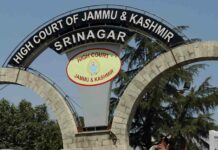
SRINAGAR: The Jammu Kashmir and Ladakh High Court has dismissed a petition challenging an order permitting a plaintiff to amend his property suit to seek restoration of possession of portions of land allegedly encroached upon by a neighbouring landowner, observing that changing the relief from permanent injunction to recovery of possession does not fundamentally alter the nature or character of a suit when both claims concern the same property.
Justice Sanjay Dhar, while dismissing the petition filed by Tara Mani, held that the trial court had correctly exercised its discretion in allowing the amendment before commencement of the trial and that its order did not warrant interference under Article 227 of the Constitution.
The judgment was delivered on October 31, 2026, in CM(M) No. 242/2026, challenging an order dated August 14, 2026, passed by the Sub Judge (Special Mobile Magistrate), Udhampur.
The dispute concerns 4 kanals and 4 marlas of land comprising Khasra Nos. 1205 and 1204 at village Jib in Udhampur district. The respondent, Radhey Krishan, had initially filed a suit seeking a permanent prohibitory injunction to restrain the petitioner from interfering with the land.
In his plaint, the plaintiff claimed that he was one of the co-owners and co-sharers of the property and that, through a private arrangement made with the consent of the other co-owners, the land had been adjusted and partitioned for its use, enjoyment and cultivation. He further claimed to have constructed a residential house on the portion falling to his exclusive share.
According to the plaintiff, Tara Mani had purchased adjoining land from one of the co-sharers and intended to raise a boundary wall by encroaching upon a portion of the disputed property.
He alleged that the defendant had fixed points and markings indicating the proposed alignment of the boundary wall, which covered part of his land. Despite being asked not to interfere, the defendant allegedly threatened to construct the wall according to his own choice and began digging its foundation.
In his written statement, the defendant maintained that he had purchased 2 kanals and 18 marlas under Khasra No. 1206 and 3 kanals under Khasra No. 1207 min and had been in lawful ownership and possession of the property for the past 50 years.
He claimed to have constructed a residential house on his land and maintained that he had no intention of encroaching upon any portion falling to the plaintiff’s share.
During the pendency of the suit, the defendant himself moved an application seeking appointment of a Local Commissioner to inspect the disputed site. The trial court allowed the application and appointed the Tehsildar, Udhampur, who conducted the inspection through revenue officials and submitted a report.
According to the report, encroachment of 16 marlas out of Khasra No. 1204 and 1 kanal and 4 marlas out of Khasra No. 1205 was found.
Following the report, the plaintiff sought permission to amend his plaint to include the relief of restoration of possession of the allegedly encroached portions of land. The trial court allowed the application on August 14, 2026.
Challenging the order before the High Court, Tara Mani argued that the proposed amendment fundamentally changed the nature and character of the original suit by converting a case based on alleged possession and interference into one seeking recovery of possession.
It was further contended that the Local Commissioner’s report had not demarcated the disputed portion and could not provide the basis for introducing a fresh cause of action. The petitioner also argued that the alleged encroachment did not constitute a subsequent development warranting amendment of the plaint.
After hearing the petitioner’s counsel, Advocate Sandeep Bhat, Justice Dhar examined the scope of Order VI Rule 17 of the Code of Civil Procedure, which governs amendments to pleadings.
The court observed that the provision empowers courts to permit amendments necessary for determining the real questions in controversy between parties, subject to the requirement of due diligence where an amendment is sought after commencement of the trial.
It noted that the primary objective of allowing amendments was to determine the real controversy between the parties and avoid multiplicity of judicial proceedings.
The court further observed that a liberal approach should ordinarily be adopted while considering applications for amendment of plaints, unless the proposed amendment causes irreparable injustice or prejudice to the opposite party, is intended to delay proceedings, withdraws an admission or introduces a time-barred cause of action or fundamentally alters the basic structure of the suit.
Examining the circumstances of the case, the court noted that the plaintiff had sought the amendment after the Local Commissioner’s report indicated encroachment upon portions of the very same property that formed the subject matter of the original suit.
The High Court referred to the Supreme Court’s judgment in Sampath Kumar v. Ayyakannu, (2002) 7 SCC 559, which held that changing the relief from injunction to possession in a dispute concerning the same property does not necessarily alter the fundamental structure or complexion of the suit.
The Supreme Court had also observed that compelling a plaintiff to withdraw the original proceedings and institute a fresh suit for possession would result in unnecessary delay and wastage of judicial time.
Applying this legal position, Justice Dhar observed that the plaintiff’s request for recovery of possession related only to the allegedly encroached portions of the same land and could not, therefore, be treated as fundamentally changing the nature of the original suit.
The court held that the trial court had correctly appreciated the factual and legal aspects while allowing the amendment at the pre-trial stage.
It further observed that the trial court’s exercise of discretion did not warrant interference under Article 227 of the Constitution, particularly in the absence of any perversity or illegality in the impugned order.
“For the foregoing reasons, I find no merit in the present petition. The same is, accordingly, dismissed,” the court held.
The petitioner was represented by Advocate Sandeep Bhat. No counsel’s appearance for the respondent is recorded in the judgment.