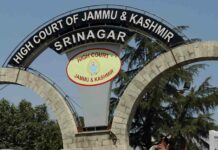
SRINAGAR: The Jammu Kashmir and Ladakh High Court has allowed three petitions filed by contractual and daily-wage workers of the Indira Gandhi National Open University (IGNOU) Regional Centre in Srinagar, directing that their cases be considered for regularisation in accordance with an earlier ruling of the court’s Division Bench.
Justice M A Chowdhary, while disposing of the connected petitions on October 5, 2026, held that the issues raised by the petitioners had already been dealt with by the Division Bench in its judgment dated April 3, 2024, and that the directions issued in that case were applicable to their claims.
The court directed that the petitioners’ cases be considered in line with the Division Bench’s directions, particularly paragraph 48 of its judgment in LPA No. 91/2016. The ruling does not grant automatic regularisation but requires the university to consider the claims under the framework laid down by the Division Bench.
The petitions were filed by Javed Ahmad Bhat, Mohammad Shafi Hajam, Furhan Ahmad Chachoo, Danish Ahmad Khan, Peerzada Adil Mehboob, Gulzar Ahmad Bhat and Manpreet Kour. They had approached the court seeking regularisation against Group C and Group D posts, along with service benefits available to regular employees performing similar duties.
They had also sought a direction to the university to stop imposing breaks in their service after every 89 days and allow them to continue working until their services were regularised or confirmed.
Advocate R A Bhat, appearing for the petitioners, argued that they had been engaged against vacant posts at the IGNOU Regional Centre in Srinagar from 2008 onwards through a selection process and possessed the requisite qualifications for the positions they held.
Invoking the principle of “equal pay for equal work”, he submitted that the petitioners performed duties similar to those of regular employees and were therefore entitled to comparable remuneration and service benefits.
Bhat also relied on IGNOU’s Non-Academic Employees (Group A, B and C) Recruitment and Promotion Rules, 2010, arguing that the petitioners should have been considered for designation as Multi-Tasking Staff and, after completing five years of service and meeting the prescribed qualifications, for promotion to Junior Assistant-cum-Typist under the 25 per cent promotional quota.
Opposing the petitions, Advocate Bilal Ahmad Malla, appearing for IGNOU and its officials, submitted that the petitioners had been engaged on a daily-wage basis to meet seasonal requirements arising during admissions and examinations. Their engagements, he argued, were governed by their respective engagement orders and undertakings rather than the 2010 recruitment rules, which applied to regular and temporary employees.
Malla maintained that the petitioners could not claim regularisation contrary to the applicable recruitment rules, particularly when their engagements were not regular appointments made through the prescribed recruitment process.
He also submitted that some of the petitioners had continued in service under interim orders passed by the court, which, according to him, could not create an enforceable right to regularisation. He relied on the Supreme Court’s ruling in Secretary, State of Karnataka v. Umadevi to support this contention.
The university’s counsel further referred to an earlier case involving similarly engaged employees, in which a single-judge bench had ordered regularisation in 2016. That ruling was subsequently set aside by the Division Bench on April 3, 2024, while directing the university to reconsider the employees’ cases.
In its earlier judgment, the Division Bench had questioned the practice of repeatedly engaging and renewing workers on a daily-wage or contractual basis at a regional centre that operated as a permanent establishment.
The Division Bench observed that the employees had “not been treated with clarity and fairness” by the university and noted that their repeated continuation and renewal of engagement had created an impression that they were quasi-permanent employees.
It also held that IGNOU’s regional centres, particularly those in the North-East, Sikkim and Jammu and Kashmir, operated as permanent establishments with cadre posts for employment.
The Division Bench, however, rejected the earlier single-judge direction declaring the employees to have been appointed on a regular basis, holding that the writ court had overstepped its jurisdiction by assuming the role of the employer.
Instead, it directed IGNOU’s Board of Management to consider whether long-serving contractual employees could be regularised in accordance with the university’s policies and practices, and to pass a reasoned decision.
Pending that decision, the Division Bench directed that the employees covered by its ruling should continue in service and should not be replaced by other daily-wage or contractual workers or through manpower-supplying agencies.
It also directed the Regional Director of IGNOU’s Srinagar centre to forward the employees’ cases, detailing their respective periods of engagement against the posts, to the Board of Management within one month. The Board was then required to consider their regularisation claims. Any adverse decision could be challenged through an appropriate legal remedy.
Justice Chowdhary noted that the Division Bench had already examined the issues concerning regularisation and continuation in service and that its directions squarely covered the present cases.
“Viewed thus, all the above titled three Writ Petitions are allowed and shall stand disposed of in terms of the directions issued by the Division Bench,” the court said.
The petitions were accordingly disposed of along with the connected miscellaneous applications.
The Union of India, IGNOU and its officials were represented by their respective counsel, including Yasmeen Jan, appearing for the Union government in place of Deputy Solicitor General of India Tahir Majid Shamsi, and Bilal Ahmad Malla for the university and its officials. The petitioners were represented by RA Bhat.