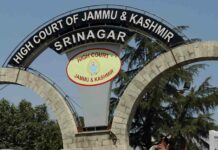
SRINAGAR: The Jammu Kashmir and Ladakh High Court has set aside the acquittal of accused persons in a 2005 attempted murder case and ordered a fresh trial, expressing serious concern over the failure of the prosecution and trial court to examine even the injured victims during more than seven years of proceedings.
A Division Bench of Justice Yash Paul Bourney and Justice Sanjeev Kumar, while rejecting a victim’s plea for special leave to appeal against the acquittal on legal grounds, invoked its inherent powers under Section 561-A of the erstwhile Code of Criminal Procedure (CrPC) to reopen the case and remand it to the trial court for proceedings in accordance with law.
The Bench directed the trial court to make every endeavour to conclude the proceedings expeditiously, preferably within six months of receiving a copy of the order.
In its judgment pronounced on November 6, 2026, the court observed that the manner in which the trial had proceeded and ended was “indeed disturbing”. It held that the failure to secure the presence of material witnesses, particularly the injured victims, had resulted in a complete failure of the process of law.
The petition was filed by Dalbeer Singh, a resident of Paloura, Jammu, who was himself one of the injured persons in the alleged murderous assault. He had approached the High Court under Section 417(2) of the Code of Criminal Procedure, seeking special leave to appeal against the acquittal order passed by the 1st Additional Sessions Judge, Jammu, on July 26, 2016.
The case originated from an incident alleged to have taken place on September 17, 2005. According to the complaint lodged by Swarn Singh at Police Station Janipur, his son Sohan Singh alias Sonu had purchased a piece of land at Chohana, Paloura and was visiting the property when he was allegedly attacked by the accused with sharp-edged weapons and sticks.
The complaint alleged that the accused shared a common intention to murder him. However, the victim was saved following the timely intervention of some passers-by and was subsequently taken to Government Medical College Hospital, Jammu, for treatment.
Following the complaint, police registered FIR No. 94/2005 under Sections 307, 326, 147, 148, 149 and 34 of the Ranbir Penal Code and Sections 4 and 25 of the Indian Arms Act.
After investigation, the police filed a charge-sheet on August 6, 2007. The case was subsequently committed to the Sessions Court, where the trial court found a prima facie case against the accused and framed charges under the relevant provisions. The accused pleaded not guilty, following which the prosecution was directed to produce its witnesses.
However, despite being granted numerous opportunities over a period of seven-and-a-half years, the prosecution managed to examine only three witnesses. These included PW-2 Sohan Singh, one of the victims, whose testimony remained incomplete, PW-7 Ranjeet Singh and PW-15 Dr Sanjay Bhat.
The High Court took particular note of the circumstances in which the examination of the injured victim remained incomplete. It observed that when Sohan Singh was examined in chief, the defence moved an application seeking deferment of his cross-examination until his brother, Dalbeer Singh, the other injured victim, was examined.
The trial court deferred the cross-examination, but it was never completed as the other injured person was not produced and examined. Consequently, the testimony of a key prosecution witness remained incomplete and the other injured victim was also never examined.
Examining the victim’s legal right to challenge an acquittal, the High Court referred to the Supreme Court judgment in Mahabir and Others versus State of Haryana, Criminal Appeal Nos. 5560-5561 of 2024, decided on January 29, 2025, and reported as 2025 INSC 120.
The Supreme Court had examined the relevant statutory provisions and judicial precedents and clarified the distinction between the right of a victim to appeal and the applicability of amendments introduced into criminal procedure law.
The High Court noted that Section 404 of the erstwhile local Code, corresponding to Section 372 of the Central Code, provided that no appeal could be filed against a criminal court’s judgment or order except as provided under the Code or any other law.
It further noted that a proviso was added to Section 372 of the Central Code through the 2009 amendment, expressly granting victims a right to appeal against acquittal, conviction for a lesser offence or an order imposing inadequate compensation. However, no corresponding amendment had been made to the erstwhile Jammu and Kashmir Code.
Referring to the legal position settled by the Supreme Court, the Bench held that the right of appeal was a substantive right and could not be applied retrospectively in the absence of an express provision or necessary legislative intention.
The court, therefore, concluded that Dalbeer Singh could not maintain an appeal under Section 417(2), as the criminal proceedings had originated from a police charge-sheet and not from a private complaint, notwithstanding his status as an injured victim.
Accordingly, his request for special leave to appeal against the acquittal was held to be legally untenable.
However, the Bench made it clear that rejection of the victim’s appeal did not prevent the High Court from exercising its inherent jurisdiction to address the serious miscarriage of justice evident from the trial record.
The court held that the failure to examine the injured victims over seven-and-a-half years was a matter of grave concern and attributed responsibility to the prosecution, the investigating agency and the trial court.
It observed that the Assistant Public Prosecutor had been seeking opportunities “leisurely”, while the investigating agency had “abdicated its responsibility” after filing the charge-sheet. The trial court, the Bench said, had remained “a mute spectator all along”.
Holding that each of the authorities had contributed in some measure to the failure of the judicial process, the court found it an appropriate case to invoke Section 561-A of the erstwhile CrPC.
The Bench observed that it was necessary to reopen and remand the case for a lawful and expeditious trial, adding that “the operation of law should not and cannot be allowed to subverted by anyone”.
The judgment was reserved on September 29, 2026, and pronounced on November 6, 2026. Advocate A K Shan appeared for the petitioner, while advocates J P Gandhi and Ashok Singh, along with Nipun Gandhi and Sonam Sharma, appeared for the respondents.
The petition was accordingly disposed of with directions for a fresh trial.