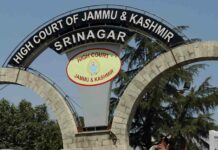
SRINAGAR: The Jammu Kashmir and Ladakh High Court has directed Deputy Commissioner Srinagar to appear personally with the complete original record of a preventive detention case after raising serious concerns over the apparent lack of independent application of mind in issuing the detention order.
Justice Wasim Sadiq Nargal, while hearing a habeas corpus petition filed by Zubair Amin Bangroo, observed that the grounds of detention appeared to lack specific particulars and contained an internal inconsistency that raised doubts about whether the detaining authority had independently assessed the material or mechanically reproduced allegations from a police dossier.
In an order dated October 15, the court directed the Deputy Commissioner, Srinagar, who passed the impugned detention order, to appear in person on the next date of hearing and explain why the order had been passed “recklessly and mechanically” without due application of mind. The matter has been listed for October 22 for continuation of arguments.
The court also directed the Deputy Commissioner to produce the complete original record relating to the detention order, including the police dossier, the material placed before the detaining authority and records showing how the authority considered that material before reaching its satisfaction.
The observations came after the court examined the grounds of detention, which alleged that Bangroo had maintained close links with terrorist elements, provided them logistical and moral support, and allowed his residential premises and other safe locations to be used as hideouts. The allegations further claimed that he remained in contact with members of the network and attempted to reconnect with elements operating outside the Union Territory.
Bangroo’s counsel, advocate Nida Nazir, challenged the detention on the ground that the allegations were vague and unsupported by specific particulars. She argued that the grounds did not identify the terrorist with whom her client allegedly maintained links, the network’s associates, the locations purportedly used as hideouts or the incidents in which logistical and moral support was allegedly provided.
The counsel also submitted that the grounds failed to identify individuals whom Bangroo was accused of motivating or instigating to undertake unlawful activities. According to the petitioner’s counsel, the order did not specify the acts attributed to him or adequately explain their connection with the security of the State.
The plea further questioned the manner in which the detention order had been issued, contending that it had been passed hurriedly and without proper application of mind. The counsel also pointed out that no FIR had been registered against Bangroo.
After a prima facie examination, Justice Nargal observed that the grounds, despite the seriousness of the allegations, did not clearly identify the persons, incidents, locations or specific acts on which the detaining authority had relied. The court emphasised that the gravity of allegations could not replace the requirement for relevant material and independent consideration by the authority empowered to order detention.
A specific inconsistency in the detention grounds drew the court’s attention. In the second paragraph, the District Magistrate, Srinagar, had referred to “aforementioned terrorists” while alleging that Bangroo provided support to terrorists and allowed them to use his residence and other locations as hideouts.
However, the court noted that the preceding portion of the grounds contained no reference identifying any terrorist. It said the first paragraph merely recorded the detaining authority’s formal assertion that it had applied its mind and did not identify any individual.
The court observed that the unexplained reference to “aforementioned terrorists” raised a serious doubt about whether the relevant portion had been mechanically lifted from the police dossier without independent scrutiny of its contents.
The judge also referred to another habeas corpus petition, HCP No. 321/2025, which had been listed immediately before Bangroo’s case. That petition concerned a separate detention order issued by the District Magistrate, Srinagar, in which the court had encountered similar prima facie concerns over the apparent reproduction of a police dossier without evidence of an independent assessment by the detaining authority.
Justice Nargal said the similarities in the formulation of detention grounds raised a serious question about whether preventive detention powers were being exercised after an objective assessment of the material or through the mechanical reproduction of police allegations.
The court clarified that a police dossier could provide the basis for consideration by the competent authority but could not replace the authority’s obligation to independently examine the material, assess its relevance and reach its own satisfaction in accordance with the law.
Emphasising the constitutional implications, the court said preventive detention was an extraordinary measure because it curtailed personal liberty without a regular criminal trial. Such powers, it observed, required strict compliance with constitutional safeguards and procedural requirements under Articles 21 and 22 of the Constitution of India.
The judge said the authority ordering detention must independently determine whether the statutory conditions had been met, adding that the power could not be exercised routinely or on the strength of allegations reproduced from a police dossier alone.
The order referred to Supreme Court judgments, including Vijay Narain Singh v. State of Bihar (1984), which held that preventive detention laws must be strictly construed to ensure that personal liberty is not jeopardised unless the case falls within the applicable legal provisions.
It also cited Arnab Manoranjan Goswami v. State of Maharashtra (2021), highlighting the responsibility of constitutional courts to protect personal liberty and guard against its deprivation.
The court further referred to the Supreme Court’s judgment in Mulla Afroz v. Union of India and Others, Criminal Appeal No. 4310 of 2026, decided on September 29, 2026, which reiterated that preventive detention must be invoked with utmost caution and only where circumstances genuinely warrant its use.
The judge clarified that the absence of a criminal case, by itself, might not determine the validity of a preventive detention order. However, the authority must demonstrate through the material considered and the grounds recorded that the legal requirements had been independently and lawfully fulfilled.
The court said the concerns in Bangroo’s case warranted an explanation from the authority responsible for issuing the order, as the matter involved not only the petitioner’s challenge but also the manner in which the extraordinary power of preventive detention was being exercised.
The Registry has been directed to communicate the order to the Deputy Commissioner, Srinagar, for immediate compliance.
The court has not, in the October 15 order, finally adjudicated the legality of the detention. The matter remains pending for further consideration on October 22.