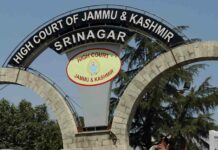
SRINAGAR: The Jammu Kashmir and Ladakh High Court has upheld the constitutional validity of Rule 129 of the Border Security Force (BSF) Rules, 1969, which allows copies of Security Force Court proceedings to be furnished to an accused only after confirmation of the finding and sentence, holding that withholding certified copies during the trial does not, by itself, violate the right to a fair trial under Article 21 of the Constitution.
Setting aside a 2022 judgment of a Single Bench that had struck down the provision as unconstitutional, a Division Bench comprising Chief Justice Pushpendra Singh Bhati and Justice MA Chowdhary held that the right to inspect trial proceedings under Rule 120, read with other safeguards under the BSF Act and Rules, provides sufficient procedural protection to an accused.
The court delivered the judgment on October 22 in a Letters Patent Appeal filed by the Union of India and other BSF authorities against the order dated April 28, 2022, passed in a writ petition filed by Rovinder Singh, a BSF constable who was tried by a General Security Force Court (GSFC) in connection with the killing of a fellow personnel at a BSF campus in Bandipora in November 2017.
The Bench held that Rule 129 does not permanently deny an accused access to the trial record but merely regulates the stage at which copies can be obtained. It observed that the Constitution guarantees a fair opportunity to defend oneself but does not prescribe that such an opportunity must invariably involve possession of certified copies of the proceedings during the trial.
“The distinction between access to proceedings and possession of copies must therefore be maintained. The former is integral to fairness. The latter is subject to legislative regulation,” the court observed.
The case originated from an incident on November 27, 2017, at the BSF campus in Bandipora, where Head Constable Chander Bhan was shot dead. Following the incident, FIR No. 163/2017 was registered under Section 302 of the Ranbir Penal Code (RPC).
After investigation, the police presented a charge-sheet before the Chief Judicial Magistrate, Bandipora, who committed the case to the Court of Sessions. However, considering that Singh was a member of the BSF, the competent authority exercised its statutory option to have him tried by a General Security Force Court under the BSF Act, 1968.
The Record of Evidence was prepared and the Inspector General, Kashmir Frontier, BSF, directed that the matter be placed before the GSFC. Singh faced trial under Section 302 RPC read with Section 46 of the BSF Act, besides a charge relating to allegedly leaving his designated picket without orders from his superior officers.
The trial commenced on November 13, 2019, and concluded on March 7, 2020. The GSFC found Singh guilty and awarded him life imprisonment and dismissal from service. However, the finding and sentence were subject to confirmation under Section 107 of the BSF Act, which provides that a finding or sentence of a General Security Force Court is not valid unless confirmed in accordance with the Act.
During the trial, Singh sought certified copies of the challan and related documents, besides copies of statements of prosecution witnesses recorded before the GSFC. His request was declined under Rule 129 of the BSF Rules. The court record, however, did not indicate that he had been excluded from the proceedings or denied the opportunity to inspect them under Rule 120.
Aggrieved by the refusal, Singh approached the High Court through a writ petition, challenging, among other things, the constitutional validity of Rule 129. He argued that withholding certified copies of prosecution evidence deprived him of the material necessary to prepare an effective defence and violated his right to a fair trial under Article 21.
The Single Bench accepted his challenge, holding that the right to inspect proceedings could not be equated with the right to receive certified copies. It concluded that postponing the supply of copies until confirmation of the finding and sentence prejudiced the accused in preparing his defence.
The Single Bench also held that Article 33 of the Constitution could not justify the restriction in the absence of a sufficiently demonstrated connection between the denial of copies and the maintenance of discipline or proper discharge of duties within the BSF. It consequently struck down Rule 129 and quashed the GSFC proceedings from the stage of leading defence evidence.
The Single Bench had directed that the trial resume from the conclusion of the prosecution evidence, with Singh being provided certified copies of the proceedings and statements of prosecution witnesses before being asked to enter his defence.
Challenging that judgment, the Union of India and other BSF authorities argued before the Division Bench that the Single Bench had wrongly treated the supply of physical copies during trial as an indispensable constitutional requirement.
The appellants submitted that the BSF Act constitutes a special statutory framework governing the constitution, discipline, offences, trials and punishments of members of the Force. They argued that Section 87 of the Act makes the Indian Evidence Act applicable to proceedings before a Security Force Court only subject to the provisions of the BSF Act.
Relying on Rule 120, the appellants maintained that an accused is entitled to inspect the proceedings at all reasonable times before the court is closed to consider its finding. They argued that Rule 129 merely regulates the time at which copies can be obtained and does not deprive an accused of access to the evidence or the opportunity to prepare a defence.
The Union also relied on the Supreme Court judgment in Union of India v. Ex. Flt. Lt. G.S. Bajwa (2003) 9 SCC 630, in which the apex court had upheld a similar arrangement under the Air Force Rules, holding that the right to inspect proceedings during trial was sufficient to meet the requirements of natural justice and that an accused could not insist on receiving day-to-day copies.
The appellants also cited Ex. Major General M.S. Jaswal v. Union of India, decided on December 6, 2025, and Mushtaq Ahmad Malik v. Union of India, decided on May 14, 2026, in support of their submissions.
Opposing the appeal, counsel for Singh argued that the proceedings involved a criminal charge carrying the punishment of life imprisonment and dismissal from service, making an effective opportunity to prepare the defence particularly important.
He submitted that statements of prosecution witnesses were essential for comparing testimonies, identifying contradictions and preparing an effective defence, and that merely permitting inspection could not provide the same assistance as furnishing copies.
The respondent’s counsel relied on the Supreme Court judgments in Nahar Singh Yadav v. Union of India and Mohd. Hussain v. State (Government of NCT of Delhi) to emphasise the constitutional requirement of a fair trial. He also cited Secretary, Ministry of Defence v. Babita Puniya to argue that restrictions under Article 33 must have a rational connection with the maintenance of discipline and the proper discharge of duties.
He further argued that the authorities had failed to demonstrate how providing copies of statements already recorded could adversely affect operational preparedness, discipline or security. Seeking broader relief, he contended that the GSFC proceedings should be recommenced from the stage of framing of charges rather than merely from the stage of leading defence evidence.
After examining the rival submissions, the Division Bench held that Section 87 of the BSF Act must be read in conjunction with the special statutory provisions governing Security Force Courts.
The Bench observed that the words “subject to the provisions of this Act” in Section 87 were significant and meant that the general law of evidence operated within the framework established by the BSF Act.
It held that the principle of generalia specialibus non derogant — a special law prevails over a general law — applied to the case, adding that Rule 129 neither destroyed the evidentiary value of the proceedings nor denied an accused the right to know or inspect the evidence.
The court also placed considerable reliance on the Supreme Court’s ruling in G.S. Bajwa, which dealt with a substantially similar provision under the Air Force Rules, 1969.
Quoting the apex court’s judgment, the Bench noted that the right of inspection at reasonable times enabled an accused to examine the proceedings and prepare a defence, and that non-supply of copies during the trial did not, by itself, violate the principles of natural justice.
On the constitutional question, the Bench acknowledged that Article 21 continues to apply to members of the BSF and that membership of a disciplined force does not deprive an individual of constitutional protection.
However, it held that the fairness of the procedure had to be assessed by examining the statutory framework as a whole rather than by considering the provision concerning copies in isolation.
The court also examined Article 33, which empowers Parliament to determine the extent to which fundamental rights may be restricted or abrogated in their application to members of the Armed Forces and forces charged with maintaining public order, to ensure the proper discharge of their duties and maintenance of discipline.
It held that the BSF, being an armed force of the Union constituted under the BSF Act, falls within the special constitutional framework contemplated by Article 33.
The Bench observed that the BSF Act provides for a specialised system of trials, confirmation, review and revision, and that Rule 129 forms part of this integrated statutory arrangement.
It further noted that Section 117 provides remedies both before and after confirmation of a finding or sentence, while Section 118 empowers superior authorities to annul proceedings found to be illegal or unjust.
The court also referred to Rule 130, which provides safeguards concerning access to proceedings in cases involving State security or friendly relations with foreign States.
Rejecting the argument that the restriction was arbitrary, the Bench held that the distinction between proceedings awaiting confirmation and those already confirmed had a rational basis in the statutory scheme, particularly because Section 107 makes confirmation a condition for the validity of a GSFC finding or sentence.
The court further held that the ruling in Nahar Singh Yadav did not establish an absolute constitutional right to possess physical copies of every proceeding during trial, irrespective of the statutory jurisdiction involved.
“The Constitution guarantees a fair opportunity to defend; it does not prescribe that such opportunity must invariably take the form of possession of certified copies,” the Bench observed.
It also noted that Singh had not placed any material before the court demonstrating that he had actually been prevented from inspecting the proceedings, cross-examining a material witness, confronting a witness with a contradiction or raising a specific defence because of the absence of certified copies.
“The existence of a possibility that a copy may assist a defence is not sufficient to invalidate a rule which forms part of a special statutory procedure,” the judgment stated.
Allowing the appeal, the Division Bench set aside the Single Bench judgment dated April 28, 2022, and declared Rule 129 of the BSF Rules, 1969, constitutionally valid and not ultra vires Part III of the Constitution, particularly Article 21.
The court held that the opportunity to inspect proceedings under Rule 120, read with the other safeguards provided under the BSF Act and Rules, constitutes a legally sufficient procedural safeguard and that non-supply of certified copies before confirmation of the finding and sentence does not, by itself, amount to a violation of the right to a fair trial.
It directed the competent authorities to proceed in the matter in accordance with the BSF Act and Rules, making it clear that its findings would have no bearing on the final adjudication of Singh’s guilt or punishment.
The judgment was reserved on September 24, 2026, and pronounced on October 22, 2026. It was authored by Chief Justice Pushpendra Singh Bhati, with Justice M A Chowdhary concurring.