by Masood Hussain
JAMMU: Jammu and Kashmir’s debt burden has soared to Rs 1.25 lakh crore by the end of the 2023-24 fiscal year, reflecting a significant rise in borrowings, particularly from the financial market. Over the past decade, Jammu and Kashmir’s liabilities have more than doubled, with increasing dependence on market borrowings to finance its expenditure.

A set of documents tabled by the government as part of the budget 2025-26, reveals key trends in the composition of debt, repayment obligations, and interest rates, painting a complex picture of Jammu and Kashmir’s fiscal health.
Debt funding of budgets has remained a routine within Jammu and Kashmir as it is with other states but debt servicing is taking a huge capital from the yearly public spending. In fiscal 2025-25, the budget proposals for which were tabled by Chief Minister, Omar Abdullah, Jammu and Kashmir will be making an interesting payment of Rs 11518 crore in addition to clearing debts of Rs 5669 crore. This means more than 15 per cent of Jammu Kashmir’s Rs 112310 crore will go into managing and clearing debts. Interestingly, the year would witness the government lifting Rs 14328 crore as loans during the financial year. The government will also access ways and means facility worth Rs 20000 crore and an overdraft of 8000 crore during the year.
The total liabilities of Jammu and Kashmir stood at Rs 1,09,825 crore in 2022-23 and rose to Rs 1,25,205 crore in 2023-24. This increase is primarily driven by market borrowings, which escalated from Rs 55,636 crore in 2022-23 to Rs 69,893 crore in 2023-24. The borrowing through this route nearly doubled in a single year, from Rs 8,473 crore to Rs 16,337 crore. Despite repayments of Rs 2,080 crore, the overall outstanding market borrowings surged. This reliance on market borrowings indicates a shift towards commercial financing over institutional loans, leading to higher interest obligations in the long term.
While Jammu and Kashmir continues to borrow heavily from financial markets, its direct loans from the central government have declined. The outstanding loans from the Centre fell from Rs 831 crore in 2022-23 to Rs 710 crore in 2023-24, with annual repayments exceeding fresh borrowings. Similarly, the liabilities under special securities issued to the National Small Savings Fund (NSSF) have decreased from Rs 6,607 crore to Rs 5,758 crore over the same period. The stagnation in fresh borrowings from these sources suggests a move away from structured government lending mechanisms.
Apart from market borrowings, Jammu and Kashmir has seen a rise in liabilities under small savings, provident funds, and reserve funds. Small savings and provident fund liabilities increased from Rs 26,753 crore in 2022-23 to Rs 27,901 crore in 2023-24. Reserve funds and deposits also recorded growth, rising from Rs 13,338 crore to Rs 14,294 crore. The increase in these categories indicates a growing reliance on public funds for financing government liabilities, which could have implications for future liquidity and repayment structures.
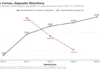
A longer-term analysis shows that Jammu and Kashmir’s total liabilities have more than doubled in the past eleven years, from Rs 98,367 crore in 2014-15 to Rs 2,45,022 crore in 2023-24. The percentage of total liabilities relative to the Gross State Domestic Product (GSDP) has fluctuated, peaking at 59 per cent in 2020-21 before moderating to 51 per cent in 2023-24. Internal debt has been the major contributor to this rise, growing from Rs 24,715 crore in 2013-14 to Rs 82,299 crore in 2023-24. The reliance on loans and advances from the central government has diminished over the years, reducing from Rs 1,775 crore in 2013-14 to just Rs 710 crore in 2023-24. Despite these changes, the growing gap between public debt and revenue sources remains a concern, particularly as interest payments continue to accumulate.
The overall weighted average interest rate on Jammu and Kashmir’s liabilities has remained stable, decreasing slightly from 7.45 per cent in 2022-23 to 7.41 per cent in 2023-24. However, different borrowing categories carry varying interest costs. Market borrowings, which form the bulk of the debt, saw a slight drop in fresh issuance rates from 7.72 per cent in 2022-23 to 7.52 per cent in 2023-24, while outstanding borrowings remained at 7.85 per cent. Central government loans witnessed a sharp rise in new borrowing rates, reaching 9.00 per cent in 2023-24, though the overall cost of outstanding loans declined to 3.97 per cent. Borrowings from financial institutions and banks saw a marginal rise in interest rates on outstanding loans from 5.74 per cent to 5.90 per cent. Small savings and provident fund liabilities saw an increase in weighted interest rates on outstanding amounts from 6.64 per cent to 7.05 per cent. These figures indicate that while overall borrowing costs remain manageable, the rising share of high-interest market loans and central government borrowings could increase debt-servicing pressure in the future.
A crucial unresolved issue in Jammu and Kashmir’s debt burden is the pending apportionment of liabilities between Jammu and Kashmir and Ladakh. Following the bifurcation of the erstwhile state in October 2019, the division of debt between the two Union Territories has not been finalised, meaning that the current liabilities figures reflect the combined obligations of both regions.
With Jammu and Kashmir’s debt touching Rs 1.25 lakh crore and market borrowings at an all-time high, fiscal prudence will be essential in the coming years. The sharp rise in liabilities, coupled with a growing share of high-interest debt, poses challenges for the Union Territory’s financial management. While the GSDP growth provides some cushion, a long-term strategy for debt reduction, revenue augmentation, and effective expenditure control will be necessary to ensure that Jammu and Kashmir’s debt remains sustainable in the future.
Even Omar Abdullah sounded concerned in his budget speech by acknowledging that the public debt is now 52 per cent of the GSDP (Rs 245022 crore on current prices) of Jammu and Kashmir, which is one of the highest. States usually cap it at around 20 to 25 per cent. Talking to the media after presenting the budget, Omar hinted that high-cost debts are being converted into low-cost debts but avoided offering details.