by Humaira Nabi
SRINAGAR: By 5:33 PM on May 10, 2025, as people in Kashmir prepared for another tense night, a tweet from US President Donald J Trump brought an unexpected wave of hope and happiness across the region. The US president, the most powerful man on earth, enjoys a huge influence in the region, mostly in the Gulf and India.
“After a long night of talks mediated by the United States, I am pleased to announce that India and Pakistan have agreed to a full and immediate ceasefire,” Trump tweeted. “Congratulations to both countries on using Common Sense and Great Intelligence. Thank you for your attention to this matter.”
For most of the last night, Trump’s Secretary of State, Marco Rubio was busy in “shuttle diplomacy”, reports in American media said. “Over the past 48 hours, Vice President Vance and I have engaged with senior Indian and Pakistani officials, including Prime Ministers Narendra Modi and Shehbaz Sharif, External Affairs Minister Subrahmanyam Jaishankar, Chief of Army Staff Asim Munir, and National Security Advisors Ajit Doval and Asim Malik,” Rubio said in a statemmnet. “I am pleased to announce the Governments of India and Pakistan have agreed to an immediate ceasefire and to start talks on a broad set of issues at a neutral site. We commend Prime Ministers Modi and Sharif on their wisdom, prudence, and statesmanship in choosing the path of peace.”
The announcement, sudden and sweeping, was quickly echoed by Pakistan’s Foreign Minister Ishaq Dar, who confirmed that both nations had agreed to a ceasefire with immediate effect.
Shortly afterwards, India’s External Affairs Minister Dr S Jaishankar issued a statement. “India and Pakistan have today worked out an understanding on the stoppage of firing and military action,” he said. “India has consistently maintained a firm and uncompromising stance against terrorism in all its forms and manifestations. It will continue to do so.”
Within minutes, the virtual world was ablaze. Social media platforms got filled with reactions, news alerts, and screenshots of Trump’s tweet. What began as a day marked by the most intense escalation between the two countries in recent decades quickly turned into one of cautious relief.
In Kashmir, where the cross-border tension over the past few days had sent ripples of fear, the impact was immediate. Lal Chowk, the heart of Srinagar, had grown eerily silent by late afternoon. Few shops were shuttered, roads were less congested, and anxiety hung thick in the air. But by 6:30 PM, the mood had palpably shifted. People stepped out of their homes, murmurs turned into conversations, and the city seemed to breathe again.
For 75-year-old Jana, the ceasefire meant far more than a political truce; it brought a rare moment of peace in a life consumed by care and worry. For the past six years, Jana has been tending to her 35-year-old daughter, paralysed and entirely dependent on her. The past few nights, marked by blackouts and the looming threat of war, had been particularly cruel.
When the news of the ceasefire finally reached her, Jana’s eyes welled up with tears. “Khuda bouzin jang maklen (May God stop the war),” she murmured, unsure if what she’d heard was real. Once reassured that the shelling had truly stopped, she exclaimed with visible relief, “Let me inform my daughter first. She’ll have a good sleep tonight.”
“I would turn on the torch on dim light whenever my daughter needed help to move. I was unable to see anything. As night approached, my daughter would become anxious,” Jana recalled.
For families like Jana’s, the announcement wasn’t just about geopolitics or diplomacy, it was about survival, sanity, and peace.
The response to the development was massive in border belts, where the people have had terrifying lives amid the massive costs they paid to the border violence. While most of Poonch is mourning the deaths the town witnessed, hundreds have lost their homes. In the plains of Jammu, people had fled, leaving their standing crops behind. The ceasefire was greeted by them all.
Across Kashmir, reactions mirrored Jana’s happiness. For 23-year-old Umaima, the news brought an emotional release. A resident of uptown Srinagar, she had witnessed the early morning airstrikes by Pakistan and had been gripped by anxiety ever since. “I’m just too emotional right now,” she said. “I haven’t breathed properly since morning.”
The younger generation, interestingly, was pained over the crisis. Frightened by the fierce thuds of the explosives, they were brooding over the prospect of losing internet connectivity and even their cell phone. “I do not wish to die,” a young teenage girl cried over her mother. “Why should I die? I have not seen anything in my life unlike you.”
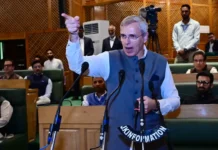
The political section across the region, however, had its reasons to welcome the ceasefire along the Line of Control. “I welcome the ceasefire. If it had happened 2-3 days ago, the lives we lost would not have been lost,” Jammu and Kashmir Chief Minister Omar Abdullah said. “Pakistan’s DGMO called our DGMO and the ceasefire was implemented. It is the responsibility of the current J&K government to assess wherever the damage has been done and wherever people are injured, they get proper treatment and also get relief under the government scheme.”
Former Jammu and Kashmir Chief Minister Mehbooba Mufti welcomed Trump’s intervention. For most of the day, she was keenly following the US response to the evolving situation in Jammu and Kashmir.
Her first tweet indicated her hope for happening. “Even though initially US Vice President J D Vance stated that America wouldn’t intervene beyond a certain point in the escalating tensions between India and Pakistan – now in light of the worrying intensity of the situation, US Secretary of State Marco Rubio has reached out to the Pakistani Army Chief, urging de-escalation, she wrote. Highlighting the fact that India is the world’s largest democracy,
an emerging power and the most populous nation, she suggested India must “embrace its leadership role in the subcontinent and take the first step to de-escalate”. The world, she said, is watching us. “This is the moment for India to stand tall and demonstrate that its true strength lies in its soft power and commitment to peace not in nukes.”
“US President’s intervention resulting in an immediate ceasefire between India & Pakistan is a welcome step,” Ms Mufti said in her second tweet after Trump tweeted. “I hope both countries will work towards everlasting peace for this region.”

Later in the evening, she wrote again. “The ceasefire between India and Pakistan is not just an agreement or one-time event -it’s a fragile hope, a step toward healing wounds that have festered for generations. There are warmongers and detractors who thrive on conflict, those who fear peace more than war,” she wrote. “But let compassion rise above hatred and wisdom silence the drums of war. May this ceasefire be the beginning of a future where peace is not the exception but the norm.”
Jammu and Kashmir National Conference (NC) president and five-time Chief Minister, Dr Farooq Abdullah, said the “primary responsibility” of the Government of India is to bridge the “trust deficit with Pakistan” and appealed to the neighbouring country to address India’s concerns regarding “cross-border terrorism”.
“Our people along the LoC and IB (International Border) have borne the brunt of the deteriorating situation between the two neighbouring countries. This measure will greatly alleviate the suffering of our people who have been caught in the crossfire,” Abdullah said. “Our party has always advocated for lasting friendship between India and Pakistan.”
“The announcement of the ceasefire by the Union Government is a welcome step. There is a sense of relief all around,” Sajad Lone, the president of the People’s Conference, said. “The inhabitants of the border areas in J&K have had a harrowing time. Hope they are able to resume their lives, and hope we as a society come to their aid and help them rebuild their homes.”
Kashmir’s chief cleric Mirwaiz Umar Farooq hoped India and Pakistan’s decision to talk with each other would bring stability and peace. “Alhumdulillah (Thank God), better sense has prevailed and India and Pakistan have agreed on a ceasefire,” Mirwaiz said. “It’s a huge relief for all, especially those living on both sides of the LoC… Precious lives were lost and shelter and livelihoods were destroyed.” He welcomed America’s involvement in negotiating the ceasefire.
Even during the ceasefire, India and Pakistan diverged in their portrayal of US involvement. India’s official statement claimed the truce was negotiated directly between the two countries, omitting any mention of American mediation.
On the other hand, Pakistan openly credited the United States, with Prime Minister Shehbaz Sharif thanking President Trump for his “proactive role” and acknowledging US senators Vance and Rubio for their contributions. Sharif described the development as a potential turning point for lasting peace in South Asia.