by Maleeha Sofi
SRINAGAR: Indian scientists have reported a major advance in cancer treatment after using artificial intelligence to redesign CAR T cell therapy, a complex and life-saving form of immune-based cancer care that has so far remained prohibitively expensive for most patients. The study, led by Dr Tanveer Ahmad, a Kashmiri-origin geneticist, has been accepted for publication in Nature Communications, one of the world’s leading peer-reviewed scientific journals.
CAR T cell therapy works by genetically reprogramming a patient’s own immune cells to identify and destroy cancer cells. While the treatment has delivered remarkable results globally, its long-term effectiveness is often limited because cancer cells evolve and evade immune detection, leading to relapse.
The new research demonstrates that artificial intelligence can be used to engineer more sophisticated CAR T cells that recognise cancer through multiple mechanisms and remain active in the body for longer periods, significantly reducing the risk of recurrence.
A key outcome of the work is its potential to transform access to treatment. Currently, CAR T cell therapy costs close to Rs 4 crore per patient in the United States, placing it far beyond the reach of most patients in low- and middle-income countries. Dr Ahmad’s team has developed an AI-designed CAR T molecule that can be manufactured in India for under Rs 25 lakh, without compromising on safety or quality.
Researchers explained that AI functioned as a high-speed virtual testing platform, enabling scientists to evaluate thousands of possible CAR T designs computationally before moving only the most promising and safest candidates into laboratory testing. This approach condenses years of trial-and-error research into a significantly shorter timeframe, reduces failure rates, and lowers overall development costs.
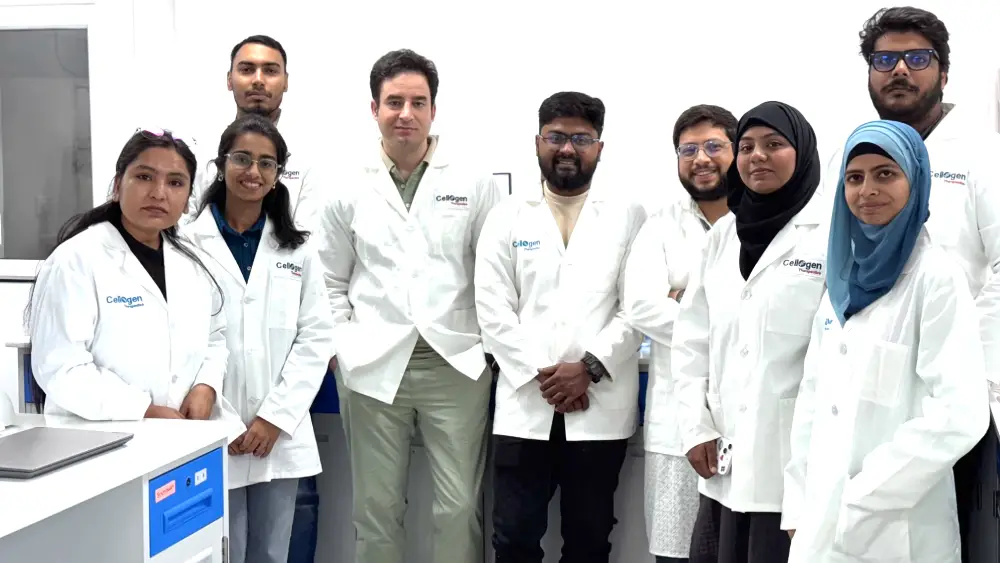
The research has already moved beyond the laboratory stage. One CAR T therapy developed through this AI-driven platform has entered clinical trials, while another advanced molecule is now progressing toward clinical testing. The scientific work was led by researchers Mohammad Sufyan Ansari and Varnit Chauhan, with clinical and academic support from doctors and scientists across multiple institutions in India. Funding for the study was provided by Cellogen Therapeutics Pvt Ltd, an Indian biotechnology company specialising in the development of affordable cancer therapies.
The project is being highlighted as a model of collaborative science, involving close coordination between research institutes, hospitals, clinicians, engineers, and data scientists, along with industry partners. Rather than emerging from a single laboratory, the breakthrough reflects a nationwide effort to combine advanced technology with clinical insight.
As the world moves into 2026, the researchers say the findings offer renewed hope that cutting-edge cancer treatments such as CAR T therapy can be made accessible not just in India but globally, ensuring that survival is no longer determined by geography or cost.
Dr Tanveer’s laboratories have had a series of breakthroughs in the last many years. Earlier, his team developed a patented, AI-driven diagnostic technology that combines digital pathology with genomic analysis to detect and predict oral cancer with high precision, marking a significant advance in cancer diagnostics. Led by Tanveer Ahmad and his PhD scholar Ms Nisha Chaudhary, the system analyses tissue images alongside genomic markers to accurately identify oral malignant and pre-malignant disorders and predict their progression to cancer, enabling earlier and more targeted clinical intervention.
Tanveer also developed a novel class of genetically engineered stem cells that show strong therapeutic potential against infectious and inflammatory diseases, including Covid-19. This research not only identified, at the molecular level, how SARS-CoV-2 triggers cellular damage and inflammatory mitochondrial DNA release in lung cells, but also demonstrated that specially engineered stem cells, named IMAT-MSCs, can reverse this damage by transferring healthy mitochondria to infected cells, restoring their function and reducing inflammation, marking a first-of-its-kind mechanistic and therapeutic advance in cell-based medicine.
Earlier, he led the development of a novel optogenetic tool that offers new insights into the molecular mechanisms underlying major brain disorders such as Alzheimer’s disease, depression and schizophrenia, in a collaborative study. The research combines light-sensitive molecular engineering with advanced neuroscience to precisely control and track brain protein behaviour, leading to the discovery of a previously unknown mechanism of neuronal protein trafficking termed “trans-synaptic retention”, a finding that could open new pathways for targeted gene, viral and mRNA-based therapies for neurodegenerative and psychiatric disorders.