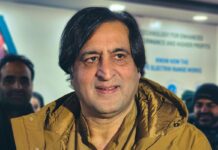
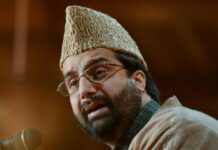
SRINAGAR: Seeking to contain the fallout from remarks that triggered widespread outrage in Kashmir, Peoples Democratic Party (PDP) president Mehbooba Mufti on Tuesday expressed regret over her controversial comments at New Delhi’s Jantar Mantar. She said an omitted word had altered the meaning of her statement.
The developments came on the PDP’s 27th foundation day, when the party sought to shift the focus from the controversy surrounding Mufti’s remarks to its long-standing political agenda of restoring Articles 370 and 35A, reopening cross-Line of Control routes, securing the release of political prisoners and pursuing a political resolution of the Kashmir issue.
Addressing party workers in Srinagar after returning from Delhi, Mufti acknowledged that the viral video of her remarks was genuine but maintained that it did not reflect what she intended to say. She explained that while speaking to multiple reporters after the Jantar Mantar protest, she inadvertently omitted the word “bahana” (excuse), making it appear as though she had justified the use of force against protesters in Kashmir.
“I will not say that it is a fake video. The video is correct. But the word I intended to use—that militancy provides an excuse (‘bahana banta hai‘)—slipped from my mouth in the rush of answering several questions. Because of that omission, my statement acquired a completely different meaning,” Mufti said. She added that if her incomplete remark had hurt the people of Jammu and Kashmir, she regretted it and apologised for the pain it had caused.
The controversy erupted after Mufti, while condemning the use of force against students protesting in Delhi, remarked that such scenes had long been witnessed in Kashmir “because there is militancy there.” Critics interpreted her words as justifying the use of pellet guns and force against Kashmiri civilians, drawing sharp criticism across the political spectrum.
Responding to the backlash, Mufti accused the ruling National Conference (NC) of exaggerating her comments for political gain.
“The National Conference is portraying it as if I signed the death warrants of Afzal Guru and Maqbool Bhat, or as if I had said ‘shoot the Kashmiris’,” she remarked, insisting that her words had been taken out of context. She also criticised Chief Minister Omar Abdullah for not raising the concerns of Kashmiri students during his own visit to Jantar Mantar.
Despite her clarification, the apology failed to calm the political storm.
Chief Minister Omar Abdullah argued that Mufti had merely expressed regret rather than offering an unconditional apology. He said there was a clear distinction between saying one regretted that people were hurt and accepting responsibility for the remarks themselves.
“There is a difference between regret and apology. She did not use the word maafi (apology),” Omar said, adding that the use of the word “if” in her statement suggested she had not unequivocally accepted wrongdoing. He also pointed out that Mufti herself had now confirmed that the controversial video was authentic, contradicting earlier claims by PDP leaders that it had been generated using artificial intelligence.
The National Conference’s chief spokesperson Tanvir Sadiq echoed that criticism, saying Mufti’s explanation amounted to a justification rather than an apology.
Sadiq argued that victims of the 2016 pellet injuries deserved a clear and unconditional apology, recalling that even young children had suffered life-altering injuries during the unrest. He also revived another controversy from Mufti’s tenure as chief minister, urging her to apologise for her “milk and toffee” remarks made during the 2016 protests.
Amid the controversy, the PDP sought to redirect public attention towards its political programme. Reading out resolutions adopted on the party’s foundation day, Mufti called upon party workers and supporters to observe August 5 through peaceful protests at district headquarters across Jammu and Kashmir.
The protests, she said, would reaffirm the party’s commitment to restoring the constitutional position of Jammu and Kashmir and resisting what she described as the continued erosion of democratic and federal principles. The resolutions also reiterated the party’s demands for the restoration of Article 370 and Article 35A, restoration of statehood, reopening of cross-LoC trade and travel routes, release of detainees held under preventive laws, greater control over Jammu and Kashmir’s natural resources, and the dignified return of displaced Kashmiri Pandits.
The episode has once again brought the legacy of the 2016 unrest back into political discourse in Kashmir. Hundreds of civilians, many of them young protesters, suffered eye injuries from pellet guns during Mufti’s tenure as chief minister, making any perceived defence of the security response particularly sensitive in the Valley. The latest controversy has reopened old wounds while simultaneously reshaping the political narrative ahead of the anniversary of the August 5, 2019 constitutional changes, when Jammu and Kashmir’s special status was revoked.