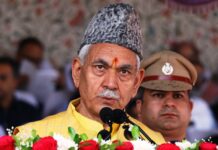
SRINAGAR: Mirwaiz-e-Kashmir Moulvi Mohammad Umar Farooq has expressed serious concern over a six-day eviction notice issued to Delhi’s historic Race Course Mosque, questioning the failure of Waqf authorities to protect a religious property that has been recorded in the Delhi Administration’s Gazette since 1977 and is also listed as a heritage site.
“Is this becoming the new normal for Muslim places of worship?” the Mirwaiz asked in a post on X, describing the development as “deeply disturbing” and raising questions about the effectiveness of safeguards available to Muslim religious endowments.
“This is precisely why we strongly opposed the Waqf amendments and increased government control through appointed nominees over Muslim religious endowments,” he said, adding that the inability to protect even a legally recognised mosque raised serious questions about the security of other religious properties.
The controversy centres on the mosque, located behind Safdarjung Tomb near the Prime Minister’s official residence in New Delhi, after its imam, Mohammed Haroon, alleged that the Land and Development Office (L&DO) had directed him to vacate the premises within six days. The mosque’s electricity and water connections were disconnected on October 7, while the closure of its gates restricted access for worshippers.
The issue has triggered protests and demands for intervention from Muslim religious leaders, political parties and community organisations, with questions being raised about the mosque’s legal status, the conduct of the authorities and the response of the Delhi Waqf Board.
Kashmir’s Grand Mufti and chairman of the Muslim Personal Law Board, Nasir-ul-Islam Farooqi, also expressed strong concern, urging Union Minority Affairs Minister Kiren Rijiju and the concerned Waqf authorities to intervene immediately.
“Unfortunately, developments of this nature reinforce the very concerns we have been raising about the security of Muslim religious properties and the accountability of the institutions entrusted with their protection,” Farooqi said, describing it as alarming that a mosque with a longstanding history could face such uncertainty.
He said the community’s trust would inevitably be shaken if institutions responsible for protecting religious properties failed to act.
Farooqi linked the controversy to concerns over the amendments to the Waqf legislation and the expanding role of government-appointed nominees in the management of Muslim religious endowments. He said the objections stemmed from genuine concerns about institutional independence, accountability and the protection of religious rights.
He also called for the mosque’s legal status to be examined and due process to be respected.
Shia cleric Aga Syed Hassan Mosavi Al-Safavi, president of the Anjuman-e-Sharie Shian, said the six-day notice raised questions about the protection of Muslim religious endowments and the accountability of Waqf authorities.
Describing Waqf properties as sacred trusts with religious and historical significance, he said they must be protected against arbitrary interference. He called for a review of the matter, observance of due process and effective safeguards for the mosque, stressing the need to preserve the autonomy of Waqf institutions.
The mosque’s imam, Mohammed Haroon, has claimed that he had been seeking the intervention of the Delhi Waqf Board for six months but had received no effective assistance.
Associated with the mosque for nearly four decades, Haroon said he had repeatedly approached the board’s chief executive officer and urged the authorities to take the matter to court. He also claimed that he had sought permission to pursue legal action himself, but no effective steps were taken.
In a video statement circulated on social media, Haroon said the disconnection of essential services and restrictions on access had made it increasingly difficult for him, his family and worshippers to use the premises.
“I have put in all my efforts but I’m miserable as the Waqf Board, which has legal authority to deal with such cases, is not standing by me and this mosque,” he was quoted as saying, appealing to people concerned about justice to help protect the property.
Haroon maintained that the mosque was an authorised heritage property and said a survey conducted in 2021 had not identified it as unauthorised or as an encroachment.
The mosque and its adjoining graveyard are recorded under entry number 18 in a Delhi Administration Gazette notification dated September 8, 1977. The property, identified as Masjid and Qabristan Race Course, covers two bighas and includes both the mosque and the graveyard.
The mosque is also listed as a heritage property by the New Delhi Municipal Council (NDMC), which included it in its heritage records through a notification dated October 1, 2009. It is reportedly listed at serial number 22 in the NDMC’s heritage register.
The L&DO has put up a warning notice at the site stating that the land belongs to the Government of India and that unauthorised occupation, encroachment, construction or other illegal activity could invite legal action. The notice identifies the Central Public Works Department as the implementing agency.
The Delhi Waqf Board subsequently wrote to the L&DO seeking protection for the mosque and the restoration of its electricity and water connections. In its communication, the board said the services were disconnected on October 7 during the removal of nearby jhuggis and houses, without prior notice or any apparent valid reason.
The board also pointed out that the mosque had a lawful electricity connection dating back to 1976. It urged the L&DO to examine the matter on priority and restore essential services to ensure that daily prayers could continue uninterrupted.
The development offered some relief to Haroon, who described the board’s letter as a positive step, while maintaining that the authorities needed to take effective action to secure the mosque’s future.
The dispute has also drawn sharp criticism from political leaders.
Aam Aadmi Party leader Amanatullah Khan, a former chairman of the Delhi Waqf Board, raised concerns over the reported threat to the mosque and said he would visit the site. He pointed out that the mosque predated Independence and was included in the NDMC’s heritage list.
AIMIM leader Shoaib Jamai described the reported action as arbitrary, arguing that the 1977 Gazette notification established the mosque’s recorded status. He questioned why the Waqf Board had not approached the court to challenge the action and alleged that the authorities were threatening the removal of the mosque without following proper legal procedures.
AIMIM chief Asaduddin Owaisi also questioned the Waqf Board’s handling of the matter, alleging that it had neither challenged the action nor taken effective steps to resolve the dispute. He called for urgent intervention by Rijiju and argued that the board’s chief executive officer could have acted to protect the property.
Owaisi also pointed to the absence of a constituted Delhi Waqf Board since 2023, raising questions about the institutional arrangements for protecting Waqf properties in the national capital.
Congress MP Syed Naseer Hussain accused the BJP government of pursuing what he termed “bulldozer politics” and urged the Delhi government to restore the mosque’s essential services and prevent any demolition attempt.
Meanwhile, a delegation of Jamiat Ulama-i-Hind, led by its general secretary, Maulana Muhammad Hakimuddin Qasmi, met Rijiju on Monday and submitted a memorandum seeking urgent intervention to protect the mosque and its adjoining graveyard.
The memorandum, submitted on behalf of Jamiat president Maulana Mahmood Asad Madani, cited the mosque’s inclusion in the 1977 Delhi Gazette and the NDMC heritage register. It called for a detailed report from the concerned authorities, verification of the property’s legal status and compliance with applicable laws and judicial orders before any demolition-related action.
The organisation also sought restoration of electricity and water supplies and unrestricted access for worshippers. Rijiju assured the delegation that he would make every possible effort to address the matter.
The dispute has emerged against the backdrop of wider concerns over the protection and management of Muslim religious properties in the capital. The controversy has revived questions about the role of Waqf institutions, their capacity to defend properties recorded in official documents and the implications of greater government involvement in their management.
Jamai also referred to the earlier controversy surrounding the Madina Masjid, popularly known as the Shalimar Mosque, in Shalimar Bagh, which was demolished in two main phases by the Municipal Corporation of Delhi for a road-widening project on Max Hospital Road.
The Race Course Mosque issue has therefore become a focal point for religious leaders and political representatives questioning whether existing legal and administrative safeguards are adequate to protect Muslim places of worship.
The immediate dispute concerns the status of the land and the eviction notice issued to the imam. The Gazette notification and heritage listing have been cited by the Waqf Board and community organisations in support of their demand for protection, while the L&DO notice maintains that the land belongs to the Government of India and warns against unauthorised occupation or activity.
The matter now hinges on the action taken by the concerned authorities to establish the property’s legal position, address the eviction notice and restore access and essential services to the mosque.