SRINAGAR: The death toll from the devastating flash floods in Nepal rose to 1,356 on Monday, while nearly 5,000 people remained missing as rescue teams continued searching flood-hit areas across the country.
According to the National Disaster Risk Reduction and Management Authority (NDRRMA), 4,994 people, including at least 589 foreign nationals, are still missing. A total of 13,396 people have so far been rescued.
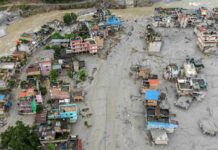
The floods were triggered by an ice-rock avalanche near the Nepal-Tibet border on August 26. The resulting surge in the Bhotekoshi River swept through settlements in northern and central Nepal, destroying homes, vehicles, roads and bridges and damaging several hydropower projects.
The disaster also claimed at least 43 lives on the Chinese side of the border, while more than 500 people are reported missing in Tibet, according to Chinese media.
Chitwan recorded the highest number of recovered bodies in Nepal at 363, followed by Nawalparasi East with 223, Nawalparasi West with 221, Nuwakot with 197, Rasuwa with 169, Gorkha with 75, Dhading with 70 and Tanahu with 38, NDRRMA data showed.
Authorities are facing major difficulties in identifying the victims. Only 98 bodies had been identified and handed over to relatives by Monday.
Many of the bodies recovered downstream were badly decomposed, severely damaged or found only in parts after being carried through water and mud. Police said the distance from the disaster sites has further complicated the identification process.
Nepal Police has been collecting DNA samples from relatives of missing people to establish the identities of unidentified victims and human remains. More than 1,000 unidentified bodies have been buried after samples were collected so that they can be identified later.
Hospitals have also struggled to handle the growing number of unidentified bodies, while relatives of missing people have been visiting medical facilities with photographs of their loved ones and checking images of recovered victims.
President Ramchandra Paudel visited the flood-hit districts of Nuwakot and Rasuwa on Monday to review search, rescue, relief and rehabilitation efforts.
The President’s Secretariat said Paudel was briefed by senior officials about ongoing rescue operations, relief distribution and the arrangements being made for displaced people.
Addressing the nation after his visit, Paudel urged the international community to take concrete steps towards climate justice for Nepal and other Himalayan countries facing the growing impact of climate change.
He also appealed to political parties and citizens to work together on relief and recovery efforts instead of engaging in blame or confrontation.
Nepal observed a national day of mourning on Monday, the 13th day since the disaster. The national flag was flown at half-mast at government offices and Nepali diplomatic missions abroad.
The Indian Embassy in Nepal expressed solidarity with the flood victims and said India would continue to support Nepal’s search, rescue and relief operations.
Meanwhile, families of people missing since the August 26 floods gathered at Maitighar Mandala in Kathmandu, carrying photographs and placards of their loved ones. They demanded greater efforts to locate those still unaccounted for and sought clearer information from the authorities.
NDRRMA Executive Chief Dharma Raj Uprety said security personnel had been deployed round-the-clock for search, rescue and relief operations. He said relief supplies had reached most affected areas, while helicopters were being used to deliver food and other essentials to places cut off by the floods.
Around 3,500 displaced people were staying in government-run holding centres in Rasuwa, Nuwakot and Dhading. Others have taken shelter in schools, temples, monasteries, community buildings, vacant offices and tents.
Search operations are also continuing at damaged hydropower projects, where 121 workers are believed to be trapped inside underground tunnels.
The Nepali Army said searches inside the tunnels would continue until rescuers achieve a breakthrough, with operations being carried out jointly with other security agencies.
Army personnel and officials from the Rasuwagadhi hydropower project have reached the damaged powerhouse and control point as part of the search for survivors.
Nepali Army spokesperson Raja Ram Basnet said rescue efforts had been divided into air, ground and tunnel operations. Teams from India and China are also assisting Nepali authorities.
Australian tunnel expert Arnold Dix, who was involved in the rescue of 41 workers trapped in the Silkyara tunnel in India in 2023, is helping with the search at the Chilime hydropower project tunnel.
At the same time, authorities have begun restoring vital infrastructure damaged by the floods. A 252-metre temporary track has been opened at the Krishnabhir section of the Prithvi Highway in Dhading, restoring a key road link between Kathmandu and western Nepal. Repairs are also under way on other damaged roads and bridges.
The disaster has also raised concerns over Nepal’s autumn tourism season, an important source of jobs and foreign exchange.
Tourism Minister Khadak Raj Poudel has launched a social media campaign under the hashtag “Nepal Calling” to reassure international visitors that the country remains open and Himalayan trekking routes are ready for tourists.
Tourism contributes around 6.7 per cent of Nepal’s GDP directly and indirectly and supports more than one million jobs. A decline in tourist arrivals could affect hotels, trekking agencies, guides, porters, airlines, restaurants and transport operators.