SRINAGAR: More than 400 students in Bandipora put aside their schoolbags and textbooks for a day and instead learnt to cook, organise, host, serve and work together, as PM Shri Government Secondary School Laharwalpora organised a Bagless Day that turned the school grounds into an unusual classroom.
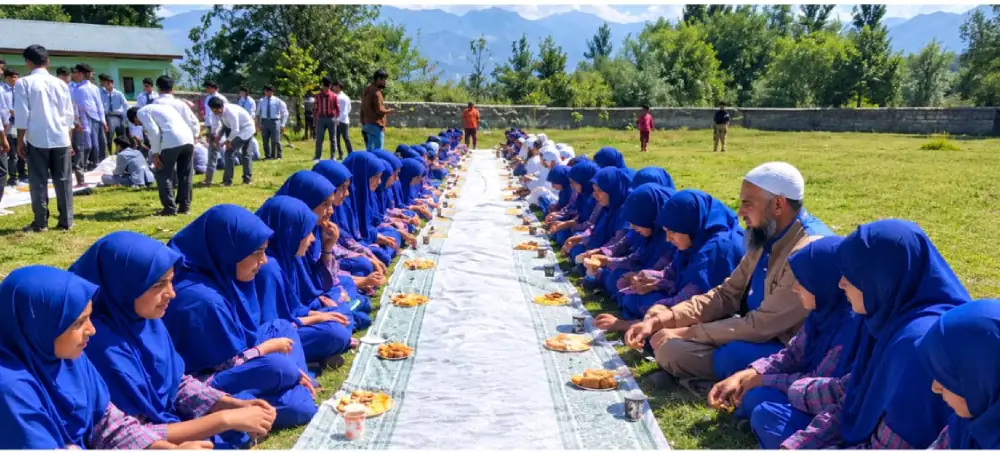
The initiative brought together students and teachers from four government schools for an inter-school programme of quizzes, public speaking, Naat and Tilawat, but its most distinctive lesson unfolded around a joint Dastarkhan, where more than 400 students and teachers sat together on the school lawns over Namkeen tea and traditional chapatis.
What made the gathering particularly notable was that the students themselves planned and executed the event. Rather than simply attending activities arranged by adults, they took responsibility for preparing food, organising the gathering, serving guests and managing different aspects of the programme.
The students prepared around 500 rootis for the occasion. Ten groups, each comprising five students, were assigned responsibility for making the chapatis, while tea was served in traditional Samawars on the school’s green lawns.
The exercise effectively turned the Bagless Day into a practical lesson in teamwork, leadership, hospitality, cooperation, resource management and event organisation.
The programme comes amid a wider discussion over the number of days children should spend in school and what constitutes meaningful schooling. While the debate has included demands for a five-day school week, there has also been a counter-view that a day away from conventional classroom instruction can be useful if it gives children opportunities to learn practical skills and engage in activities that are difficult to accommodate in a textbook-driven routine.
The Laharwalpora initiative offered one example of what such a day can look like: students remained in school, but the school itself changed character for the day.
Students and teachers from Middle School Reshi Mohalla, Primary School Hum Mohalla and Primary School Fisherman Colony, besides the host school, participated in the event.
The academic and cultural competitions provided another dimension to the programme. Students competed in Quiz, Public Speaking, Naat and Tilawat, with 60 students receiving stationery items as prizes in recognition of their participation and performance.
The prizes were distributed by Imam of Jamia Masjid Khursheed Anwar Nadi, who appreciated the participation of the students and the efforts of the schools to create learning experiences beyond conventional classroom teaching.
In his address, Nadi encouraged students to assist their parents in household work and to respect and follow their parents’ advice, stressing values of responsibility, service and respect for family and society.
For Javaid Jawad, Head of Institution of PM Shri Government Secondary School Laharwalpora, the exercise represented the broader purpose of experiential education.
The school has now organised its third Bagless Day, he said, in keeping with the experiential, holistic and skill-oriented approach envisaged under NEP 2020.
“Today, our students were not merely participants; they became organisers, hosts, cooks, servers and team leaders,” Jawad said. “They learnt how to plan an event, divide responsibilities, work in teams, manage resources and welcome guests. These are life skills that cannot always be learnt from textbooks.”
The event also demonstrated an important distinction in the concept of a “bagless” day: it need not mean a day without learning.
For the students at Laharwalpora, there were no conventional lessons to revise and no schoolbags to carry, but there were hundreds of decisions to make—from preparing food and allocating responsibilities to coordinating guests and working collectively.
By the end of the day, the school grounds had served as a kitchen, dining space, competition venue and training ground for practical skills, with the students learning through doing rather than simply listening.
The experiment left a simple proposition behind: a school day does not necessarily become less educational when textbooks are put aside. Under the right structure, cooking a roti, serving a guest, organising a team or sharing a Dastarkhan can itself become a lesson.