by Syed Shadab Ali Gillani
SRINAGAR: The Jammu and Kashmir Legislative Assembly session on Tuesday descended into a political battle, centring on Waheed Para’s private member bill that sought to regularise proprietary rights for residents living in houses constructed on state land. Chief Minister Omar Abdullah decisively rejected the proposal, drawing a clear distinction between historical land reform and what he termed an invitation to organised ‘land grab.’
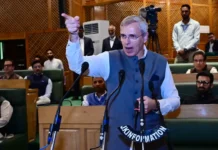
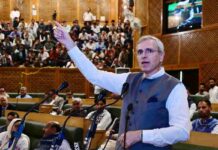
The Chief Minister did not mince words when addressing the proposed legislation, which was moved by People’s Democratic Party (PDP) MLA Waheed ur Rehman Para. Speaking against the bill’s introduction, Abdullah painted the measure not as an act of social justice, but as a dangerous legislative precedent that threatened to permanently erode the region’s land integrity.
“This bill would open floodgates for land grab,” Chief Minister Omar Abdullah asserted from the floor of the Assembly. He acknowledged the seemingly simple premise of the bill but immediately drew parallels to the Roshni scheme (The Jammu and Kashmir State Lands (Vesting of Ownership to the Occupants) Act, 2001).
“On the surface, it looks easy. If someone has constructed a house on government land, give the land to him,” Abdullah stated. He elaborated that the Roshni scheme, while initially intended to convert leasehold into freehold to generate revenue for power projects, had been corrupted when a subsequent government removed the crucial ‘pre-militancy’ cut-off clause. “There was a controversy, and there was talk of ‘land jehad’ and whatnot. It went to court, and we could not defend it there.”
Abdullah’s core objection was that Para’s proposal went even further than the flawed Roshni Act. “This proposal of the MLA is beyond the Roshni scheme. The bill does not put a cut-off timeline. We cannot do this.”
Omar argued that the government already possessed mechanisms to address genuine need through programmes like the Pradhan Mantri Awas Yojana (PMAY) for landless people, making a sweeping, non-selective regularisation law unnecessary and reckless.
The proposed legislation The Jammu and Kashmir (Regularisation and Recognition of Property Rights of Residents in Public Land) Bill, 2025, sought to grant special, one-time provisions to recognise the proprietary rights of residential structures built on State land, Kahcharai land (grazing land), Common land, and Shamilat land, specifically for residents in continuous physical possession of the property for over 20 years. Its stated goals were humanitarian: to provide legal security of tenure and enable residents to access financial services.
The urgency driving the bill stemmed directly from the massive anti-encroachment drive launched in the preceding years, which had seen thousands of hectares of land retrieved. For the PDP, the drive was less about justice and more about targeting the marginalised and creating a climate of fear, especially in the Kashmir Valley.
MLA Waheed Para stood firm in defence of his legislative initiative, positioning it as a moral imperative.
“While the state land is being allotted… will you render homeless those who are already living on the state land?” Para questioned the Chief Minister, challenging the logic of the government’s approach. Para then attempted to draw a connection to the foundational history of the National Conference itself, “You have a legacy of (National Conference founder) Sheikh Abdullah to live up to.”
The attempt to invoke the NC founder’s name, however, elicited a sharp rebuke from the Chief Minister. Abdullah immediately reminded the PDP MLA that his party had historically disowned the NC’s legacy.
“The PDP never owned NC’s legacy, but today he is remembering it,” Abdullah retorted, before delivering the crucial ideological distinction, “’Land to tiller’ (law implemented by Sheikh Abdullah) was giving rights to tillers, not land grabbers. There is a huge difference between land to tiller and what you are proposing. We don’t work under fear. I will say that floodgates would be opened by this bill.”
The debate quickly moved beyond the historical parallel, as the Opposition stepped in to dissect the bill’s financial and legal implications, echoing the government’s fears.
Sunil Sharma, Leader of the Opposition (LoP), articulated his party’s stance against what he termed an ideological failure.
“The bill by Waheed ur Rehman Parra was to encourage those people who, with a certain intention, promote land jihad and ‘demographic change.’ It was for this purpose that they had encroached on the land,” Sharma said, thanking the CM for defeating this “nefarious design of the PDP.”
Tanvir Sadiq, Chief Spokesperson and MLA of the National Conference, reinforced the CM’s argument with an emphasis on ideological consistency, reminding the House of the sanctity of the original ‘Land to the Tiller’ movement.
“If the outsiders come here, they will grab the land, and the domicile rules will have been changed. If their friend from Nagpur comes here and grabs land from anywhere, they say, give him the land,” Sadiq argued, reiterating that the NC and CM Omar Abdullah have already committed to giving five Marlas to genuinely landless people.
RS Pathania, a BJP leader and MLA, dismissed the proposal’s grounding. “This bill has no head or feet, and it was wrongly linked with Sheikh Muhammad Abdullah and the Land to Tiller law. Land to Tiller was a separate law altogether… Whosoever has control over State land, it will be theirs, it will be a loot.”
In the Assembly, Waheed Para addressed the fears of ‘land grab’ by insisting the legislation was aimed squarely at the residentially established. “The Chief Minister talks of ‘land grabbers’ and ‘floodgates,’ but the reality is that the ‘bulldozer moves’ made by the regime in the Muslim belt have created deep uncertainty and anxiety among people in Kashmir,” Para stated. He pointed out the fundamental inconsistency: the government was willing to give new land under PMAY, yet threatened to dismantle homes already built.
The bill was subsequently put to a voice vote by Speaker Abdul Rahim Rather. Having faced the combined weight of the government’s executive opposition and the legal scrutiny of the broader opposition, the bill received support from only three members. It was defeated by a voice vote and was not rejected at the admission stage.
Later, talking to the media, Waheed Para called the rejection an unfortunate betrayal of the people of Jammu and Kashmir.
“Our entire aim, ever since this party was formed in 2019, has been to address one of the most pressing issues in Jammu and Kashmir—the issue of land,” Para stated, referencing the anxiety following the abrogation of Article 370 and the two years of eviction notices for Gash Charai and Shamliat lands. “We introduced a bill to regularise the property rights of the people of Jammu and Kashmir. Unfortunately, Omar Abdullah chose to reject the bill.”