by Faiqa Masoodi
SRINAGAR: The Chenab Rail Bridge, now the world’s tallest railway arch soaring 359 metres above the riverbed in Jammu and Kashmir’s Reasi district, has captured global attention for its engineering audacity. Built to endure 260 kmph winds, magnitude-8 earthquakes, and last a century, it is India’s infrastructural moonshot. But beneath this Rs 1,486-crore marvel lies an equally remarkable, yet unsung story, one of grit, intellect, and quiet revolution, embodied by a woman who spent 17 years taming the mountain it stands on.
We are proud of Prof Madhavi Latha & her team’s contribution to the #ChenabBridge inaugurated by Hon’ble PM Narendra Modi🎉
The team worked on stability of slopes, design & construction of foundations, design of slope stabilisation systems incl. rock anchors to withstand hazards. pic.twitter.com/BApCSJTRZX— IISc Bangalore (@iiscbangalore) June 6, 2025
Meet Dr G Madhavi Latha, Professor of Geotechnical Engineering at the Indian Institute of Science (IISc), Bengaluru, who worked behind the scenes, anchoring the bridge, quite literally, into some of the most unforgiving geology in the Himalayas. While India celebrates the bridge as a symbol of national pride and progress, Dr Latha’s contribution reminds that true marvels are also built on perseverance, adaptability, and breaking invisible barriers.
Born in Yedugundlapadu, a small village in Andhra Pradesh, Madhavi Latha was the first engineer in her community. She originally aspired to become a doctor, but economic constraints steered her into engineering, a field more accessible through government institutions. She graduated in civil engineering from JNTU Kakinada, topped her class at NIT Warangal in geotechnical engineering, and earned a PhD from IIT Madras in 2000. In 2003, she joined IISc as its first female faculty member in civil engineering, at a time when even a women’s toilet didn’t exist in the department.
That same year, the Chenab Bridge began to take shape on drawing boards.
When Northern Railways and Afcons Infrastructure faced escalating technical uncertainty at the bridge site in 2005, they brought in IISc. Dr Latha was tapped for her expertise in rock mechanics, soil behaviour, and geosynthetics. As the site revealed fractured rock faces, hidden cavities, and slopes prone to collapse, Dr Latha’s work became central to the project’s survival.
Over the next 17 years, she visited the remote Reasi site countless times, navigating landslides, sub-zero temperatures, and sceptical glances in a field still dominated by men. She led the geotechnical consulting on foundation design and slope stabilisation, developing dynamic strategies to adapt to the unpredictable terrain.
Rather than rely solely on pre-approved blueprints, Dr Latha championed a “design-as-you-go” philosophy, unusual in a government mega-project. This meant recalculating load-bearing capacities on-site, repositioning anchor bolts, adjusting grouting levels, and customising rock retention measures every week.
“It was not just engineering,” she recalled in a recent interview. “It was problem-solving at every step. No textbook had answers for what we were encountering.”
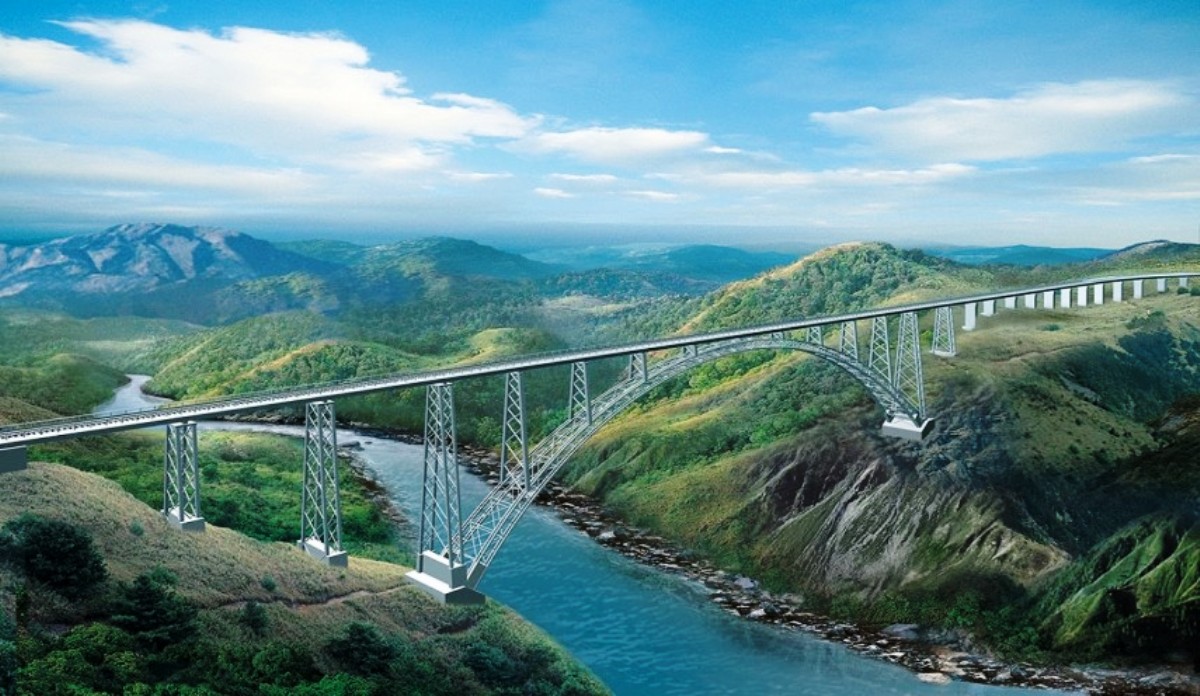
The Chenab Bridge is no ordinary crossing. Stretching 1,315 metres with a 467-metre-long steel arch, it overshadows the Eiffel Tower and will link the Kashmir Valley to the rest of India by rail, cutting the Katra-Srinagar travel time to less than three hours. But it also runs through one of the most seismically volatile zones in the subcontinent.
To handle these extremes, Dr Latha’s designs incorporated tens of thousands of metres of rock anchors, cement grouting, and reinforced abutments. Her engineering ensured that the bridge’s foundations could bear vertical and lateral loads under extreme geological stress.
At critical points during tunnel boring or slope excavation, she was on site through the night, guiding teams as geological surprises upended plans. Each intervention she made pushed the project a little further from peril and closer to completion.
Her work was not just academic. It was field-tested, rigorously monitored, and often urgent.
 In 2022, as full-speed train trials began, she published her field experiences in the Indian Geotechnical Journal in a paper titled Design as You Go: The Case Study of Chenab Railway Bridge. It formalised the engineering innovations her team introduced, and is now considered a case study for mega-projects in geologically sensitive zones.
Recognition followed. In 2021, she received the Best Woman Geotechnical Researcher award from the Indian Geotechnical Society. In 2022, she was included in the Government of India’s 75 Women in STEAM list. But accolades are an afterthought in her narrative.
“What I want,” she says, “is for young women to realise that rock slopes, mines, and bridges are not beyond them. They belong here, too.”
Dr Madhavi Latha’s presence in a project as grand and militarily strategic as the Chenab Bridge is not just a professional feat; it’s a social milestone. At a time when women remain underrepresented in India’s STEM workforce, her work has moved mountains.
And while the bridge itself may stand for decades, her quiet 17-year revolution, fought in meetings, tunnels, laboratories, and field sites, has already carved a longer-lasting legacy. She trekked through dangerous terrain, crossed rivers by boat, and camped at remote sites where even a small geotechnical error could have catastrophic consequences. Working in a high seismic risk zone, she led complex ground interventions like cement grouting and high-precision rock anchoring, reinforcing the mountainside with more than 66 kilometres of steel anchors. Often on site overnight, she guided excavation teams in real time, her input critical when unknown geological surprises emerged mid-construction. Her commitment culminated not just in a structure, but in a standard of engineering resilience.
When she finally visited the completed bridge in 2022, it was a personal milestone — a mother showing her children what 17 years of quiet resolve could achieve. Though the Chenab Bridge is her most visible triumph, her career also includes serving as Editor-in-Chief of the Indian Geotechnical Journal (2016–2022) and mentoring the next generation at IISc, extending her legacy far beyond steel and stone.
In every vibration it absorbs, in every storm it withstands, and in every train that crosses it, the Chenab Bridge carries the signature of a woman who proved that engineering marvels don’t need spotlights, they just need someone willing to build them, one bolt, one idea, one late night at a time.
(The news story is based on the huge reportage on the lady engineer and her contributions that appeared in the media)