SRINAGAR: A wave of unrest has gripped Los Angeles after federal immigration raids across the city triggered widespread protests, isolated acts of violence, and the extraordinary deployment of 2,000 National Guard troops by the Trump administration.
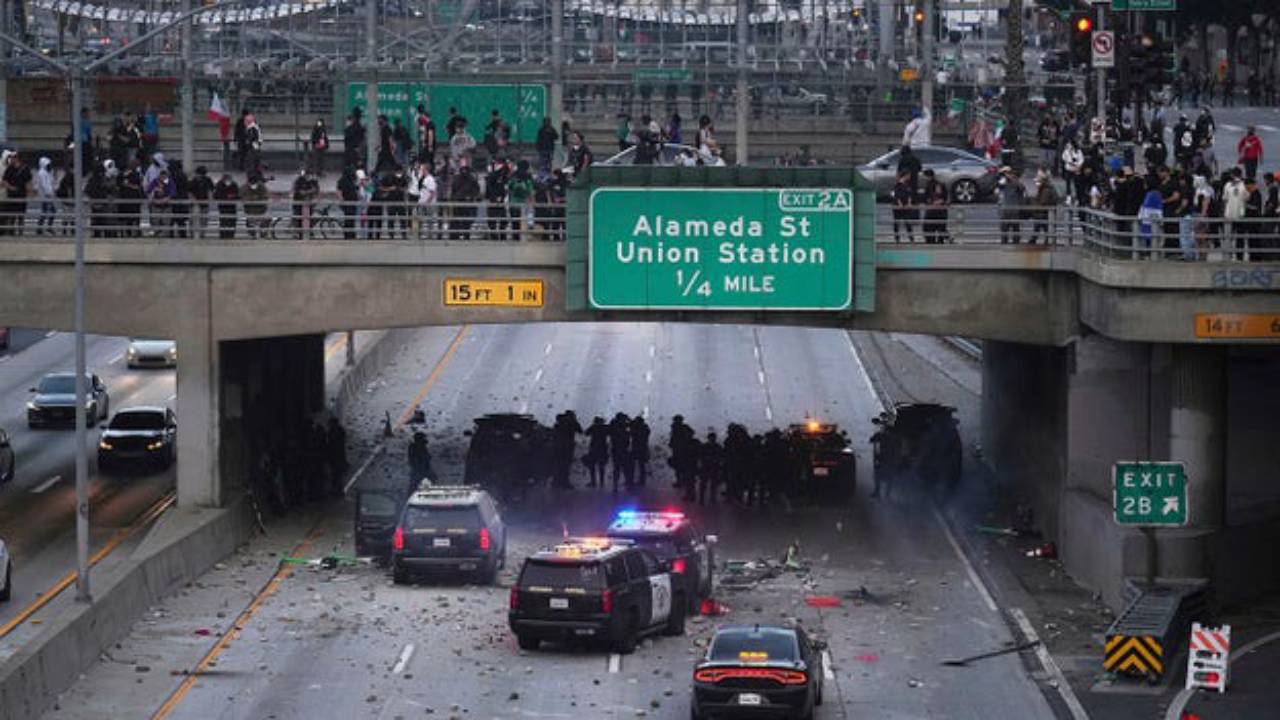
The flashpoint came Friday, when US Immigration and Customs Enforcement (ICE) launched simultaneous operations in multiple locations, including garment factories and commercial centres, detaining 44 undocumented individuals. Among those arrested was David Huerta, the president of the powerful SEIU California labour union, who was injured and taken into custody while filming one of the raids. He has been charged with obstructing federal officers.
As word of the raids spread, protesters began gathering outside detention centres and federal facilities, particularly the Metropolitan Detention Centre in downtown Los Angeles. The crowd chanted slogans like “ICE go home” and “No justice, no peace,” as law enforcement used pepper balls, tear gas, and flash-bang grenades to disperse demonstrators. A fire was set in a vehicle near Paramount, and several federal agents and protesters sustained minor injuries during the clashes. By Sunday, the protests had spread to Compton and other areas of South Los Angeles.
Video footage aired on local networks showed federal agents in riot gear and military-style vehicles confronting crowds. In a particularly chaotic moment in Paramount, protesters allegedly threw rocks and even Molotov cocktails at officers. The Los Angeles Sheriff’s Department confirmed that at least two individuals had been arrested on charges of assaulting law enforcement.
In response, President Trump invoked Title 10 of the US Code and ordered the deployment of the National Guard, stating that California’s leadership had failed to maintain order. He declared that Los Angeles was being “invaded” by “illegal aliens and criminals,” and called for immediate “liberation” of the city through federal force. He further warned that California officials who obstructed deportation efforts could face prosecution.
The Trump administration’s aggressive posture has drawn sharp rebuke from state officials. Governor Gavin Newsom called the deployment a “serious breach of state sovereignty” and “a complete overreaction,” asserting that no unmet security need justified federal intervention. Mayor Karen Bass accused the White House of “provoking chaos” for political gain and said, “This is not about public safety, this is about advancing an agenda.”
Federal officials, including Secretary of Defence Pete Hegseth, have indicated that the National Guard’s presence could last up to 60 days, and that active-duty Marines from Camp Pendleton are on standby. The deployment marks a rare use of federal military personnel in a US city without a governor’s request, something that has not occurred in California since the Watts Riots of 1965.
Meanwhile, communities directly impacted by the violence and crackdowns have been left to clean up the debris. In Compton, Ernest Melendrez and his family spent Sunday morning sweeping up tear gas canisters and graffiti-stained pavement near a Home Depot that had served as a staging ground for one of Saturday’s most intense confrontations. “People have the right idea, just the wrong approach,” Melendrez said. “You need some community support, or this is what happens.”
The damage to local businesses, many immigrant- and minority-owned, has added to the anguish. Residents voiced frustration that national political battles were playing out in their neighbourhoods with little regard for the human cost. “They don’t care about Compton,” said Melendrez’s daughter, Elaina Angel. “But I don’t think they were counting on us to come out and clean it up.”
The protests stem not only from the ICE raids themselves but also from growing fear among Los Angeles’ immigrant communities. One in three city residents is foreign-born, and the city officially became a sanctuary jurisdiction last November. Local laws prevent Los Angeles authorities from cooperating with federal immigration enforcement, a position that has enraged the Trump administration, which is seeking to identify and punish noncompliant cities.
Federal officials argue that the raids targeted employers suspected of harbouring undocumented migrants using falsified documents. Homeland Security spokesperson Yasmeen Pitts O’Keefe said that four warrants had been executed in central Los Angeles and that additional arrests may follow.
Yet, even among law enforcement and legal experts, the approach has raised eyebrows. Erwin Chemerinsky, dean of the UC Berkeley School of Law, said that while the president can invoke the Insurrection Act, doing so in this case could appear to be a political manoeuvre rather than a justified public safety measure.
Political reaction has fractured sharply along partisan lines. Senator Bernie Sanders warned that the administration’s actions reflect “a president moving this country rapidly into authoritarianism.” Former Vice President Kamala Harris, speaking from Los Angeles, called it a “cruel, calculated agenda to spread panic and division.” Meanwhile, Republican House Speaker Mike Johnson defended Trump, saying the president “stepped in where Gavin Newsom failed.”
As the city braces for further unrest, officials have not ruled out more demonstrations, stone pelting and brick brickbating and possible escalations. The Department of Homeland Security continues to maintain a heavy presence in immigrant-heavy areas, and hundreds of National Guard troops remain stationed at sensitive locations.
(The report is based on reportage of the unfolding events from Los Angeles, including AP, LAT, and other global media.)