SRINAGAR: The Supreme Court of India has delivered a judgment on the custodial torture of Jammu and Kashmir Police constable Khursheed Ahmad Chohan, ordering an immediate Central Bureau of Investigation probe, arrest of implicated officers within a month, and compensation of Rs 50,00,000 to the victim for gross violation of his fundamental rights.
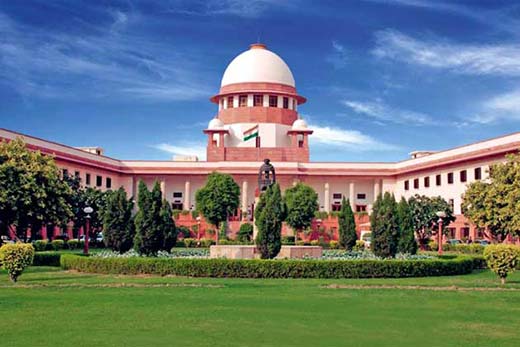
The bench of Justices Vikram Nath and Sandeep Mehta was hearing Chohan’s appeal challenging the Jammu and Kashmir High Court’s September 2024 refusal to quash FIR No. 32 of 2023 registered against him under Section 309 of the Indian Penal Code for attempted suicide. Chohan alleged that he was illegally detained for six days from February 20 to February 26, 2023, at the Joint Interrogation Centre, Kupwara, where he was subjected to torture that included complete mutilation of his genitalia.
According to the judgment, Chohan, a selection grade constable, was summoned under the pretext of assisting in the investigation of narcotics cases but was instead confined in a barrack and subjected to inhuman treatment. The medical records produced before the Court revealed shocking details: complete amputation of both testicles, severe lacerations on the scrotum, multiple bruises on buttocks and thighs, tenderness on palms and feet suggesting electric shocks, vegetative particles in the rectum indicating assault, and multiple fractures throughout the body.
The Kupwara police maintained that Chohan inflicted these injuries upon himself using a razor blade out of panic when his alleged accomplice in a narcotics case was arrested. However, the Supreme Court rejected this version as “utterly implausible and manifestly concocted,” observing that the nature and extent of the injuries could not possibly be self-inflicted. Justice Mehta, writing for the bench, stated, “The transformation of a torture victim into an accused through a fabricated theory of attempted suicide reflects institutional malice of the highest order.”
Chohan’s wife had made repeated attempts to have an FIR registered against the responsible officers but was refused. When she filed a written complaint on March 1, 2023, no action was taken. Instead, the police filed FIR No. 32 of 2023 under Section 309 IPC against Chohan. He approached the High Court seeking quashing of this FIR and a direction to register a case against the officers for custodial torture.
The High Court, in September 2023, directed the Senior Superintendent of Police, Kupwara, the very officer accused of complicity in the torture, to conduct a preliminary inquiry into the allegations. It refused to quash the suicide attempt FIR. On September 19, 2024, the Division Bench dismissed Chohan’s appeal, holding that a Letters Patent Appeal was not maintainable as the matter had a criminal nature.
The Supreme Court not only quashed FIR No. 32 of 2023 but also criticised the High Court’s approach. It held that continuing prosecution of an alleged suicide attempt by a victim of custodial torture would be a travesty of justice. The bench underscored that custodial torture is a grave violation of Article 21 of the Constitution and cannot be justified under any circumstance.
The Court cited the landmark ruling in D.K. Basu v. State of West Bengal to reiterate that “custodial torture is a naked violation of human dignity and whenever human dignity is wounded, civilisation takes a step backward.” The judgment also noted that the mandatory guidelines in Lalita Kumari v. State of Uttar Pradesh required immediate registration of an FIR for cognisable offences, making the High Court’s direction for a preliminary inquiry legally unsustainable.
The Supreme Court ordered the Central Bureau of Investigation to register a fresh FIR based on the complaint dated March 1, 2023, and investigate not only the torture but also “systemic and institutional failings” at the Joint Interrogation Centre, Kupwara. The bench directed that all implicated officers must be arrested within one month and the investigation concluded within three months.
Additionally, the Union Territory of Jammu and Kashmir was directed to pay Rs 50,00,000 to Chohan as interim compensation. The Court clarified that this amount could later be recovered from the officials found guilty after the CBI investigation.
Justice Mehta, in the concluding portion of the judgment, observed, “Only an independent investigation by the CBI can restore public faith in the criminal justice system, ensure that this dehumanising crime does not go unpunished, and reveal the truth without institutional bias or cover-up attempts.”