CHENNAI: India’s fiscal federalism is increasingly out of sync with the country’s transformed political economy, and the time has come for a new federal compact that treats states as active economic agents rather than passive recipients of central transfers, economist and former Jammu and Kashmir Finance Minister Dr Haseeb A Drabu argued on Tuesday.
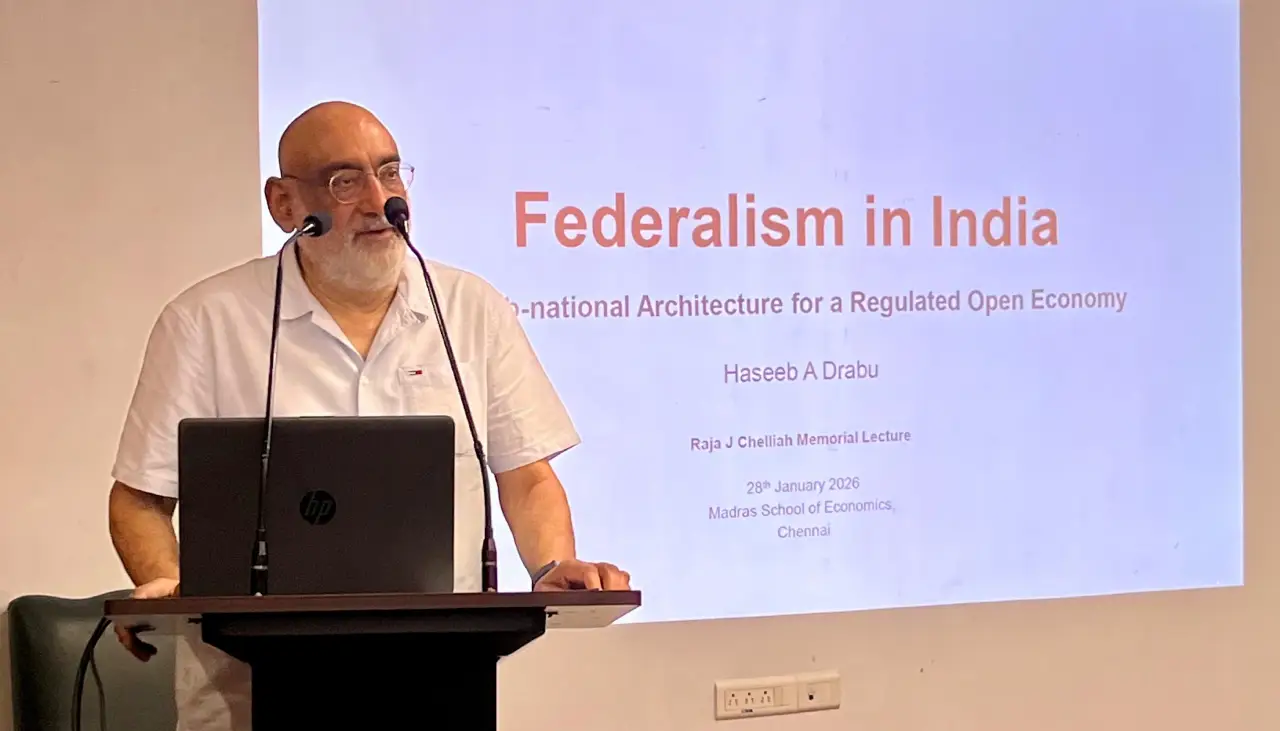
Delivering the prestigious Dr Raja J Chelliah Memorial Lecture for 2026 at the Madras School of Economics (MSE), Dr Drabu spoke on “Federalism in India: Sub-national Architecture for a Regulated Open Economy”, offering a wide-ranging critique of India’s existing Centre–State fiscal framework and outlining the contours of reform required to align it with contemporary economic realities.
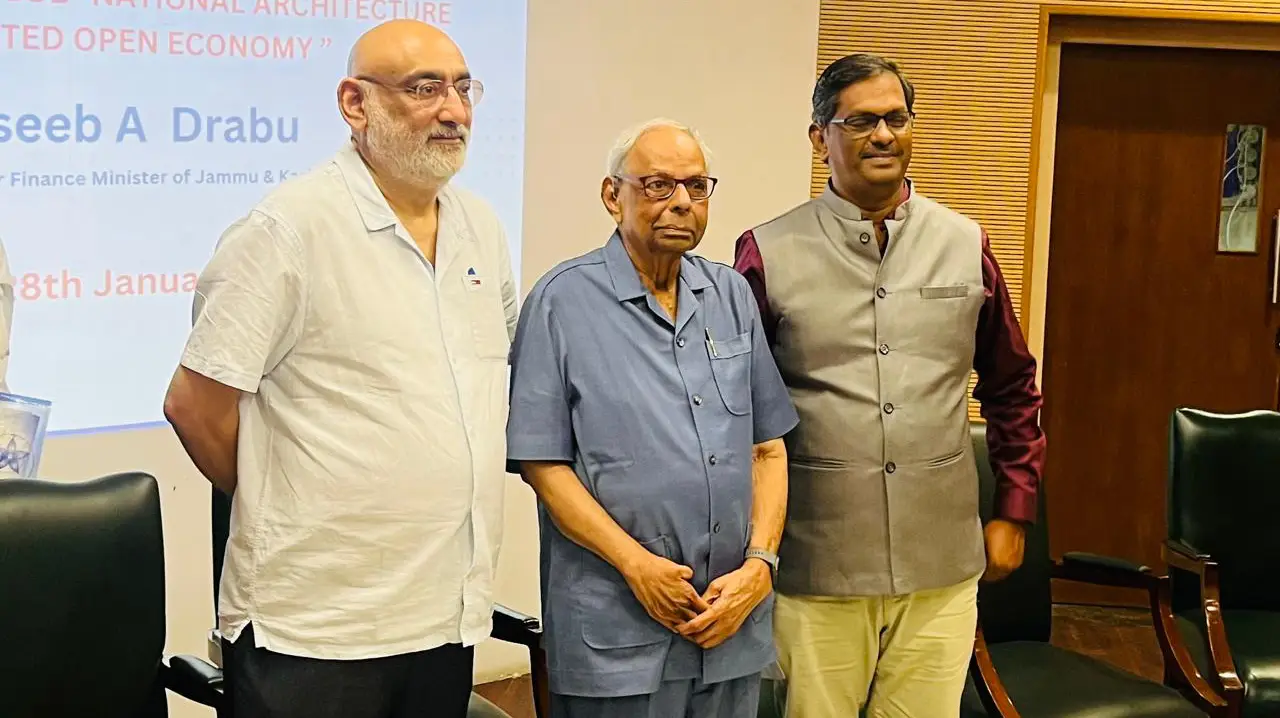
The lecture was chaired by eminent economist and former Reserve Bank of India Governor C. Rangarajan, who described Dr Drabu’s arguments as deserving “deeper discussion and deliberation within both academic and policy circles,” adding pointedly that “a solution must be found.”
In a lighter moment that nevertheless captured the intellectual tension of the debate, Rangarajan remarked, “Haseeb calls me his guru, and now the shishya is rebelling,” drawing laughter from the audience even as he underscored the seriousness of the challenge posed to established thinking on fiscal federalism.
Dr Drabu’s central contention was that while India’s economy and governance structures have undergone profound structural change over the past three decades, its fiscal federal architecture has remained largely static.
He noted that India has moved decisively from a state-led socialist model to a regime of business liberalism; governance has evolved from a two-tier Centre–State system to a constitutionally recognised three-tier structure with empowered local governments; and policymaking is now dominated by a regulatory state, characterised by independent regulators and rule-based oversight rather than direct administrative control.
Most significantly, he argued, the introduction of the Goods and Services Tax (GST) has fundamentally altered India’s tax sovereignty by pooling indirect taxation powers, marking a decisive break from the past.
“Fiscal federalism has not kept pace with these transformations,” Dr Drabu said, pointing to what he described as a growing misalignment between economic governance and the constitutional framework governing Centre–State relations.
Critiquing the prevailing transfer-centric model, Dr Drabu called for a shift towards a more dynamic federal compact—one that recognises states as economic agents, regulators, and development strategists, rather than merely as administrative units dependent on central allocations.
He argued that sub-national governments today play a critical role in shaping markets, regulating economic activity, and competing for investment. Yet, India’s fiscal architecture continues to treat them primarily as spending arms of the Centre.
Redefining the relationship between the state and markets at the sub-national level, he said, is essential for sustaining growth in an increasingly open and regulated economy.
Responding to the lecture, Rangarajan, who has served as RBI Governor, Chairman of the Prime Minister’s Economic Advisory Council, and Chairman of the Finance Commission, said Dr Drabu’s propositions raise fundamental questions about India’s fiscal future.
“These ideas merit deeper discussion and deliberation,” he said, signalling that the debate on federal reform must move beyond academic forums into the realm of policy action.
Instituted by the Madras School of Economics, the Dr Raja J Chelliah Memorial Lecture honours the legacy of India’s pioneering public finance economist, widely regarded as the architect of modern tax reform in the country. Dr Chelliah chaired the landmark Tax Reforms Committee of 1991, served on the Planning Commission and Administrative Reforms Commission, worked with the IMF and World Bank, and was awarded the Padma Vibhushan in 2007.
Dr Drabu’s selection places him in a distinguished line of speakers that includes former RBI Governors C Rangarajan, YV Reddy and Urjit Patel, as well as Montek Singh Ahluwalia, Vijay Kelkar and Arvind Subramanian.
A former member of the Planning Commission, Finance Commission, Economic Advisory Council to the Prime Minister and the GST Council, Dr Drabu has long engaged with questions of federal finance and institutional reform. His lecture, attended by faculty, students, bureaucrats and scholars, is expected to energise ongoing debates on reimagining India’s Centre–State fiscal relations for a rapidly changing economic landscape.
As Rangarajan’s quip suggested, the “rebellion” of the shishya may well prove to be an invitation to rethink some of the most settled assumptions of India’s fiscal federalism.