If you’ve noticed a receding hairline around your temples, thin patches near your forehead, or small bumps along your scalp’s edges, your hairstyle might be doing more damage than you realize. Traction alopecia is one of the most preventable forms of hair loss, yet it often goes unnoticed until the damage has already begun. Understanding what causes it and how to stop it early can make a real difference.
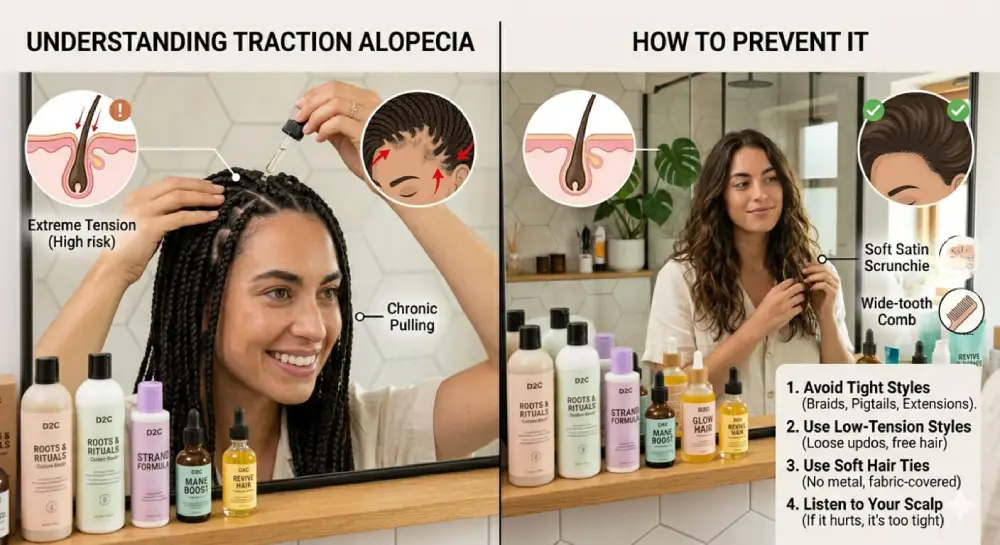
What Is Traction Alopecia?
Traction alopecia is hair loss caused by repeated or prolonged tension on the hair follicles. Unlike genetic hair loss or hormonal imbalances, this type is entirely mechanical. It happens when hair is pulled too tightly over a long period of time, gradually weakening the follicle and eventually stopping hair growth altogether.
The tricky part is that it develops slowly. You won’t wake up one morning with a bald patch. It creeps in over months or years, which is exactly why many people dismiss the early signs or attribute them to something else entirely.
Who Is Most Affected?
This condition is more common than most people think, and it cuts across age, gender, and ethnicity. That said, certain groups are more at risk:
- Women who wear tight braids, cornrows, weaves, or high ponytails regularly
- Ballet dancers and athletes who pull hair back tightly on a daily basis
- People who use hair extensions or hair bonding regularly
- Men who wear tight dreadlocks or frequently use headgear that grips the hairline
- Children whose hair is styled tightly for school or cultural practices
The front hairline and temples are the most vulnerable areas because the hair there is finer and the skin is more sensitive. Over time, chronic pulling at these points causes inflammation, follicle damage, and eventually scarring if left untreated.
Why the Follicle Gets Damaged
To understand why traction alopecia happens, it helps to know a little about how hair grows. Each strand of hair is anchored inside a follicle, a small pocket in the scalp. The follicle goes through cycles of growth, rest, and shedding. When the hair is constantly under tension, it disrupts this cycle. The follicle is pulled at an unnatural angle repeatedly, which triggers inflammation around it.
In the early stages, this inflammation is reversible. The follicle is stressed but still functional. If the tension continues, however, the surrounding tissue begins to scar. Scar tissue doesn’t support hair growth. This is when traction alopecia moves from a temporary problem to a permanent one. That distinction matters because early intervention works, but late intervention often doesn’t.
Recognizing the Early Signs
Catching this condition before scarring sets in is critical. The early warning signs are subtle but worth paying attention to:
- Small pimples or pustules along the hairline after styling
- Soreness or tenderness at the scalp’s edges after wearing a tight style
- Short, broken hairs around the temples or forehead
- A hairline that appears to be slowly moving backward
- Itching or scaling along the edges of the scalp
If you notice any of these consistently, it’s a signal that your hair follicles are under too much stress. Ignoring them because “it doesn’t look that bad yet” is a common mistake that delays recovery.
How to Prevent and Manage It
Prevention is straightforward in theory, though it requires changing habits that may feel deeply routine. A detailed look at Traction Alopecia outlines how different styling choices contribute to the condition and what changes actually help. In practice, here’s what makes the biggest difference:
- Avoid styles that pull tightly at the roots, especially every day
- Alternate between loose and tight styles to give your scalp recovery time
- If you use extensions or weaves, take breaks of at least a few weeks between applications
- Choose looser braiding techniques and ask your stylist to leave the roots relaxed
- At night, use a silk or satin pillowcase and avoid tight sleeping caps that grip the hairline
- If you notice scalp soreness after styling, take it seriously rather than pushing through
Some hair care approaches, like those used by Traya, focus on identifying the root cause of hair loss, whether mechanical, hormonal, or nutritional, before recommending any treatment. That kind of structured thinking is useful here too, because traction alopecia is sometimes layered with other issues like scalp inflammation or nutritional deficiencies that slow recovery.
Final Thoughts
Traction alopecia is one of those conditions where the solution is genuinely within reach, but only if you act before permanent damage sets in. The hairstyles you love don’t have to go away entirely, but they may need to change in how often you wear them and how tightly they’re applied. Your scalp sends signals early. Paying attention to them is the simplest form of prevention there is.