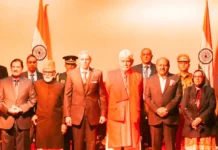
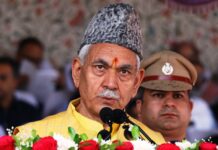
SRINAGAR: Jammu Kashmir Lieutenant Governor Manoj Sinha on Friday led the Union Territory’s official celebrations marking the 150th anniversary of India’s national song Vande Mataram, even as the event sparked a political and religious row in the Valley over a government directive requiring its observance in schools.
The main event, organised by the Department of Culture in Jammu, saw Sinha paying rich tributes to Rishi Bankim Chandra Chattopadhyay, who composed Vande Mataram in 1875. The Lieutenant Governor also visited an exhibition dedicated to the song and joined a mass recitation of its full version alongside senior officials, Members of Parliament, and citizens from across the Union Territory.
“Our national song, written on Akshaya Navami in 1875, gave poetic expression to India’s awakening spirit of unity, self-respect, and devotion to the motherland,” Sinha said. “Rishi Bankim Chandra strengthened the bond between Maa Bharti and her sons and inspired people to secure independence.”
Reaffirming what he called a collective duty toward national progress, Sinha added, “Our commitment and dedication to the motherland will take our nation to its destiny of a Viksit Bharat. The young generation must remember they are inheritors of this great civilisation, and their contribution to the progress and prosperity of society will be a fitting tribute to Maa Bharti.”
The event, attended by Lok Sabha MP Jugal Kishore Sharma, Rajya Sabha MP Ghulam Ali Khatana, Chief Secretary Atal Dulloo, and senior bureaucrats including Principal Secretaries Chandraker Bharti and Brij Mohan Sharma, marked the culmination of a week-long series of cultural programmes across Jammu and Kashmir. Similar celebrations were held in government offices, schools, and police establishments, with the Jammu and Kashmir Police hosting a separate commemorative event at the Police Control Room in Srinagar.
Director General of Police Nalin Prabhat led officers and personnel in a collective rendition of Vande Mataram, which was followed by renewed pledges of national service and integrity. “The powerful rendition symbolised unity, dedication, and devotion to the motherland — values that the song has inspired for generations,” the police said in a statement.
However, the commemoration drew sharp reactions from political and religious quarters in Kashmir after the Department of Culture issued a circular instructing all schools to organise musical and cultural programmes marking the 150th year of Vande Mataram and ensure participation of both students and staff.
Chief Minister Omar Abdullah distanced his government from the directive, saying no decision had been approved by the cabinet or the education minister. “This decision has not been made by the cabinet, nor has the education minister signed off on it,” Abdullah told reporters in Budgam while campaigning for a bypoll. “We should decide what happens in our schools without outside dictation on these matters.”
The directive had already drawn strong criticism from the Muttahida Majlis-e-Ulema (MMU), an umbrella group of Muslim religious organisations headed by Mirwaiz Umar Farooq. In a statement, the MMU described the order as “coercive and un-Islamic,” arguing that it compelled Muslim students to participate in acts that contradict their faith.
“Singing or reciting Vande Mataram is un-Islamic, as it contains expressions of devotion that contradict the fundamental Islamic belief in the Oneness of Allah (Tawheed),” Mirwaiz’s office said. “While Muslims are encouraged to love and serve their homeland, it should not be through acts that conflict with their faith.”
The MMU urged both the Lieutenant Governor and the Chief Minister to withdraw what it termed a “coercive directive” and ensure that “no student or institution is compelled to act against their religious beliefs.” The statement alleged that the government’s order reflected “an attempt to impose an RSS-driven Hindutva ideology on a Muslim-majority region under the guise of cultural celebration.”
No formal response was issued by the administration regarding the MMU’s objections.
The controversy comes as the central government marks 150 years of Vande Mataram across India. Written by Bankim Chandra Chattopadhyay on November 7, 1875, and published in the literary journal Bangadarshan as part of his novel Anandamath, the song invoked the motherland as a symbol of strength, prosperity, and divinity.
During the early twentieth century, Vande Mataram became a rallying cry of India’s freedom movement, sung at political gatherings and protests led by figures such as Bipin Chandra Pal, Lala Lajpat Rai, and Subhas Chandra Bose. After independence in 1947, it was adopted as India’s national song, distinct from the national anthem Jana Gana Mana.
While supporters view Vande Mataram as an enduring emblem of unity and patriotism, its religious imagery has long been a point of contention in regions with significant Muslim populations. The present dispute in Jammu and Kashmir underscores how historical symbols of nationalism continue to evoke divergent interpretations in a politically sensitive landscape.
As celebrations continue nationwide, the debate over faith, identity, and national expression in Jammu and Kashmir has once again placed the song — written 150 years ago to inspire unity — at the centre of contemporary discord.