by Umaima Reshi
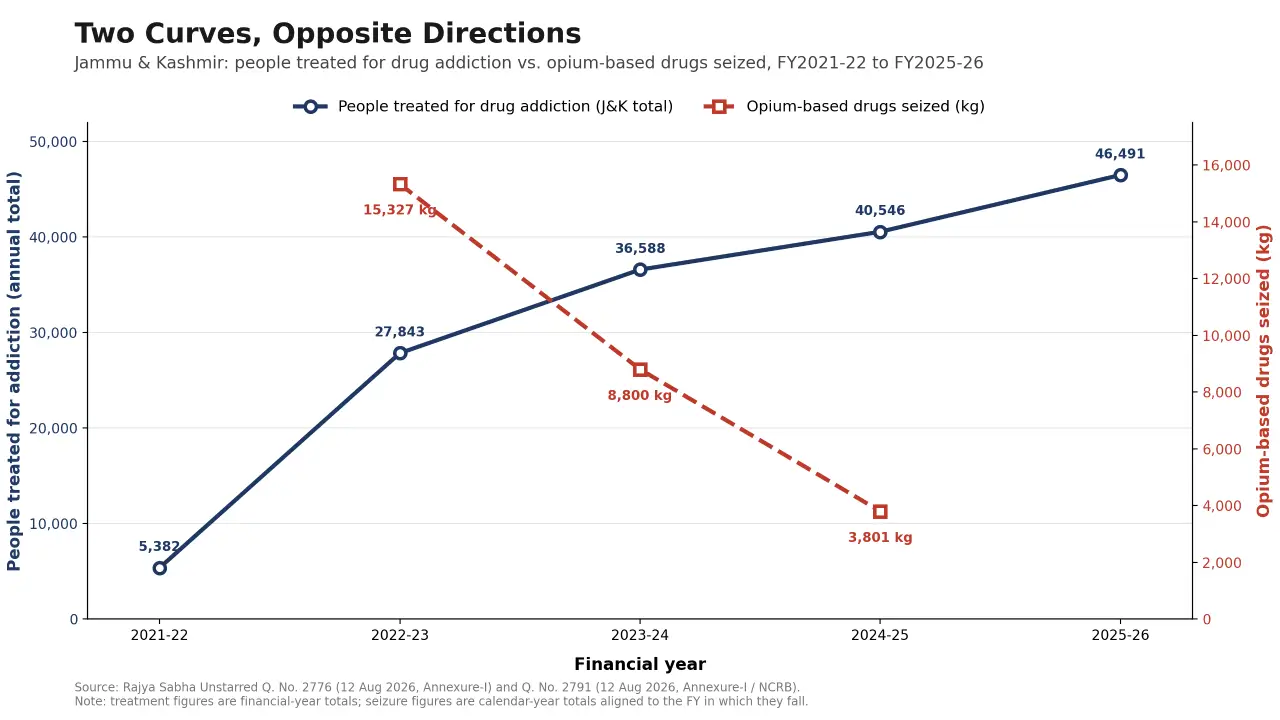
SRINAGAR: Drug seizures in Jammu and Kashmir have fallen sharply even as the number of people receiving treatment at government-supported de-addiction centres has surged nearly nine-fold in five years, according to data placed before Parliament, highlighting the widening scale of the drug-use challenge as well as gaps in measuring its current extent.
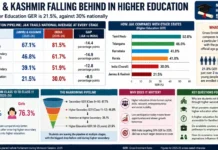
According to the government responses in Rajya Sabha, seizures of opium-based drugs in J&K fell from 15,326.70 kg in 2022 to 3,800.71 kg in 2024, a decline of about 75 per cent. Over the same period, the number of people treated at centres supported under the National Action Plan for Drug Demand Reduction (NAPDDR) rose from 5,382 in 2021-22 to 46,491 in 2025-26, an increase of more than 8.6 times.
The government data, however, do not establish whether the sharp rise in treatment represents a comparable increase in addiction or partly reflects the expansion of the treatment network and improved identification of people seeking help.
The parliamentary responses show that treatment numbers increased from 5,382 in 2021-22 to 27,843 in 2022-23, 36,588 in 2023-24, 40,546 in 2024-25 and 46,491 in 2025-26.
The district-wise figures show particularly dramatic changes. Pulwama, for instance, recorded 330 people treated in 2023-24, 1,593 in 2024-25 and 3,433 in 2025-26. Budgam rose from 154 in 2024-25 to 2,693 in 2025-26.
At the same time, treatment numbers declined substantially in some districts. Baramulla fell from 943 in 2022-23 to 211 in 2025-26, while Shopian declined from 318 to 82 and Doda from 213 to 74 over the same period.
The government responses do not provide district-level explanations for these sharp variations, making it difficult to determine whether changes reflect the prevalence of drug use, availability of treatment, outreach, reporting practices or other factors.
The latest official prevalence estimate cited by the government also dates back to the 2018 National Survey on Extent and Pattern of Substance Use, conducted by the National Drug Dependence Treatment Centre, AIIMS.
According to the government response, the survey estimated opioid prevalence in J&K at 4.91 per cent, corresponding to about 5.40 lakh users. Alcohol prevalence was estimated at 3.50 per cent, or around 3.90 lakh users; sedatives at 1.54 per cent, or 1.70 lakh; and cannabis at 1.31 per cent, or about 1.40 lakh users.
The survey covered people aged 10 to 75 and remains the latest prevalence assessment cited for J&K in the parliamentary replies.
The treatment infrastructure has expanded, but remains limited compared with the national network. According to the government, J&K has one Integrated Rehabilitation Centre for Addicts, three Outreach and Drop-In Centres, two Community-based Peer-Led Intervention units, six District De-Addiction Centres and 21 Addiction Treatment Facilities in government hospitals.
Nationally, the corresponding figures are 344, 76, 45, 145 and 155 respectively, the government said.
The government also said that more than 11,000 calls from J&K have been received on the national drug de-addiction helpline 14446, which has received about 4.6 lakh calls nationally.
On prevention, the government said 1.20 crore people in J&K have been sensitised under the Nasha Mukt Bharat Abhiyaan, including 69.14 lakh young people and 51.20 lakh women. It also reported 8,565 Nasha Mukti Mitr volunteers in the Union Territory.
The enforcement data show different trends across drug categories. While opium-based seizures declined sharply between 2022 and 2024, cannabis seizures rose from 1,631.94 kg in 2022 to 2,167.15 kg in 2023 before falling to 1,153.67 kg in 2024. The government also reported that seizures classified as “other drugs” increased from 184.40 kg in 2022 to 552.80 kg in 2024.
The opposing movement of treatment and seizure figures does not by itself establish either an increase or decrease in drug addiction. Seizure volumes can be influenced by enforcement activity and trafficking patterns, while treatment numbers can rise because of greater availability of services and improved access.
The parliamentary data nevertheless point to a rapidly expanding demand for treatment. The absence of a more recent prevalence survey means there is currently no government estimate showing whether the 5.40 lakh opioid-user figure from 2018 has increased, declined or remained broadly unchanged.
The figures therefore provide a measure of the people reaching the government-supported treatment system, but not a contemporary estimate of the total number of people affected by substance use in J&K.