by Shoaib Nazir
SRINAGAR: Once an inseparable part of every Kashmiri household, Wagoov, the traditional reed mat, was not just a utility but a symbol of everyday life. Over the years, however, this age-old craft has quietly faded from homes, culture, and even the collective memory of Kashmir.
Kashmir is globally known for its breathtaking beauty and rich, colourful traditions. Yet many indigenous crafts, including Wagoov, are struggling for survival in the face of rapid modernisation. Today, only a handful of elderly artisans continue to make Wagoov—driven not by profit, but by passion and a deep attachment to their cultural roots.
Amid this decline, Zameer Hussain of Mir Behri, Dal Lake, Srinagar, along with his wife Rukhsana, has taken a determined step to revive this nearly forgotten tradition. Their effort is not limited to restoring Wagoov’s place in Kashmiri homes but aims to introduce it on a broader, even global, platform. Once found in every household, Wagoov is now re-emerging as a decorative and eco-friendly product in restaurants, hotels, and contemporary spaces.
Ironically, Zameer once tried to distance himself from this craft—his grandfather’s legacy. But over time, he realised its value and significance. Today, he is committed to giving Wagoov a new identity and a modern space without compromising its traditional essence.
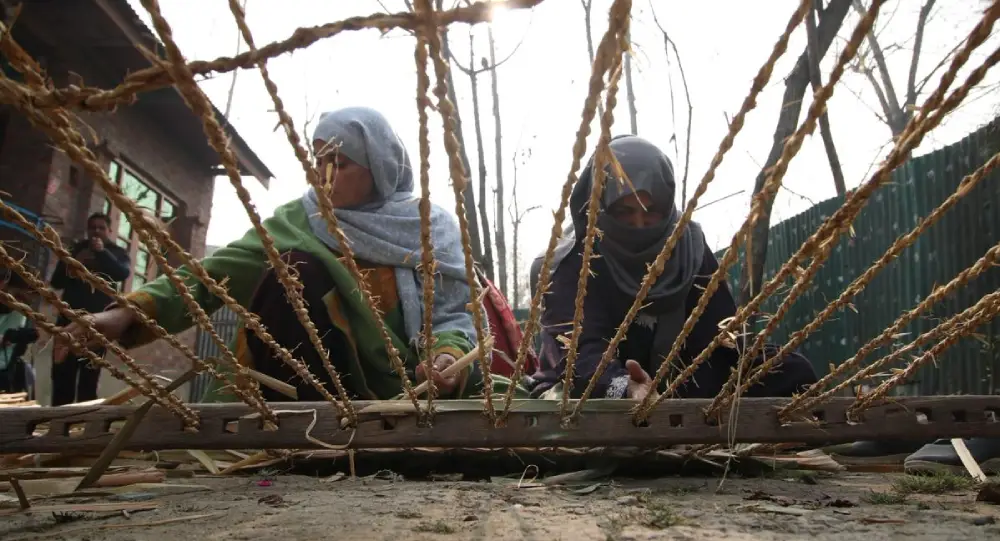
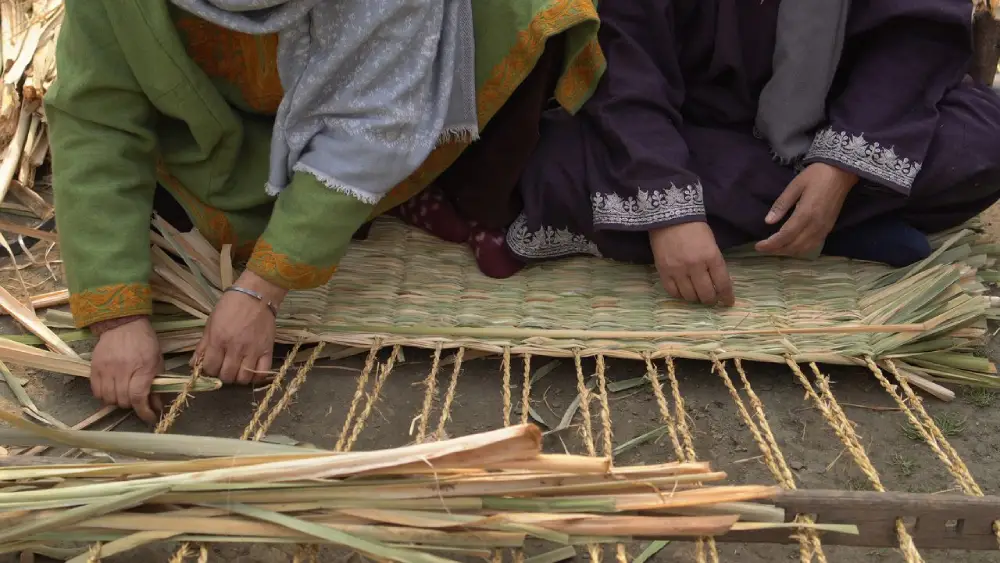
Wagoov is considered Kashmir’s organic carpet, handcrafted from reeds harvested from local wetlands and nallahs. The reeds are usually collected during September and October, depending on their colour and maturity. They are cut above the roots, tied into bundles, and sun-dried to remove moisture. Once dried, the reeds are carefully woven using grass ropes laid parallel to each other—a process that requires precision and skill.
“I want to make Wagoov familiar again to everyone in Kashmir who has forgotten it. This is our identity and culture, slowly fading because of modernisation,” says Zameer Hussain.
Reflecting on his journey, Zameer adds, “Fifteen years ago, this was my family’s legacy. I kept it alive, and for the past six years, I have been fully devoted to it. Today, people buy expensive modern carpets and sheets, but Wagoov is organic and offers several orthopaedic benefits.”
Rukhsana, who works alongside him, explains the labour behind the craft:
“We collect the reeds and dry them. It takes two people to prepare and weave a single Wagoov. Everything is handmade—there is no machine involved.”
The couple sells Wagoov at affordable prices to encourage people to adopt it again and support its revival. Their work has also received support from the Jammu and Kashmir Handicrafts Department, which is promoting the craft at various levels.
What began as a personal initiative in 2019 is now gradually turning into a movement. According to Director Handicrafts, Mussarat Zia, efforts are underway to strengthen Wagoo’s identity further.
“With GI tagging and scientific testing, we are promoting Wagoov as an organic product with health benefits. It can be used not only as a mat but also as curtains, blinds, and even tent ceilings. People need to come forward and support Zameer and Rukhsana, who have trained hundreds of girls in this traditional craft.”
As Wagoov finds its way back into modern spaces, it carries with it the story of Kashmir’s heritage—revived by commitment, craftsmanship, and a belief that tradition still has a place in today’s world.