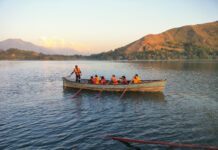
SRINAGAR: Jammu and Kashmir has completed 1,056 Amrit Sarovars under the Centre’s Mission Amrit Sarovar, aimed at strengthening water conservation, groundwater recharge and rural livelihoods, according to information provided by the Ministry of Jal Shakti in the Rajya Sabha.
The figures were part of a written reply to an unstarred question on the status of the Amrit Sarovar Mission. The ministry said 68,827 Amrit Sarovars have been constructed or rejuvenated across the country since the mission was launched on April 24, 2022. ([Press Information Bureau][1])
The Union government said the water bodies are being utilised for water conservation, groundwater recharge, irrigation, fisheries, biodiversity enhancement and other livelihood activities through convergence with various government schemes.
At the national level, the mission has also involved plantation of more than 24 lakh trees and plants around Amrit Sarovars, besides large-scale community participation through campaigns and local activities.
The government said revised Mission Amrit Sarovar guidelines provide for the formation and mapping of users’ groups, largely comprising Self-Help Group members and other local stakeholders, to ensure the long-term upkeep of the water bodies.
These groups are expected to remain involved from planning and execution to utilisation and maintenance, while Gram Panchayats, local institutions and communities have been assigned an active role in managing the assets.
The ministry said an AI and satellite-based monitoring system, BhuPRAHARI, has been deployed for nationwide monitoring and impact assessment. Analysis for 2022-24 showed that despite reduced rainfall, the average pond surface area increased by 16.3 per cent, while the number of dry ponds declined by 42 per cent, indicating improved water availability and rural water resilience.
An independent assessment covering six states also found improvements in groundwater recharge in water-stressed regions, cultivable land and agricultural productivity, biodiversity and carbon sequestration, along with strong ownership of the assets by Gram Panchayats and women Self-Help Groups.
The latest reply, however, does not provide a separate assessment of the impact of the mission specifically in Jammu and Kashmir.