by Mohammad Waseem
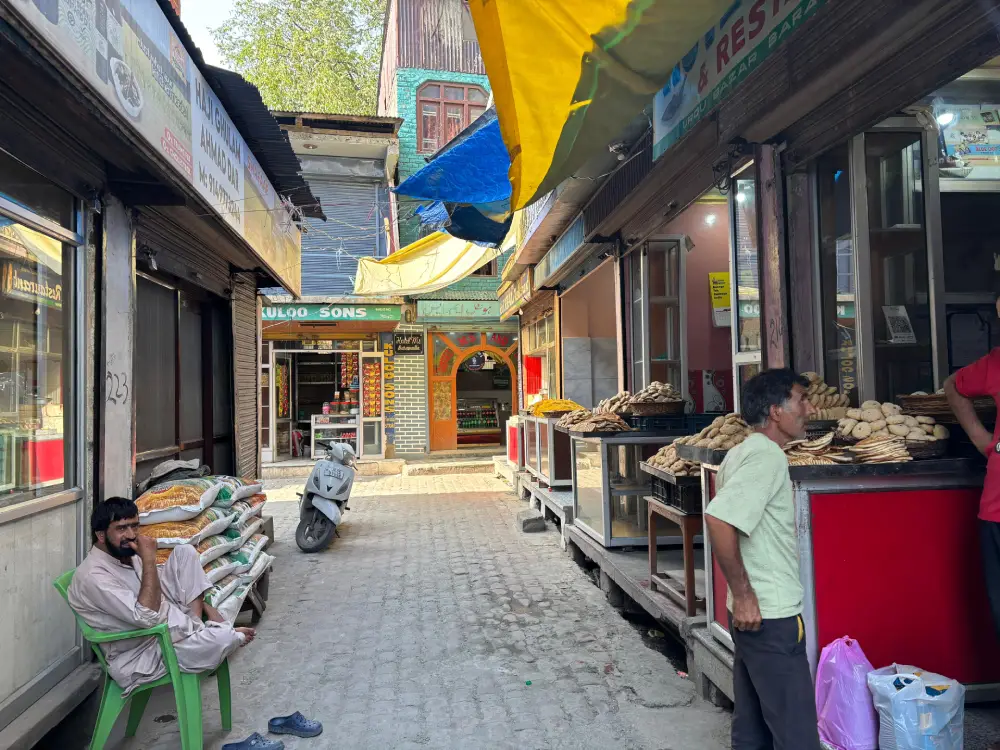
SRINAGAR: In the heart of Baramulla, a narrow street defies the tide of modern coffee culture, holding fast to a cherished Kashmiri tradition. Noon Chai Gali, lined with tea stalls and traditional bakeries, remains a sanctuary for the region’s signature pink-hued, salted tea. As businesses struggle with shifting economic realities, this historic lane continues to serve as a gathering place for locals and travellers alike, offering a taste of continuity in a changing world.
A Cultural Stronghold in a Changing World
Amidst the rapid embrace of modern coffee culture, a narrow street in Baramulla continues to uphold a cherished Kashmiri tradition. Noon Chai Gali is more than a marketplace; it is a living testament to the region’s deep-rooted affinity for Noon Chai—the pink-hued, salted tea that remains an integral part of Kashmir’s culinary and cultural identity.
Situated on the banks of the Jhelum in the Urdu Market, this street is lined with eight Noon chai stalls and several Kandour shops, where traditional bakers offer Baramulla’s renowned Baqarkhani and Kuliches. The lane has preserved an enduring custom, ensuring that the essence of Kashmiri culture is not eroded by changing times.
The Heart of Noon Chai Gali
With two entrances—one from the Urdu Market and the other from the Azadgunj cement bridge—the street is a bustling hub of daily life. An electronics shop marks the entrance on one side, while a diagnostic laboratory stands on the other. Mornings bring a steady stream of visitors, from patients arriving from nearby villages to locals gathering for their customary tea. Freshly baked Navies bread (Kandour Chyutt), crafted by skilled Kandours, adds to the vibrancy of the setting.
The Art of Making Noon Chai
Ghulam Mohammad Bhat, a tea seller with 45 years of experience, explains the meticulous process of preparing Noon chai. “It is not a simple task. It takes time and effort to achieve the perfect flavour and texture,” he says.
First, tea leaves are boiled with baking soda until they develop a deep burgundy hue. Cold water or ice is then added to halt further oxidation. Milk is incorporated to create the signature pink colour, and the tea is aerated by repeatedly ladling and pouring it back into the pot to develop froth. Finally, it is strained and served, maintaining a practice that has endured for generations.
He stated, “Butter and crushed coconut are essential ingredients that enhance the flavour of noon chai. It is traditionally boiled in a Samawar and served piping hot.”
Preserving Tradition
Speaking to Kashmir Life, Abdul Rasheed Khan, who has run a traditional bakery for over two decades, emphasised that it is not just noon chai but also Kulcha, Girda, Tsochwor, Naan, and Baqarkhani that remain highly sought after. “People carry these items to different states and even abroad, especially Baqarkhani, which is our best-selling product. This lane has long been known for quality food and the ingredients used in it,” he said.
Tanveer Ahmad Sheikh, a professional baker with two decades of experience, echoed this sentiment. “We bakers and noon chai vendors depend on each other. Noon chai and Kandour Chyutt are inseparable. It is this combination that keeps people coming back,” he said.
The Changing Business Landscape
“Business here is struggling. Only a few shops are doing well, while the rest are barely breaking even,” said Fayaz Ahmad, a shopkeeper. “When the district hospital was located here, we made good money. After its relocation to Kantbagh, our turnover has suffered significantly.”
With a tone of concern, he added, “We relied heavily on the hospital and government offices in this area. Now that both have moved, we are struggling under the burden of huge bank loans.”
A Changing Landscape
Abdul Rasheed, a shopkeeper affected by the relocation of offices and hospitals, described the profound shift in the area’s business environment. “The situation has completely changed. We are requesting the authorities to establish some offices nearby so that we can sustain our livelihood,” he said.
He pointed to the neglect of the lane, noting that aside from the installation of path tiles, no significant work had been undertaken in the past two decades. “We want the authorities to consider us and the beauty of this lane. It should be regularly upgraded,” he added.
A Culinary Landmark
Mohammad Usman, a pet shop owner from Khanpora, Baramulla, has been a regular at the market since opening his shop. “The kind of Noon Chai we get here is unmatched. This bustling lane is renowned for it. Ask anyone, even children will eagerly lead you here,” he said.
In Kashmiri, he remarked: “Yoor gassi eyunn, ytechh Noon Chai gassi chenn”—one must visit to taste the salted tea.
For Shahid Dar, from Rafiabad, Baramulla, stopping at the lane for Noon Chai has become a ritual. “Whenever I visit Baramulla, I make it a point to come here just for Noon Chai. I have been savouring it for the past three years,” he said.
He also noted the lane’s significance for patients travelling from remote areas for medical check-ups. “Many arrive on an empty stomach. Before heading to the hospital, they find comfort in a warm meal here,” he said.