by Masood Hussain
SRINAGAR: Sunderban cyclist Soman Debnath is happy that, after more than 19 years, he has become the lone Indian to have peddled through 191 countries. Not desperate to get into the record books, Debnath is currently cycling through India as part of what he said was ‘thanksgiving’.
The story of his voyage is fascinating, layered and humane. Sometimes it looks as if he is narrating the stories from the Arabian Nights. While most of the societies have been welcoming, he encountered life-threatening situations in Afghanistan, Central Asia and Africa. It sometimes involved humans and mostly wild animals.
The voyage took Debnath through Taliban captivity in Afghanistan, war-ravaged Iraq, remote tribal communities, the Arctic cold, African wilderness and the global chaos of the COVID-19 pandemic.
Speaking with Kashmir Life in a lengthy interview, Debnath described his expedition as a “cultural exchange mission” that lasted more than 7,000 days and covered nearly 200,000 kilometres, the equivalent of circling the globe more than four times.
The journey, which began when he was in his early twenties, stretched across Asia, Europe, Africa, North and South America, Oceania and Antarctica. During this period, Debnath said he visited 120 universities, stayed with nearly 2,000 families and lived among 38 tribal communities.
Armed with a bachelor’s degree in zoology and a master’s degree in fine arts, Debnath said his command of English helped him connect with students and young people around the world.
“Whenever I go, I feel that it is my family, my community, my country, my world,” he said, explaining why he never experienced homesickness despite spending nearly two decades away from India.
During the entire expedition, he returned home only once, for six days after the death of his father. At the time, he was travelling in Central America. After performing family rituals as the eldest son, he resumed the journey almost immediately.
Since bicycles cannot cross oceans, Debnath said he relied on 28 ships and 32 flights to connect different land routes across continents.
Taliban Captivity
One of the most dramatic chapters of his journey unfolded in Afghanistan in 2007 when he was allegedly captured by Taliban fighters while cycling from Kabul to Herat.
According to Debnath, the militants suspected he was an Indian Army spy. He said he was beaten with gun butts, blindfolded and held captive for four days without food.
“They thought maybe I was a spy or from the Indian Army,” he recalled during the interview.
Debnath said he tried to convince his captors that he was merely a traveller pursuing an individual mission across the world. His initial crisis was that they were speaking a language he would not understand, and he knew nothing about it that would help him communicate with them better. It started changing when one member of the group somehow started communicating in English.
During interrogation, the Taliban questioned him about Islam, the Quran and their movement. Debnath responded by describing Islam as a faith rooted in honesty and belief, while also telling them he considered the Quran “a scientific book.” He then showed them an English copy of the Quran that he carried in his bag.
The turning point came when the militants asked him what he would do if they refused to release him.
“If you don’t want to let me go, give me some job. I cannot continue my mission; let me contribute to yours,” Debnath told them. He, however, drew a firm line against violence.“I cannot take a gun and go to war to fight with others,” he said he told the Taliban. “But maybe I can clean your house, wash your clothes or clean your utensils.”
The Taliban accepted the proposal.
Debnath said he worked as a cleaner for nine days before volunteering to cook for the militants for another 11 days. He said his cooking impressed them enough for the group to eventually release him after 24 days in captivity.
Before releasing him near the Tajikistan border, the militants allegedly asked him what he would tell the world about the experience. “I will say the truth,” he replied.
After his release, Debnath crossed into Tajikistan, where he faced temperatures dropping to minus 20 and minus 30 degrees Celsius. He described cycling through snow-covered mountain corridors while living under the constant threat of wolf attacks.
Conflict Regions
Debnath said Afghanistan was not the only conflict zone he travelled through.
He also journeyed through Iraq during the 2011-12 war period, where he encountered fake checkpoints operated by armed groups impersonating police personnel.
At one stage, he spent 15 days sheltered inside the Indian embassy in Iraq, where embassy officials reportedly provided him with emergency contact support. He recalled witnessing the psychological toll of war on ordinary civilians, particularly children.
Debnath narrated an incident involving a young Iraqi girl who refused to accept grapes from him because her family feared strangers could poison food.
“When parents live under depression and fear for years, that trauma reaches children as well,” he said.
The traveller repeatedly stressed his opposition to war, saying prolonged violence destroys societies socially, psychologically and economically.
Living With Tribes
Apart from conflict zones, Debnath immersed himself deeply in indigenous communities across multiple continents.
He said he lived among 38 tribal groups, including Amazonian tribes, Inuit communities in Greenland and the Jarawa tribe.
One of his most unusual experiences, according to the interview, involved spending 20 days completely naked while living with the Jarawas because clothing was not part of their social practice.
Debnath described tribal societies as his “treasury,” saying he admired their simplicity, lifestyle and close relationship with nature.
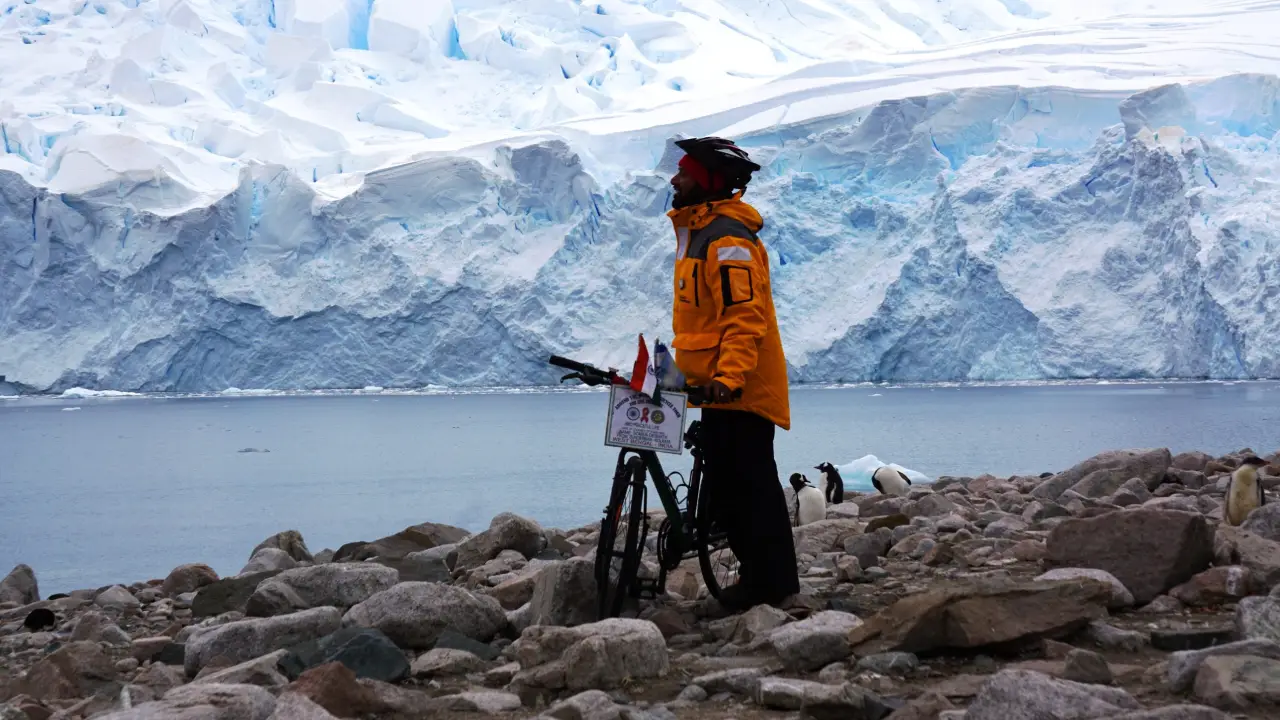
He also lived with penguins in Antarctica and encountered polar bears in Greenland, while surviving close encounters with lions and cheetahs in African forests, including the Kalahari region.
COVID-19 Ordeal
During the COVID-19 pandemic, Debnath said he contracted the virus while travelling through China. In the middle of his illness, he accidentally burned his mouth severely after drinking boiling water from a kettle.
He later escaped China and reached South Korea, but was unable to continue into North Korea despite having prior visa arrangements supported by the Indian embassy.
According to Debnath, North Korean authorities had recently executed two persons allegedly infected with COVID-19, leading to severe border restrictions.
The pandemic subsequently stranded him in New Zealand for nearly a year due to global travel shutdowns.
Muslim Countries
Debnath also spoke at length about travelling across Muslim-majority countries during periods of fasting and political tension.
Contrary to common stereotypes, he said he found many Muslim societies “liberal,” welcoming and intellectually curious.
“When they saw I came from Hind, they treated me with affection,” he said.
Because he was a non-Muslim traveller, locals often exempted him from fasting expectations during Ramazan, the muslim month of fasting, he added.
Debnath particularly praised Oman, saying many people there insisted on finding “scientific balance” and a rational explanation behind religious teachings.
“I felt people in many Muslim countries were kinder, wiser, and more connected with the world than stereotypes suggest,” he observed.
Arrest in Pakistan
Debnath also recalled being detained briefly in Islamabad, Pakistan, for nearly one-and-a-half hours. He described the episode as a misunderstanding involving “stubborn people” and said he managed to calm the situation by reminding officials about the sensitive relationship between India and Pakistan.
Rather than expressing bitterness, Debnath used the incident to explain what he called the fundamental principle of travel.
“Whenever you go to a country, you accept the country, whatever they are, however they are,” he said. “If you don’t accept, then you should go back home, eat your own food, live your own culture and live your own life.”
Inspirations Behind the Journey
Debnath said three major influences inspired his global expedition.
The first was a newspaper article about HIV/AIDS that prompted him to spread awareness about the disease.
The second inspiration came from pioneering Indian globe-trotter Bimal Mukharji, who travelled across nearly 80 countries on a bicycle between 1926 and 1937.
The third was Swami Vivekananda, particularly his belief that understanding the world is essential to understanding India. “If you don’t see with your own eyes, don’t believe,” Debnath quoted Vivekananda as having said.
Recognition and Future Plans
Debnath said he received encouragement from several Indian leaders during his travels and interacted with 25 Chief Ministers and 26 Governors. He recalled receiving a congratulatory message and phone call from former External Affairs Minister Sushma Swaraj after reaching his 100th country, Namibia.
Currently, he is writing a book The World Biking Odyssey, documenting his travels, observations and meetings with seven kings, 38 presidents and 72 prime ministers.
After completing his global journey, Debnath said he now plans to spend a year travelling across India before pursuing his next dream, establishing a sustainable “global village” where people from around the world can live, exchange ideas and contribute to community life.
He also maintains a private museum at his family residence in Kolkata, named People House Kolkata, where he stores souvenirs and memorabilia collected during his nearly two-decade-long journey.